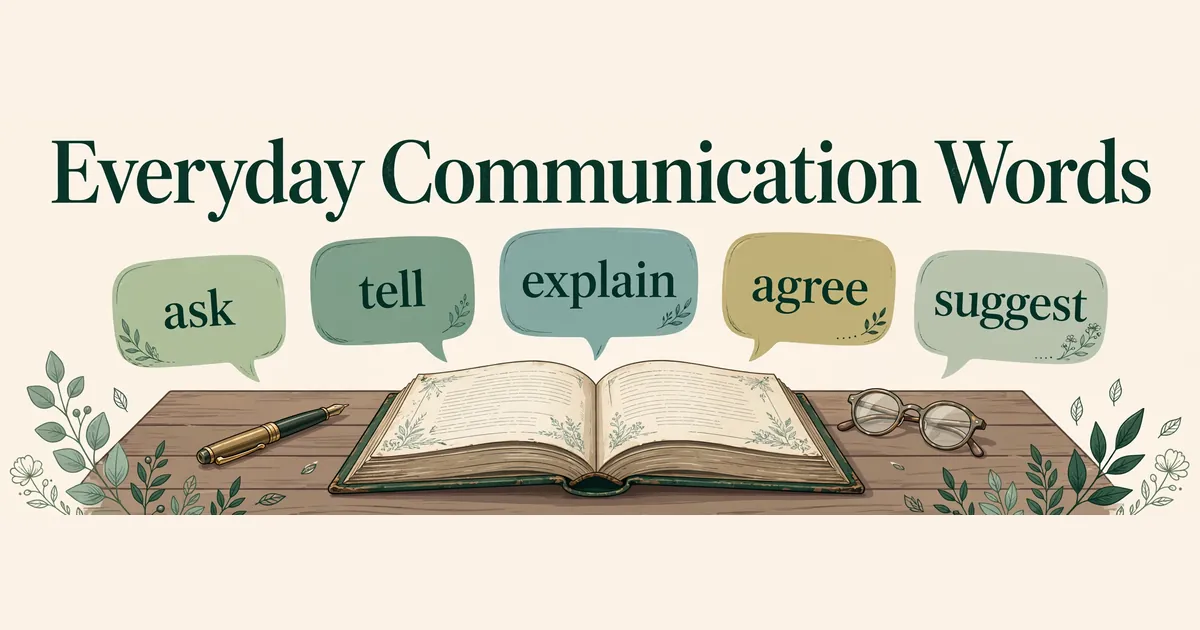
Everyday communication words are the verbs we use to exchange messages — to share news, ask for help, or explain an idea. Common examples are say/seɪ/ , ask/æsk/ , answer/ˈæn.sɚ/ , and explain/ɪkˈspleɪn/ . Each carries its own tone, so a sharper synonym can turn a blunt message polite or a vague one clear.
Two messages land in the same inbox, minutes apart. The first says: “Send me the file.” The second says: “Could you share the file when you get a moment?” Same file, same deadline, same sender — but only one of them makes you want to help.
Nothing changed except the words. Tone is not decoration on top of a message — most of the time, tone is the message.
It works the same way at home. “Tell me what happened” can start an argument at the dinner table, while “What happened?” — asked gently — starts a conversation. Families, friends, and whole offices run on these small word choices every single day.
For students, communication words turn flat essays and dialogues into writing that sounds like real people talking. For bloggers, they keep interviews, stories, and how-to guides from repeating “he said, she said” on every line. Content writers use them to match a brand’s voice — formal, friendly, or firm. For daily English users, they are the difference between sounding rude by accident and sounding polite on purpose. Most of these words are verbs at heart, so our guide to verb synonyms is the perfect companion to this list.
“The single biggest problem in communication is the illusion that it has taken place.”
That is why this list matters. Most of us let say and tell do every job — we say announcements, say apologies, and say warnings — until everything comes out at the same volume and the listener cannot tell a request from a command. A precise communication word restores the tone the plain word throws away, so people hear not just what you mean, but how you mean it.
“We have two ears and one mouth so that we can listen twice as much as we speak.”
Below, you will find 41 clear everyday communication synonyms, each with a simple meaning and two easy examples.
Main Content: 41 Everyday Communication Synonyms
1. say/seɪ/
- Meaning: The all-purpose word for putting something into words, spoken or written. Neutral and safe everywhere — but it tells the listener nothing about tone, which is why the sharper words below exist.
- Examples: She said the train was running late. Please say your name after the beep.
2. state/steɪt/
- Meaning: To say something formally and clearly, as a fact or an official position. Formal — the word of reports, officials, and written statements.
- Examples: The report states that costs rose last year. He stated his name and address for the record.
3. remark/ɹɪˈmɑɹk/
- Meaning: To say something briefly, usually as an observation or opinion. Neutral to formal — a remark is a comment, not a speech.
- Examples: She remarked that the room felt cold. He made a kind remark about her work.
4. mention/ˈmɛnʃən/
- Meaning: To say something briefly in passing, without going into detail. Neutral and light — you mention small things; you do not dwell on them.
- Examples: He mentioned your name during the meeting. Please don’t mention the surprise party to Sara.
5. ask/æsk/
- Meaning: To put a question to someone, or to request something from them. Neutral — how polite it sounds depends entirely on the words you wrap around it.
- Examples: She asked where the station was. May I ask a question?
6. inquire/ɪnˈkwaɪɹ/
- Meaning: To ask formally, usually to get official information. Formal and polite — the word of hotel desks, offices, and business letters.
- Examples: He inquired about train times at the front desk. I am writing to inquire about the course fees.
7. question/ˈkwɛs.tʃən/
- Meaning: To ask someone a series of questions, often closely or officially; also the noun for what you ask. Formal as a verb of interrogation, neutral as a noun.
- Examples: Reporters questioned the minister for an hour. She questioned whether the plan would really work.
8. answer/ˈæn.sɚ/
- Meaning: To respond to a question, call, or message — and the response itself as a noun. Neutral and universal, at home in every register.
- Examples: He answered every question honestly. Please answer the email before Friday.
9. reply/ɹɪˈplaɪ/
- Meaning: To answer, usually in words and often in writing. Slightly more formal than answer — reply is the standard word for emails, letters, and comments.
- Examples: She replied within an hour. I am still waiting for his reply.
10. respond/ɹɪˈspɑnd/
- Meaning: To react to something, in words or in action. Neutral to formal — wider than reply, because a response can be a deed, not just a sentence.
- Examples: The team responded quickly to the news. How did she respond to your idea?
11. tell/tɛl/
- Meaning: To give information to someone, or to instruct them to do something. Neutral — but grammar matters: you tell a person something, so tell almost always needs that person after it.
- Examples: Tell me the truth, please. She told the children a story about a fox.
12. inform/ɪnˈfoɹm/
- Meaning: To officially give someone facts they need to know. Formal — notices and letters inform; friends just tell.
- Examples: We regret to inform you that the flight is delayed. The school informed parents by letter.
13. notify/ˈnoʊtɪfaɪ/
- Meaning: To formally tell someone about something, usually in writing or through a system. Formal and official — this is the verb of apps, banks, and offices.
- Examples: The bank will notify you by text message. Please notify us of any change of address.
14. talk/tɔːk/
- Meaning: To speak with someone in conversation. Neutral and everyday — talk suggests an exchange, not a speech, and it is the verb inside the phrase “talk it over.”
- Examples: We talked for hours after dinner. I need to talk to you about the schedule.
15. discuss/dɪˈskʌs/
- Meaning: To talk about a topic in detail, weighing the points before deciding. Neutral to formal — and never add “about” after it: you discuss the plan, not discuss about it.
- Examples: We discussed the budget for an hour. Let’s discuss this tomorrow morning.
16. converse/kənˈvɝs/
- Meaning: To hold a conversation with someone. Formal and slightly literary — people converse in novels and interviews; friends chat.
- Examples: They conversed in French all evening. She finds it easy to converse with strangers.
17. chat/ˈt͡ʃæt/
- Meaning: To talk in a friendly, informal way — and the online conversation itself as a noun. Informal and warm, in speech and on screens.
- Examples: We chatted over coffee for an hour. The cousins chat in the family group every day.
18. explain/ɪkˈspleɪn/
- Meaning: To make something clear so that someone understands it. Neutral and essential — a real explanation gives reasons, not just facts.
- Examples: She explained how the machine works. Can you explain this word to me?
19. clarify/ˈklæɹ.ɪ.faɪ/
- Meaning: To make something clearer, usually after confusion has already appeared. Neutral to formal — clarify removes fog; explain builds understanding from the start.
- Examples: He clarified his point with a short example. Let me clarify what I meant earlier.
20. describe/dɪˈskɹaɪb/
- Meaning: To say what someone or something is like, in words. Neutral — describing paints the picture, while explaining gives the reasons behind it.
- Examples: She described the house in detail. Describe exactly what you saw.
21. argue/ˈɑɹ.ɡju/
- Meaning: To give reasons for an opinion — or to quarrel with someone. Two-faced: neutral and respected in essays (argue a case), heated and unhappy in daily life (argue with a neighbor).
- Examples: He argued that the fee was unfair. The brothers argued about money again.
22. debate/dɪˈbeɪt/
- Meaning: To discuss opposing views in an organized way. Formal — a debate has sides, turns, and rules; an argument just has volume.
- Examples: The class debated the new rule for an hour. They debated whether to move or stay.
23. whisper/ˈ(h)wɪspɚ/
- Meaning: To speak very softly, using breath but almost no voice. Neutral — whispers carry secrets, warnings, and bedtime stories.
- Examples: She whispered the answer to her friend. “Be quiet,” he whispered.
24. murmur/ˈmɝ.mɚ/
- Meaning: To speak softly and not clearly, in a low, continuous sound. Literary and gentle — crowds murmur, and so do people who are half asleep.
- Examples: The crowd murmured in agreement. He murmured something in his sleep.
25. mumble/ˈmʌmbəl/
- Meaning: To speak unclearly, with the words running together. Informal and slightly critical — mumbling is what makes listeners ask you to repeat yourself.
- Examples: He mumbled an apology and left. Stop mumbling and speak up, please.
26. shout/ʃaʊt/
- Meaning: To speak very loudly, from excitement, anger, or distance. Neutral — shouting is about volume, and it is not always angry.
- Examples: He shouted her name across the street. The fans shouted with joy at the goal.
27. yell/jɛl/
- Meaning: To shout loudly and sharply, often in anger or pain. Informal and stronger than shout — yelling almost always has an edge to it.
- Examples: She yelled at the dog to come back. He yelled in pain when he fell.
28. announce/əˈnaʊns/
- Meaning: To make something known publicly and officially. Formal — announcements come from stages, offices, and loudspeakers.
- Examples: They announced the winner to cheers. The company announced a new branch in March.
29. declare/dɪˈklɛɚ/
- Meaning: To announce something firmly and openly, with authority behind it. Strong and formal — governments declare results and wars; lovers declare feelings, dramatically.
- Examples: The judge declared him innocent. She declared that she would never give up.
30. suggest/sə(ɡ)ˈd͡ʒɛst/
- Meaning: To put forward an idea for someone to consider. Polite and neutral — a suggestion leaves the final decision with the listener, which is exactly why it works.
- Examples: I suggest taking the early train. He suggested a completely new plan.
31. recommend/ˌɹɛkəˈmɛnd/
- Meaning: To advise something because you genuinely believe it is good. Neutral to formal — stronger than suggest, because your own experience stands behind it.
- Examples: I recommend this book to every student. The doctor recommended two weeks of rest.
32. request/ɹɪˈkwɛst/
- Meaning: To ask for something politely and formally. Formal — requests are made in writing, and they can be granted or refused.
- Examples: Passengers are requested to fasten their seat belts. She requested a day off next week.
33. greet/ɡɹiːt/
- Meaning: To welcome someone with words or a gesture when you meet them. Neutral and warm — greetings open every conversation, so they set the tone for all of it.
- Examples: He greeted us with a smile. She greets every customer at the door.
34. thank/ˈθæŋk/
- Meaning: To tell someone you are grateful for what they did. Neutral and universal — it also does polite duty in refusals: “No, thank you.”
- Examples: She thanked him warmly for his help. I want to thank everyone who came today.
35. apologize/əˈpɑləˌd͡ʒaɪz/
- Meaning: To say you are sorry for something you did. Neutral to formal — spelled apologize in American English and apologise in British English.
- Examples: He apologized for being late. I must apologize for the mistake in the bill.
36. agree/əˈɡɹi/
- Meaning: To hold the same opinion as someone, or to say yes to a plan. Neutral — mind the patterns: agree with a person, agree on a plan, agree to do something.
- Examples: I agree with you completely. They agreed to meet at six.
37. refuse/ɹɪˈfjuz/
- Meaning: To say no to something, firmly. Neutral to formal — as a verb the stress falls on the second syllable (re-FUSE); the noun REF-use means rubbish, a different word entirely.
- Examples: He refused to answer the question. She refused their offer politely.
38. deny/dəˈnaɪ/
- Meaning: To say that something is not true. Formal and serious — deny belongs to accusations, rumors, and courtrooms, not to everyday small talk.
- Examples: He denied taking the money. The company denied the report in a statement.
39. promise/ˈpɹɑmɪs/
- Meaning: To tell someone you will definitely do — or not do — something. Neutral, but weighty: a promise binds the speaker, which is why listeners trust it.
- Examples: I promise to be on time tomorrow. She promised to write every week.
40. /woɹn/ warn
- Meaning: To tell someone about a danger or a problem ahead of time. Neutral and caring — warnings protect people; threats are the ones meant to harm.
- Examples: The sign warns drivers about ice on the road. I warned him about the traffic.
41. praise/pɹeɪz/
- Meaning: To say that someone or something is good, with warm approval. Neutral to formal — praise is often public: teachers, managers, and reviewers praise; friends usually compliment.
- Examples: The teacher praised her essay in class. He praised the team for their hard work.
Communication Words for the Workplace
Offices run on four verbs from this list: inform, notify, discuss, and suggest. When news is official, inform and notify carry it with the right weight — “We are writing to inform you” sounds professional, while “We want to tell you” sounds like a chat. When a decision is still open, discuss is the verb that invites every side to speak before anyone decides.
And when you have an idea but no authority to order it, suggest is your safest power tool. “I suggest we test it for a week” moves a whole team without a single command, because a suggestion lets colleagues agree with you instead of obeying you. Register is the whole game at work: the same sentence, one verb sharper, stops sounding like an order and starts sounding like leadership.
Communication Words for Polite Conversations
Politeness in English is rarely about fancy grammar — it is about choosing the softer verb and the softer frame. These six swaps from our list cover most of daily life:
- inquire/ɪnˈkwaɪɹ/ — instead of “Tell me the price”: “I would like to inquire about the price.”
- request/ɹɪˈkwɛst/ — instead of “Give me two days off”: “I would like to request two days off.”
- suggest/sə(ɡ)ˈd͡ʒɛst/ — instead of “Do it this way”: “May I suggest trying it this way?”
- apologize/əˈpɑləˌd͡ʒaɪz/ — instead of “My bad”: “I apologize for the delay.”
- thank/ˈθæŋk/ — instead of silence: “Thank you for waiting.”
- greet/ɡɹiːt/ — instead of jumping straight to business: “Good morning! How are you today?”
Communication Words for Messages and Chats
Text has no voice, so in messages and chats the verb does all the emotional work. Reply and respond set the rhythm of a conversation — a fast reply says “I care,” a late one needs a softener — while mention is how you pull someone gently into a group thread without making a speech about it. And chat itself names the whole friendly exchange, which is why it sounds warmer than “discussion.”
The risk in writing is tone deafness: “Send it now” reads as anger on a screen even when you typed it calmly. One small verb swap — ask instead of tell, suggest instead of demand — cools the message down. And because every message carries a feeling underneath the words, our emotion and mood synonyms are the natural next list when you want to name those feelings exactly.
Communication Words for Presentations and Meetings
A good presentation is built from four verbs in sequence. You open by stating your point plainly, so the room knows where you stand. You announce each new section or result, so listeners can follow the map. Then you explain the reasoning and describe the evidence, so the point you stated actually lands.
Notice what is missing: say. “I want to say three things” is the weakest opening in meetings. Swap in the sharper verbs and the same content sounds prepared instead of improvised — the audience hears a speaker who chose every word on purpose.
Strong Communication Synonyms
Some communication words do not ask — they settle things. Declare is the strongest way to announce: it carries authority and leaves no room for doubt. Insist is the strongest way to hold your ground in a discussion — you insist when being polite has stopped working. Proclaim is declare at full volume, made for crowds, manifestos, and historic moments. And demand is the strongest way to ask: it expects obedience, not agreement.
Use these four sparingly and they will keep their force. Declare a result, insist on a principle, proclaim big news, demand what is truly yours — and let the softer verbs on this list handle the other ninety percent of your day.
Positive Communication Synonyms
Not every strong word pushes people away. These five build people up — the verbs of encouragement, gratitude, and good news:
- praise/pɹeɪz/ Meaning: To express warm approval of someone’s work or character. Examples: The teacher praised her essay in front of the class. He praised the team for finishing early.
- compliment/ˈkɑmpləˌmɛnt/ Meaning: To politely say you admire something about a person. Examples: She complimented his cooking warmly. He complimented her on the presentation.
- encourage/ɪnˈkʌɹ.ɪd͡ʒ/ Meaning: To give someone hope and support so they keep going. Examples: Her words encouraged the whole team. Good friends encourage you before a big test.
- reassure/ˌɹi.əˈʃʊɹ/ Meaning: To remove someone’s worries by what you say to them. Examples: The doctor reassured the anxious patient. “Everything is ready,” she reassured him.
- congratulate/kənˈɡɹæt͡ʃ.ʊˌleɪt/ Meaning: To tell someone you are pleased about their success or good news. Examples: We congratulated her on the new job. He congratulated the winners warmly.
Synonyms for a Clear Communicator
When these communication verbs become habits, people start describing you with a different set of words entirely. A clear communicator is articulate — able to put thoughts into words cleanly, in the right order. They are expressive, so their face and voice carry the feeling behind the facts. They are fluent, never hunting for the next word, and persuasive, because listeners feel the reasoning, not just the conclusion.
These four words sit halfway between skills and character — which is why they pair so well with our people and character synonyms. Nobody is born articulate; people become articulate one sharper verb at a time, and this list is where that starts.
Communication Synonyms and Antonyms
The synonyms in this guide cluster around a few big moves: opening up (announce, explain, admit), answering back (reply, respond, agree), and warming up (greet, thank, praise). Their antonyms pull in the opposite direction: conceal opposes announce — it hides what the other word publishes; deny opposes admit; confuse opposes explain; criticize opposes praise; and refuse opposes agree.
Knowing both directions helps you describe communication honestly. A manager who announces results but conceals problems, or a friend who explains patiently but never admits a mistake, is drawn in one sentence — because the verbs pull against each other, and the contrast does the describing for you.
FAQ Section: People Also Ask
What are communication synonyms?
Communication synonyms are different words for the acts of exchanging messages — saying, asking, answering, explaining, and everything around them. “Ask,” “inquire,” and “request” are communication synonyms: one act, three levels of formality.
They matter because the act stays the same while the tone changes completely. Choosing among them is choosing how you will sound — polite or blunt, official or friendly, firm or gentle.
What is a better word for “say”?
It depends on what you are doing while you say it. For a brief observation, use remark or mention. For something official, use state or announce. For an idea you want considered, use suggest.
The honest rule: there is no single better word for say — there is a better word for each situation. Find the verb that matches the moment, and say quietly disappears from your writing.
What are polite words for asking?
The two safest are inquire and request. Inquire fits questions about information — prices, times, rules. Request fits asking for things and actions — a day off, a document, a change.
Frames matter as much as verbs. “Could you…,” “May I…,” and “I would like to…” soften any request before it even arrives, which is why polite English sounds longer than blunt English — the extra words are the politeness.
How can I improve my everyday English communication?
Start by listening more than you speak — notice which verbs clear speakers around you actually use, and steal one a week. Then practice tone swaps on your own messages: before sending, check whether tell should be ask, or say should be suggest.
Reading your sentences aloud helps more than any rule, because your ear catches bluntness your eyes forgive. Ten minutes a day with a list like this one — one new verb, used once in a real message — compounds faster than memorizing fifty words you never say.
Conclusion
Communication is not one skill but a shelf of small choices, and these 41 words are the shelf. Learning them does more than grow your vocabulary — it changes how people receive you. A request that sounds polite gets answered; an explanation that sounds clear gets understood; a warning that sounds caring gets heard.
“Kind words can be short and easy to speak, but their echoes are truly endless.”
Try one of these everyday communication words in a real message today — inquire instead of ask, suggest instead of tell — and listen to how the reply changes. When you are ready to add color around these speaking words, our guide to adjective synonyms will help you describe everything and everyone your messages are about.
“The most important thing in communication is hearing what isn’t said.”
Keep this list of everyday communication words close by. Come back whenever “say” and “tell” start doing all the work, and let these 41 words put the right tone back in your voice.

I am a linguist with 15 years of experience in English language teaching, including postgraduate-level instruction. My expertise includes English grammar, and I contribute as a content and blog writer, producing scholarly and educational language resources.