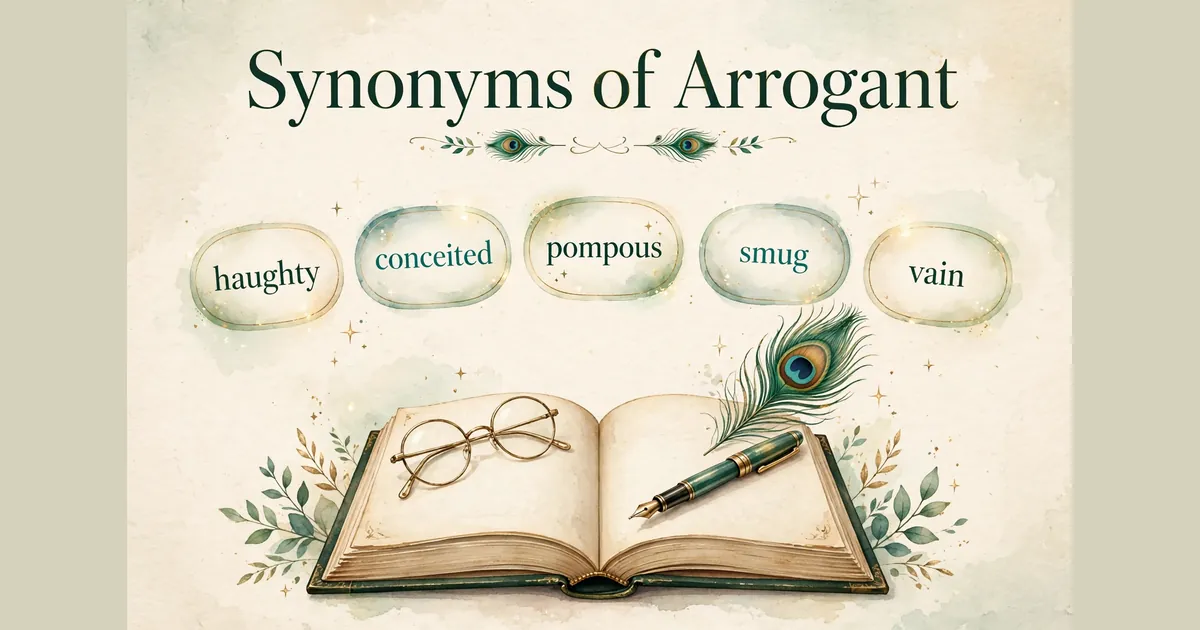
Synonyms of arrogant are words for having too much pride in yourself and too little respect for everyone else. Common examples are haughty/ˈhɔːti/ , conceited/kənˈsiː.tɪd/ , pompous/ˈpɒmpəs/ , and smug/smʌɡ/ — and the headword itself, arrogant/ˈɛɹəɡənt/ /ˈæɹəɡənt/, covers them all: excessive pride, often with contempt for others. Each one shows a different face of the same fault.
| Synonym | Meaning |
|---|---|
| Proud | too high an opinion of yourself |
| Haughty | coldly proud, looking down on others |
| Conceited | far too impressed with yourself |
| Vain | overly proud of your appearance |
| Pompous | grand and stiffly self-important |
| Snobbish | looking down on lower social classes |
| Snooty | informal: stuck-up and snobbish |
| Stuck-up | believing you are better than others |
| Superior | acting as if you rank higher |
| Disdainful | openly scornful of other people |
Below, you will find 32 clear synonyms of arrogant, each with a simple meaning and two easy examples.
Main Content: 32 Synonyms for Arrogant
1. proud/ˈpɹaʊ̯d/
- Meaning: The double-sided word of this list. Proud of your own work is healthy; proud over other people — too high an opinion of yourself, certain that you rank above them — is arrogance. The tone of the sentence decides which proud you are hearing.
- Examples: He was too proud to ask for help, even when he was clearly lost. Her proud glance told the new waiter his place without a single word.
2. haughty/ˈhɔːti/
- Meaning: Conveying a sense of superiority in your manner; disdainful and cold. A formal, literary word — the classic term for nose-in-the-air arrogance that never raises its voice.
- Examples: The haughty manager answered our questions without looking up from her desk. He gave a haughty laugh and walked away from the discussion.
3. conceited/kənˈsiː.tɪd/
- Meaning: Having a far too favourable opinion of your own ability, appearance, or worth. The everyday word for someone who rates himself much higher than everybody else does.
- Examples: After one small prize, he became so conceited that nobody could talk to him. She is a good singer, but she is not conceited about it.
4. vain/veɪn/
- Meaning: Overly proud of yourself, especially of your appearance and accomplishments, usually with little real reason. Vain is arrogance that needs a mirror and an audience.
- Examples: He is so vain that he checks his hair in every shop window. All her vain boasting could not hide how little she had actually done.
5. pompous/ˈpɒmpəs/
- Meaning: Affectedly grand, solemn, and self-important, with stiff manners and heavy speech. A pompous person does not enter a room; he makes an entrance.
- Examples: The pompous official spoke in long sentences that said almost nothing. His pompous tone annoyed everyone at the family dinner.
6. snobbish/ˈsnɒbɪʃ/
- Meaning: Arrogant about social class: warm only to people you count as important, dismissive of everyone you see as beneath you. A snobbish person judges by labels, schools, money, and accents.
- Examples: She was too snobbish to sit with the new students at lunch. His snobbish remarks about cheap restaurants embarrassed his friends.
7. snooty/ˈsnuti/ /ˈsnuːti/
- Meaning: An informal word for haughty and snobbish — nose turned up, too good for ordinary people. Snooty sounds lighter than snobbish, almost teasing, but the sting is real.
- Examples: The snooty waiter looked at our clothes before giving us a table. Do not be so snooty about her old car; it runs better than yours.
8. stuck-up
- Meaning: Informal and idiomatic: believing you are better than others, usually after some success, and unfriendly because of it. This is the word friends use about you behind your back.
- Examples: Ever since her promotion, she has become really stuck-up. He is not stuck-up; he is just shy with new people.
9. superior/sʊˈpɪɹ.i.ɚ/ /suːˈpɪə.ɹi.ə/
- Meaning: Behaving as if you were higher in rank, better, or cleverer than the people around you. As an attitude it is cold and quietly ranking — think of a superior smile or a superior tone.
- Examples: His superior tone suggested that the rest of us knew nothing at all. She answered with a superior smile and changed the subject.
10. disdainful/dɪsˈdeɪn.fəl/
- Meaning: Showing contempt or scorn for people and things you judge unworthy. Disdainful is arrogant with open disrespect mixed in — the true look-down-your-nose word.
- Examples: She gave a disdainful look at his worn-out shoes. His disdainful reply ended the friendship in one sentence.
11. supercilious/ˌsu.pɚˈsɪ.li.əs/ /ˌsuː.pəˈsɪ.li.əs/
- Meaning: Behaving as if you were above everyone else, with cool and contemptuous indifference. A formal, literary word — it comes from the Latin for a raised eyebrow, and you can still see the eyebrow in it.
- Examples: The supercilious critic dismissed the young writer’s novel in a single line. He listened to our plan with a supercilious smile.
12. condescending/ˌkɑndəˈsɛndɪŋ/ /ˈkɔn.dɪ.sɛnd.ɪŋ/
- Meaning: Assuming a tone of superiority; talking down to people as if they were children. It is the arrogance of the “helpful” expert who enjoys feeling needed.
- Examples: Her condescending explanation made the senior staff feel small. Please do not use that condescending voice with me.
13. presumptuous/pɹəˈzʌmpt͡ʃuəs/ /pɹəˈzʌmp.tʃuː.əs/
- Meaning: Making unwarranted assumptions and taking liberties beyond your rightful place, out of excessive self-confidence. The word for arrogance that oversteps a boundary.
- Examples: It was presumptuous of him to promise me the job before the interview. She made a presumptuous remark about the director’s private life.
14. overbearing
- Meaning: Overly bossy, domineering, and arrogant in action, not just in attitude. An overbearing person does not merely feel superior; he runs over everyone else in the room.
- Examples: His overbearing manner silenced the whole committee. The overbearing coach shouted instructions at everybody, all the time.
15. domineering
- Meaning: Ruling over others in an arrogant, dictatorial way. Close to overbearing, but domineering stresses control: this person does not want admiration — he wants obedience.
- Examples: Her domineering husband answered every question for her. A domineering boss can empty a good team within a year.
16. imperious/ɪmˈpɪɹ.i.əs/ /ɪmˈpɪə̯.ɹi.əs/
- Meaning: Domineering and arrogant like an emperor: urgent, commanding, and expecting instant obedience. Formal and dramatic — the word for queens, generals, and very confident managers.
- Examples: With an imperious wave of her hand, she sent the servants away. His imperious voice allowed no argument.
17. egotistical/ˌi.ɡoʊˈtɪs.tɪk.(ə)l/
- Meaning: Believing yourself to be better and more important than others, and talking about yourself far too much. The egotistical person stands at the centre of every story he tells.
- Examples: His egotistical speech mentioned his own success eleven times. An egotistical leader takes the credit for his team’s work.
18. narcissistic/ˌnɑɹ.sɪˈsɪs.tɪk/ /ˌnɑː.sɪˈsɪs.tɪk/
- Meaning: Having an inflated idea of your own importance and an endless need for admiration. In daily speech it means deeply self-loving; in psychology it points to a real personality pattern.
- Examples: His narcissistic posts celebrated himself far more than the event. A narcissistic manager hears honest feedback as an insult.
19. self-important
- Meaning: Acting as if you and your opinions mattered far more than they really do. Often gently mocking — the self-important guest explains everything to everyone, invited or not.
- Examples: The self-important speaker cleared his throat for a full minute before beginning. Her self-important emails always open with a long story about herself.
20. boastful/ˈbəʊstfʊl/
- Meaning: Tending to boast and brag about what you have and what you have done. Boastful is arrogance with the volume turned up: it talks, loudly, about itself.
- Examples: His boastful stories about his salary bored the whole table. She is wealthy but never boastful about it.
21. cocky/ˈkɑki/ /ˈkɒki/
- Meaning: Overly confident; arrogant and boastful in a bold, cheeky way. Informal, and usually aimed at the young — the player who celebrates before he has scored.
- Examples: The cocky young player promised two goals before the match had even begun. Do not get cocky just because you won once.
22. smug/smʌɡ/
- Meaning: Irritatingly pleased with yourself; offensively self-satisfied. Smug is quiet arrogance: no boasting, no shouting — just that small, satisfied smile.
- Examples: He gave a smug smile when his rival’s plan failed. Her smug answer suggested she had known the result all along.
23. pretentious/pɹɪˈtɛn.ʃəs/
- Meaning: Driven by an unjustified desire to impress others, with an unwarranted claim to importance or culture. Pretentious arrogance is a costume, and the audience usually sees through it.
- Examples: His pretentious speech was full of foreign words nobody needed. The cafe’s pretentious menu made a simple coffee sound like poetry.
24. cavalier/ˌkævəˈlɪɚ/
- Meaning: Haughty and dismissive toward things that matter to other people; careless where care is owed. A cavalier attitude treats other people’s concerns as too small to bother with.
- Examples: His cavalier attitude toward safety worried the whole crew. She gave a cavalier wave and dismissed their complaint.
25. lofty/ˈlɔːfti/ /ˈlɒfti/
- Meaning: Proud and disdainful in manner, as if speaking down from a great height. In this sense lofty is arrogance with distance: it floats above ordinary people and their problems.
- Examples: From his lofty height, the director never noticed the junior staff. She answered our request with lofty indifference.
26. contemptuous/kənˈtɛmp.t͡ʃu.əs/ /kənˈtɛm(p).tʃu.əs/
- Meaning: Showing contempt: open disdain and a complete lack of respect. Stronger than disdainful — contemptuous does not even pretend to hide what it thinks of you.
- Examples: He was contemptuous of anyone without a university degree. Her contemptuous laugh cut deeper than any insult.
27. scornful/ˈskɔɹnfəl/ /ˈskɔːnfəl/
- Meaning: Showing scorn or disrespect; contemptuous, scathing, and withering. Scornful words are meant to wound — this is arrogance used as a weapon.
- Examples: She was scornful of his excuses and told him so plainly. His scornful review destroyed the young singer’s confidence.
28. uppity/ˈʌpəti/
- Meaning: Informal: presumptuous, self-important, and acting above your station. Use it with care — in American history it was thrown at people who refused an unfair “place”, so today it is often used ironically.
- Examples: The new clerk was called uppity simply for questioning the manager. He gets uppity whenever anyone questions his recipe.
29. hoity-toity/ˈhɔɪtiˈtɔɪti/
- Meaning: Affected, pretentious, and snobbish, with an air of fancy self-importance. A playful, mocking word — hoity-toity laughs at arrogance instead of fearing it.
- Examples: The hoity-toity club would not let him in without a tie. She put on a hoity-toity accent just to make us laugh.
30. overweening/oʊvɚˈwinɪŋ/ /əʊvəˈwiːnɪŋ/
- Meaning: Unduly confident and proud; arrogant and presumptuous, with no sense of limits. A formal word, heard most often in the phrase “overweening ambition”.
- Examples: His overweening ambition made him ignore every warning. Overweening pride turned the general’s victory into defeat.
31. vainglorious/ˌveɪnˈɡlɔː.ɹi.əs/
- Meaning: Possessing excessive vanity and unwarranted pride, hungry for glory. A grand, old-fashioned word — vainglorious rulers build monuments to themselves.
- Examples: The vainglorious king put his own face on every coin in the land. His vainglorious speech praised nobody but himself.
32. hubristic/h(j)uˈbɹɪstɪk/ /h(j)uːˈbɹɪstɪk/
- Meaning: Marked by hubris: the excessive pride of someone who believes the rules and the limits do not apply to him. The most literary word on this list — Greek tragedy runs on it.
- Examples: His hubristic refusal to listen destroyed the company he had built. Critics called the whole plan hubristic from the very first day.
Arrogant Synonyms for the Workplace
At work, arrogance rarely announces itself. It shows up as behaviour: the overbearing manager who talks over every meeting, the domineering team lead who must approve every comma, the imperious director whose requests sound like royal commands. These three words describe power used without respect — arrogance with an office door.
The fourth workplace word is quieter and, in some ways, worse: condescending. The condescending colleague explains your own project to you, slowly, in front of everyone. If you have ever felt that sting, you already know why the words you choose in meetings matter — our guide to everyday communication words shows how the same message can sound like leadership or like an order, depending on the verb you pick.
Arrogant Synonyms for Social Snobbery
Some arrogant words are not about power at all — they are about rank: who is in, who is out, and who decides. These five belong to parties, clubs, schools, and family dinners:
- snobbish/ˈsnɒbɪʃ/ Meaning: Judging people by class, money, and accent, and dismissing everyone “below” you. Examples: Her snobbish friends refused to eat at the small family restaurant.
- snooty/ˈsnuti/ /ˈsnuːti/ Meaning: The informal, nose-in-the-air version of snobbish. Examples: The snooty assistant pretended not to see us at the counter.
- hoity-toity/ˈhɔɪtiˈtɔɪti/ Meaning: Playfully mocking someone’s fancy, superior airs. Examples: He skipped the hoity-toity gala and ate pizza with us instead.
- supercilious/ˌsu.pɚˈsɪ.li.əs/ /ˌsuː.pəˈsɪ.li.əs/ Meaning: Cool, raised-eyebrow contempt for everyone in the room. Examples: One supercilious glance from the critic silenced the young poets.
- stuck-up Meaning: The blunt everyday word: too proud to be friendly. Examples: The stuck-up neighbours have never once said hello.
Arrogant Synonyms for Stories and Novels
Writers reach for the grand words. A haughty queen, a vainglorious general, an imperious villain — these adjectives build a character in a single stroke, before he has spoken a line. The oldest of them is hubristic: in Greek tragedy, the hero’s hubris is the pride that insults the gods and pulls the whole story down on his head.
That is why these words pair so naturally with our people and character synonyms: arrogance is a character trait before it is anything else, and the right shade — haughty for the cold one, vainglorious for the glory-hungry one — tells the reader exactly who is walking onto the page.
Arrogant Synonyms for Everyday Speech
In daily talk, nobody says “supercilious”. We say cocky for the young player who celebrates too early, stuck-up for the neighbour who stopped saying hello, and boastful for the uncle whose fishing stories grow at every dinner. These are the warm, blunt, kitchen-table words of this list.
And the quietest of them all is smug. The smug person says nothing at all — he just smiles when your plan fails, and somehow that smile is more arrogant than a whole speech. Everyday words, everyday arrogance: small doses, delivered daily.
Strong Synonyms for Arrogant
When arrogant is too weak, English keeps three heavy tools. Supercilious is the strongest for cold contempt — use it for the critic, the examiner, the host who finds every guest beneath him. Imperious is the strongest for commanding arrogance — use it when someone gives orders as if born to a throne. Hubristic is the strongest for self-destroying pride — use it for the leader whose confidence has outgrown every fact.
Save these three for people who have earned them. Used on a merely confident colleague, they sound unfair; used on the truly impossible, each one lands like a verdict.
Milder Synonyms for Arrogant
Sometimes you need the neighbourhood of arrogant without the insult — words for self-belief that stops before it starts looking down on anyone. These five are the safe side of the line:
- confident/ˈkɑnfɪdənt/ /ˈkɒnfɪdənt/ Meaning: Sure of your own ability, without needing to rank yourself above anyone. Examples: She gave a confident answer and sat down. A confident teacher welcomes questions.
- self-assured Meaning: Calmly sure of yourself in company; poised rather than pushy. Examples: His self-assured manner calmed the whole interview panel. She is self-assured without ever sounding proud.
- assertive/əˈsɝtɪv/ Meaning: Stating your needs and opinions clearly and firmly, while still respecting others. Examples: Be assertive in the meeting, but listen to the end. An assertive email asks once, politely and clearly.
- self-confident Meaning: Trusting your own judgment and skills; the quiet root of the other words here. Examples: Years of practice made her self-confident on stage. He is self-confident enough to admit a mistake.
- dignified/ˈdɪɡnɪfaɪd/ Meaning: Calm, serious, and deserving respect; proud in bearing without a trace of contempt. Examples: Her dignified reply ended the argument without anger. He kept a dignified silence throughout the trial.
Notice the pattern: every word in this section is about how you carry yourself, and none of them is about how you treat other people. That is the whole difference. Confidence looks inward; arrogance looks down.
Synonyms for an Arrogant Person
Turn the adjective into a person and English gives you a small rogues’ gallery. An egotist talks about himself endlessly and believes the world agrees he is fascinating. A snob measures every room by rank and money, and a narcissist needs the room’s admiration the way others need air. Older books add the coxcomb — a vain, showy man, all feathers and no weight.
Each noun carries its own flavour of the fault: the egotist bores you, the snob excludes you, the narcissist uses you. Choose the one that matches the behaviour you have actually seen, and the description will feel precise instead of merely rude.
Synonyms and Antonyms for Arrogant
The synonyms in this guide fall into families: the cold family (haughty, disdainful, supercilious), the loud family (boastful, cocky, vainglorious), the bossy family (overbearing, domineering, imperious), and the mirror family (conceited, vain, narcissistic). Their antonyms walk the other way: humble, modest, meek, unassuming, and self-effacing — people who carry their worth quietly and let others shine.
Because arrogant is an adjective, it lives and dies by contrast, like most describing words. If you want to sharpen your feel for that whole family of words, our adjective synonyms guide is the natural companion to this one: describe the person precisely, and you rarely need to raise your voice.
FAQ Section: People Also Ask
What is a stronger word for arrogant?
For cold, contemptuous arrogance, the strongest common word is supercilious. For commanding, order-giving arrogance, use imperious. For pride so large it destroys the proud person, writers reach for hubristic.
Strength here is about precision, not volume. A merely rude man is not supercilious, and a strict teacher is not imperious. Match the word to the behaviour and the stronger word will also be the fairer one.
What is the difference between arrogant and confident?
Confidence is about yourself: you trust your ability. Arrogance is about other people: you rank yourself above them and let them feel it. A confident surgeon says, “I can do this operation.” An arrogant one adds, “Nobody else here could.”
The simplest test is how a person treats correction. Confidence listens, because it is secure. Arrogance refuses, because it is performing. If being wrong feels like an insult, confidence has already turned into its neighbour on this list.
What is a polite way to call someone arrogant?
Describe the behaviour, not the person. “He sounded dismissive in the meeting” is politer — and more accurate — than “He is arrogant”. When you must use one word, the milder family does the job: self-assured, proud, or, at the firm end, overconfident.
In writing, softeners do the same work: “rather proud”, “a little superior”, “somewhat condescending”. The shade stays honest, but the sentence leaves the other person a door to walk through.
What is the opposite of arrogant?
The core opposite is humble, with modest and meek beside it. A humble person may be highly skilled; he simply does not use his skill as a rank. A modest person understates what he has done instead of advertising it.
Notice that the opposites are not weakness. The humble expert still corrects your mistake — he just does it without enjoying your embarrassment. That is why these words end this guide: they show exactly which ingredient arrogance adds, and it is never talent. It is contempt.
Conclusion
Arrogance turns out to be a whole wardrobe, not a single coat: the cold haughtiness of the raised eyebrow, the loud costume of the boastful, the quiet smile of the smug. Learning these 32 words does more than grow your vocabulary — it teaches you to read people precisely, and to describe them fairly, in essays, in stories, and in the office on Monday morning.
“Pride goes before destruction, and a haughty spirit before a fall.”
Try one new word from this list this week — call the meeting’s loudest voice overbearing instead of just rude, or catch the smug smile and name it. And when you want the feeling underneath the behaviour, our emotion and mood synonyms will help you name what proud people are usually hiding.
“The truest characters of ignorance are vanity and pride and arrogance.”
Keep this list of synonyms of arrogant close by. The next time “arrogant” feels too blunt for the person in front of you, one of these 32 words will fit exactly.

Hello! I’m Irshad Ullah, scholar, content writer, motivational speaker and a linguist. I have 15 years experience of content writing on multiple topics which are recognized as socially, religiously and linguistically. I am also a versatile teacher, and have been teaching the subjects of aforesaid domains to the post graduate classes since the last 18 years.