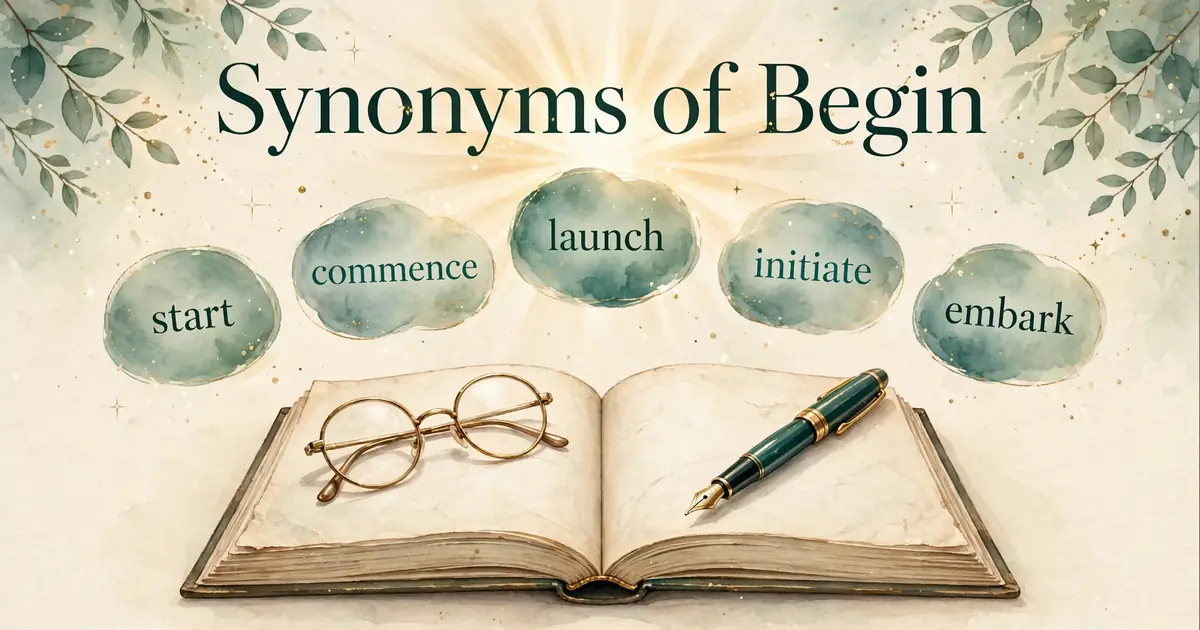
Synonyms of begin are words that name the very first moment of something — the point where nothing has happened yet, and then it has. Common examples are start/stɑɹt/ , commence/kəˈmɛns/ , launch/lɔntʃ/ , and arise/əˈɹaɪz/ . These words open doors: use the exact one, and a dull first line turns into a strong one.
| Synonym | Meaning |
|---|---|
| Start | to begin doing something |
| Commence | to begin, in formal settings |
| Initiate | to set a process in motion |
| Launch | to send something new out |
| Open | to begin an event or meeting |
| Enter | to begin a new stage |
| Proceed | to begin in an ordered way |
| Undertake | to begin a task with commitment |
| Embark | to begin a journey or venture |
| Set out | to begin with a clear aim |
Below, you will find 27 clear synonyms of begin, each with a simple meaning and two easy examples.
Main Content: 27 Synonyms for Begin
1. start/stɑɹt/ /stɑːt/
- Meaning: To begin doing something — the everyday, all-purpose word of this family. Neutral in tone, safe in any sentence, and the word children learn first.
- Examples: The class starts at nine in the morning. She started her own bakery last spring.
2. commence/kəˈmɛns/
- Meaning: To begin — the formal twin of start, at home in ceremonies, official notices, timetables, and legal writing. In casual speech it can sound stiff.
- Examples: The graduation ceremony will commence at noon. Work on the new bridge commences next month.
3. initiate/ɪˈnɪʃ.i.eɪt/
- Meaning: To set a process in motion on purpose — the word for talks, reforms, inquiries, and procedures that someone deliberately puts into gear. Formal and businesslike.
- Examples: The two countries initiated peace talks. The manager initiated a review of the safety rules.
4. launch/lɔntʃ/
- Meaning: To send something new out into the world with energy — rockets, products, campaigns, books, and careers. It pictures a beginning with lift-off, not a quiet first step.
- Examples: The company will launch its new phone in June. He launched his speech with a joke.
5. open/ˈoʊ.pən/ /ˈəʊ.pən/
- Meaning: To begin an event, meeting, show, or performance — or to start business for the first time, or for the day. The natural word for first sessions and first days.
- Examples: The mayor opened the meeting with a short welcome. The exhibition opens to the public on Friday.
6. enter/ˈɛntɚ/ /ˈɛntə(ɹ)/
- Meaning: To begin a new stage, period, or arrangement — you step into it, the way you step into a room. Common with phrases like enter a phase, enter talks, enter an agreement.
- Examples: The talks have entered their final stage. She entered college at seventeen.
7. proceed/pɹəˈsid/
- Meaning: To begin doing something in an ordered way, often after a pause or an introduction — formal, and almost always followed by to: proceed to explain, proceed to vote.
- Examples: After the break, the speaker proceeded to explain the plan. Please proceed to the next question.
8. undertake/ˌʌndɚˈteɪk/
- Meaning: To begin a task with real commitment — you take the work on your own shoulders. Formal; it promises responsibility, not just a first step.
- Examples: They undertook the repair of the old school. She undertook to finish the report by Friday.
9. embark/ɪˈbɑːk/
- Meaning: To begin a journey or a large new course of action — almost always embark on or embark upon. It carries the feeling of boarding a ship: no quick way back.
- Examples: He embarked on a career in medicine. The crew embarked at dawn for the long voyage.
10. set out/ˈsɛt‿aʊt/
- Meaning: To begin a journey, or to begin with a clear aim in mind — set out to do something means you start already knowing where you want to arrive.
- Examples: They set out early to reach the village by noon. She set out to prove the old map wrong.
11. originate/əˈɹɪd͡ʒɪneɪt/
- Meaning: To be the place or moment where something begins — or to bring that beginning about. It answers the question: where did this start?
- Examples: The custom originated in ancient Persia. He originated a new method of teaching.
12. arise/əˈɹaɪz/
- Meaning: To come into being, usually without anyone planning it — the word for problems, questions, doubts, and chances that appear on their own. Slightly formal.
- Examples: Problems arose when the funds ran out. A doubt arose in her mind.
13. appear/əˈpɪɹ/
- Meaning: To begin to be seen or to exist — a beginning the eye can witness, whether it creeps in slowly or arrives all at once.
- Examples: Cracks appeared in the wall after the quake. The first stars appeared in the evening sky.
14. emerge/ɪˈmɜːd͡ʒ/
- Meaning: To come out into view or into knowledge after being hidden — beginnings that surface slowly, like a swimmer rising from deep water.
- Examples: A clear pattern emerged from the data. The sun emerged from behind the clouds.
15. dawn/dɔn/
- Meaning: To begin, the way a day begins with first light — used for days, ages, and eras; also, in dawn on someone, for an idea that slowly becomes clear.
- Examples: A new era dawned with the invention of printing. It dawned on him that the keys were in his coat.
16. erupt/ɪˈɹʌpt/
- Meaning: To begin suddenly and with force — wars, protests, arguments, laughter, and cheers all erupt. It is the loudest, least gentle word in this list.
- Examples: Cheers erupted when the final goal was scored. The argument erupted without warning.
17. found/ˈfaʊ̯nd/
- Meaning: To bring an institution into being — the founding act behind cities, companies, schools, and charities. Not to be confused with found, the past form of find.
- Examples: They founded the university in 1882. She founded a charity for village schools.
18. establish/ɪˈstæb.lɪʃ/
- Meaning: To set something up so that it lasts — businesses, rules, relations, and reputations. Where found starts a thing, establish plants it firmly.
- Examples: The two nations established trade relations. He established a small clinic in the town.
19. institute/ˈɪnstɪtuːt/
- Meaning: To begin a system, rule, or official inquiry — formal and deliberate, used by boards, governments, and courts rather than by families.
- Examples: The board instituted new safety checks. The city instituted a weekly market day.
20. inaugurate/ɪˈnɔːɡjʊ.ɹeɪt/
- Meaning: To begin something important with a ceremony — presidents take office this way, and bridges, buildings, and eras get opened this way. The most ceremonial word in the list.
- Examples: The president was inaugurated in January. The bridge was inaugurated with a festival.
21. create/kɹiːˈeɪt/
- Meaning: To bring something entirely new into existence — a beginning that makes, not just starts. What follows it did not exist in any form before.
- Examples: The artist created a mural for the station. The scheme created hundreds of jobs.
22. introduce/ˌɪntɹəˈdjuːs/
- Meaning: To bring something new into use or into a place for the first time — laws, products, programs, and ideas all get introduced.
- Examples: The school introduced a new reading program. This chapter introduces the main characters.
23. pioneer/ˌpaɪ.əˈnɪɹ/
- Meaning: To be the very first to begin or develop something new — the pioneer begins where no path exists yet, and others follow.
- Examples: She pioneered the use of radio lessons in villages. They pioneered a way to clean river water.
24. usher/ˈʌʃəɹ/
- Meaning: To mark the beginning of a new period and help it arrive — almost always in the pattern usher in: usher in an era, usher in change.
- Examples: The invention ushered in a new age of travel. The reforms ushered the country into calmer years.
25. trigger/ˈtɹɪɡə/
- Meaning: To cause something to begin suddenly, especially something unwelcome — a small cause with a large, fast result, like a finger on a trigger.
- Examples: The news triggered a wave of protests. One spark can trigger a forest fire.
26. spark/ˈspɑɹk/
- Meaning: To set off a reaction, a feeling, or an idea — the brighter cousin of trigger. What it starts is often interest, debate, or imagination rather than trouble.
- Examples: Her question sparked a lively debate. The story sparked his interest in history.
27. activate/ˈæktɪˌveɪt/
- Meaning: To switch something on so that it begins to work — accounts, cards, alarms, and systems. The most technical word in this list, and a very modern one.
- Examples: Activate your account with the code in the email. The alarm activates when a door opens.
Synonyms for Begin for Journeys and New Chapters
Some beginnings are journeys. When a person starts a long course of study, a new career, or a life in a new town, the fitting words are embark and set out — both carry movement inside them. A student embarks on a degree; a family sets out for a new home. For the slower turn of a whole life, where one chapter closes and another opens, usher and dawn do the work: a new decade dawns, and small choices usher in a different life.
These chapter-beginnings belong with the big idea words — hope, ambition, courage — because every fresh start is powered by one of them. You will find those companions collected in our abstract idea synonyms guide, where the invisible things that move us are each given their exact name.
Synonyms for Begin for Work and Business
In offices and boardrooms, beginnings are announced, funded, and minuted — so the working words are planned ones. Four of them cover nearly every professional start:
- launch/lɔntʃ/ Meaning: To release something new to the public or the market. Examples: The startup launched its app in March. They plan to launch the campaign next week.
- establish/ɪˈstæb.lɪʃ/ Meaning: To set up a business, office, or system so it lasts. Examples: She established a design studio with two partners. The firm established a branch in Lahore.
- institute/ˈɪnstɪtuːt/ Meaning: To officially begin a rule, system, or procedure. Examples: The hospital instituted a new check-in system. Management instituted weekly reviews.
- pioneer/ˌpaɪ.əˈnɪɹ/ Meaning: To be the first to develop a product or method. Examples: The team pioneered online classes in the region. Their company pioneered same-day delivery.
Notice the ladder of weight: a product is launched, a company is established, a rule is instituted, and a whole field is pioneered. Pick the step your sentence is really standing on.
Synonyms for Begin for Stories and Writing
Stories cannot begin with begin — not twice, anyway. A novel opens with a scene, a tale dawns on a quiet morning, a mystery lets its first clue appear, and a battle scene lets the noise erupt. Each choice sets the temperature of the first page before the reader knows a single character.
Writers also hide beginnings inside quiet verbs. A rumour arises in a village; the truth emerges three chapters later. Pair these starting verbs with the exact describing words in our adjective synonyms guide, and an opening line can carry a place, a mood, and a promise all at once.
Synonyms for Begin for Feelings and Sudden Starts
Feelings rarely start politely. Anger erupts, panic is triggered, interest is sparked, and a worry quietly arises in the night. The verb tells the reader how the feeling arrived — all at once, from a small cause, or out of nowhere — before any detail is given.
The shades matter here. Trigger points back at a cause, spark promises something may catch fire, and arise asks for no cause at all. Choose by asking one question: does my sentence know what started this, or only that it started?
Strong Synonyms for Begin
Three words in this list outweigh the rest, and each earns its weight differently. Inaugurate is strong with ceremony: it says this beginning matters enough to be witnessed and remembered. Trigger is strong with consequence: it warns that what begins now will not stay small. Erupt is strong with force: it skips the first steps entirely and starts at full volume.
Spend them carefully. A meeting that merely starts should not erupt, and a chat should never be inaugurated. Strong beginning words are strong because careful writers refuse to waste them on small starts.
Positive Synonyms for Begin
Not every beginning is heavy. These five are the hopeful load-bearers — the words of first pages, fresh years, and new ventures:
- launch/lɔntʃ/ Meaning: To send something new out with energy and hope. Examples: She launched her first novel in spring. The school launched a reading club.
- create/kɹiːˈeɪt/ Meaning: To bring something new and good into being. Examples: They created a garden from a bare yard. The course created real confidence in her.
- dawn/dɔn/ Meaning: To begin like a new day, full of light. Examples: A brighter chapter dawned for the family. Hope dawned with the good news.
- spark/ˈspɑɹk/ Meaning: To set a good feeling or idea alight. Examples: The teacher sparked a love of reading. One kind word sparked her courage.
- pioneer/ˌpaɪ.əˈnɪɹ/ Meaning: To begin something new that others will follow. Examples: He pioneered free evening classes. The village pioneered a clean-water project.
Synonyms and Antonyms for Begin
The synonyms gather by shade: the everyday group (start, open, proceed), the formal group (commence, initiate, institute, inaugurate), the coming-into-being group (arise, appear, emerge, dawn, originate), the founding group (found, establish, create, introduce, pioneer), and the sudden-cause group (trigger, spark, erupt, activate). One word, five different doors into a sentence.
The antonyms close those doors: end, finish, conclude, stop, cease, and complete. They are not all equal either — a meeting concludes, a noise ceases, a task is completed. Writing improves fastest when both ends of the line are exact: how a thing begins, and how it ends.
FAQ Section: People Also Ask
What is the best synonym for begin?
For everyday writing, the best synonym is start. It fits almost every situation begin fits, and it sounds natural in speech and on paper. When a teacher, a friend, or a manager begins something, started is usually the cleanest word for it.
The honest answer, though, is that the best word depends on the beginning. A ceremony commences, a product is launched, a problem arises, and a new era dawns. Match the word to the weight of the moment and you will rarely need begin at all.
What is the difference between begin and commence?
The meaning is nearly the same; the clothing is different. Begin is the plain, everyday word, at home everywhere. Commence is its formal dress — the word of printed programs, official notices, and examination papers: the ceremony will commence at noon.
Use commence when the occasion itself is formal, and begin or start everywhere else. In a text message or a friendly letter, commence can sound like a joke you did not mean to make.
What is a formal or fancy word for begin?
The classic formal choices are commence and initiate. Commence simply means begin in formal dress, while initiate adds the idea of setting a process in motion: a government initiates reforms, a chairperson initiates a discussion.
For beginnings with ceremony, the fanciest word of all is inaugurate. And in offices, institute serves the same formal purpose for rules and systems. All four appear in the main list above with their exact shades.
What is the opposite of begin?
The plain opposites are end and finish. End is the widest word: a road ends, a story ends, a year ends. Finish adds the feeling of reaching the last step of something you were doing, like finishing a race or a meal.
Other opposites carry their own shades, just as the synonyms do. Conclude is the formal close of meetings and speeches, cease means stop completely and suddenly, and complete means finish by making a thing whole. Beginnings and endings mirror each other more than most learners expect.
Conclusion
Every strong piece of writing, every business, every journey, and every habit starts with a single beginning — and now you have 27 exact words for that moment instead of one tired one. Start for the everyday, commence for the ceremony, launch for the venture, dawn for the hope: the shade you choose tells your reader how the story will feel before it has even begun.
“Well begun is half done.”
Try one this week. Take a sentence you have already written — a message, a caption, an essay line — and swap its plain begin for the exact word from this list. And once your sentence has begun well, keep it talking with the words in our everyday communication words guide.
“Whatever you can do or dream you can, begin it. Boldness has genius, power, and magic in it.”
Keep this list of synonyms of begin close by. The next time a blank page stares back at you, you will have the right first word ready.

I am a linguist with 15 years of experience in English language teaching, including postgraduate-level instruction. My expertise includes English grammar, and I contribute as a content and blog writer, producing scholarly and educational language resources.