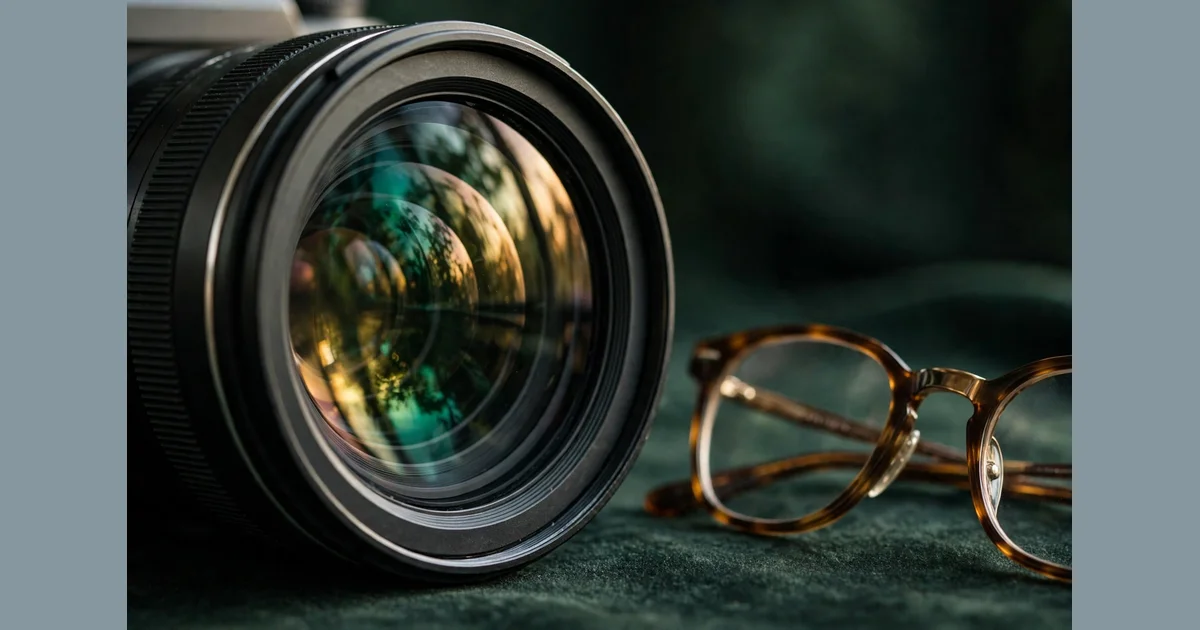
The best synonyms of lens include contact lens, objective, eyepiece, magnifying glass, and perspective. A lens (US IPA: /lɛnz/ ) is a curved piece of glass or clear material that bends light to make things clearer or bigger. The right word depends on where the lens works. An optician fits a corrective lens, a photographer mounts an objective, and a writer looks at history through the lens of experience — where lens means a way of seeing. These 30 words will help you name the right lens in eye care, photography, and science.
10 Lens Synonyms at a Glance
| No. | Synonym | Simple Meaning |
| 1 | Contact Lens | Small lens worn on eye |
| 2 | Corrective Lens | Lens that fixes eyesight problems |
| 3 | Objective | Main lens facing the subject |
| 4 | Eyepiece | Lens you look through |
| 5 | Magnifying Glass | Hand lens that enlarges things |
| 6 | Glass | Photographer’s word for a lens |
| 7 | Loupe | Small magnifier for fine detail |
| 8 | Crystalline Lens | Natural lens inside the eye |
| 9 | Perspective | A way of seeing things |
| 10 | Viewpoint | A personal way of judging |
These words are not all equal. Some name pieces of glass, some name the lens inside your own eye, and some name no glass at all — only a way of looking at the world. Each word below comes with a meaning, pronunciation, and two examples.
Synonyms of Lens for the Eye and Glasses
Most people meet the word lens first at the optician. Some of these words name lenses you can hold or wear; two name lenses inside the eye itself — one natural, one man-made.
1. Contact Lens (Noun)
US IPA: /ˈkɑntækt ˌlɛnz/ | UK IPA: /ˈkɒntækt ˌlɛnz/
Meaning: A contact lens is a thin, curved lens worn directly on the surface of the eye to correct vision — the full, formal name for what most people simply call contacts.
Examples:
- She wears a contact lens in each eye instead of glasses.
- He took out his contact lens before going to sleep.
2. Contacts (Noun)
US IPA: /ˈkɑntækts/ | UK IPA: /ˈkɒntækts/
Meaning: Contacts is the short, everyday name for contact lenses. The word stays plural even for one pair — the form friends and family use in normal speech.
Examples:
- I forgot my contacts at home, so I wore glasses.
- Her new contacts feel comfortable all day.
3. Corrective Lens (Noun)
US IPA: /kəˈrɛktɪv ˈlɛnz/ | UK IPA: /kəˈrɛktɪv ˈlɛnz/
Meaning: A corrective lens is any lens made to fix eyesight, in glasses, on the eye, or inside it — the careful term opticians use.
Examples:
- The doctor prescribed a corrective lens for his left eye.
- A corrective lens bends light so the image falls sharply on the retina.
4. Spectacle Lens (Noun)
US IPA: /ˈspɛktəkəl ˈlɛnz/ | UK IPA: /ˈspɛktəkəl ˈlɛnz/
Meaning: A spectacle lens is the lens set into a pair of glasses — the formal term of optical shops, built on the older word spectacles.
Examples:
- One spectacle lens was scratched, so the shop replaced it.
- Modern spectacle lenses are usually made of light plastic, not glass.
5. Crystalline Lens (Noun)
US IPA: /ˈkrɪstəlɪn ˈlɛnz/ | UK IPA: /ˈkrɪstəlɪn ˈlɛnz/
Meaning: The crystalline lens is the natural, transparent lens inside your own eye, just behind the pupil. It changes shape to focus light on the retina — the lens you were born with.
Examples:
- The crystalline lens becomes cloudy in old age, causing cataracts.
- Muscles around the crystalline lens help the eye focus on near objects.
6. Intraocular Lens (Noun)
US IPA: /ˌɪntrəˈɑkjələr ˈlɛnz/ | UK IPA: /ˌɪntrəˈɒkjʊlə ˈlɛnz/
Meaning: An intraocular lens is a small artificial lens placed inside the eye in cataract surgery to replace the cloudy natural lens. Doctors shorten the name to IOL.
Examples:
- After the surgery, the intraocular lens gave her clear sight again.
- The surgeon chose an intraocular lens that corrects both near and far vision.
7. Monocle (Noun)
US IPA: /ˈmɑnəkəl/ | UK IPA: /ˈmɒnəkəl/
Meaning: A monocle is a single round lens for one eye only, held in the eye socket. Gentlemen wore monocles in the 1800s; today you mostly see them in films and costumes.
Examples:
- The old colonel raised his monocle to read the letter.
- Her fancy-dress costume included a monocle on a gold chain.
Lens Words for Cameras and Photography
Photographers have their own rich vocabulary. Some words name the whole lens on the camera, some name one piece of glass inside it, and one is the trade’s cheerful slang.
8. Glass (Noun)
US IPA: /ɡlæs/ | UK IPA: /ɡlɑːs/
Meaning: In photography, glass is the everyday trade word for a camera lens. Photographers praise “fast glass” and “good glass” when they mean high-quality lenses.
Examples:
- He saved for months to buy some fast glass.
- Good glass matters more than an expensive camera body.
9. Objective (Noun)
US IPA: /əbˈdʒɛktɪv/ | UK IPA: /ɒbˈdʒɛktɪv/
Meaning: The objective is the lens nearest the object being viewed — the main image-forming lens of a camera, microscope, or telescope, and another formal name for the whole camera lens.
Examples:
- She cleaned the objective before class began.
- This objective gives a wider view than the standard kit lens.
10. Camera Lens (Noun)
US IPA: /ˈkæmərə ˈlɛnz/ | UK IPA: /ˈkæmərə ˈlɛnz/
Meaning: A camera lens is the plain, general name for the lens assembly fitted to a camera — the phrase shops, manuals, and beginners use.
Examples:
- Rain drops on the camera lens spoiled the last photograph.
- He rents a long camera lens for wildlife trips.
11. Optic (Noun)
US IPA: /ˈɑptɪk/ | UK IPA: /ˈɒptɪk/
Meaning: An optic is a lens or a complete lens device, such as a scope or sight. The word is common for binoculars and telescope parts, where the instrument is named by its glass.
Examples:
- The birdwatcher carried a spotting optic on a tripod.
- A clear optic makes a cheap telescope worth using.
12. Element (Noun)
US IPA: /ˈɛləmənt/ | UK IPA: /ˈɛlɪmənt/
Meaning: An element is one single piece of glass inside a lens assembly. Makers count them in their descriptions — a modern lens may hold fifteen working as one.
Examples:
- This lens has twelve elements arranged in nine groups.
- One damaged element can soften every photograph the lens takes.
13. Doublet (Noun)
US IPA: /ˈdʌblət/ | UK IPA: /ˈdʌblət/
Meaning: A doublet is two lenses joined together and used as one unit, paired so their faults cancel out — a sharper image with less colour fringing.
Examples:
- The telescope’s doublet keeps the stars free of purple edges.
- Early camera lenses were often simple doublets of crown and flint glass.
14. Achromat (Noun)
US IPA: /ˈækroʊmæt/ | UK IPA: /ˈækrəʊmæt/
Meaning: An achromat, short for achromatic lens, brings two colours of light to the same focus, so pictures lose their coloured fringes. Achromats are common in telescopes and binoculars.
Examples:
- A small achromat is a fine first telescope for a beginner.
- The achromat in these binoculars keeps edges clean and colour-free.
Lens Words for Microscopes, Telescopes, and Science
Science gave us some of the most useful lens words of all. Lenses reveal a hidden world — too small, too far, or too faint for the naked eye.
15. Eyepiece (Noun)
US IPA: /ˈaɪpiːs/ | UK IPA: /ˈaɪpiːs/
Meaning: The eyepiece is the lens set at the eye end of a microscope or telescope — the part you look through. It magnifies the image the objective has formed.
Examples:
- Look through the eyepiece and turn the knob until the cells are sharp.
- A wider eyepiece makes stargazing more comfortable.
16. Ocular (Noun)
US IPA: /ˈɑkjələr/ | UK IPA: /ˈɒkjʊlə/
Meaning: The ocular is the technical name for a microscope’s eyepiece — the word laboratory manuals prefer for the lens you look through.
Examples:
- The ocular of this microscope magnifies the image ten times.
- She rotated the ocular to line up the measuring scale.
17. Magnifying Glass (Noun)
US IPA: /ˈmæɡnɪfaɪɪŋ ˈɡlæs/ | UK IPA: /ˈmæɡnɪfaɪɪŋ ˈɡlɑːs/
Meaning: A magnifying glass is a convex lens in a frame with a handle, held over print to make it look bigger — the classic tool of detectives and stamp collectors.
Examples:
- Grandfather reads the newspaper with a magnifying glass.
- The detective studied the footprint through a magnifying glass.
18. Magnifier (Noun)
US IPA: /ˈmæɡnɪˌfaɪər/ | UK IPA: /ˈmæɡnɪˌfaɪə/
Meaning: A magnifier is the general name for any lens or device that makes things appear larger — desk lamps with built-in lenses, hand lenses, and reading aids.
Examples:
- She keeps a magnifier beside her sewing basket.
- A lighted magnifier helps him solder the tiny wires.
19. Hand Lens (Noun)
US IPA: /ˈhænd ˈlɛnz/ | UK IPA: /ˈhænd ˈlɛnz/
Meaning: A hand lens is a small magnifying lens, often folding into a case, that scientists carry into the field — geologists for rocks, botanists for leaves.
Examples:
- The geology student examined the crystal with a hand lens.
- A hand lens showed the tiny hairs on the leaf’s edge.
20. Loupe (Noun)
US IPA: /luːp/ | UK IPA: /luːp/
Meaning: A loupe is a small, powerful magnifier for very fine detail. Jewellers hold one to the eye to judge gems; watchmakers and printers depend on loupes daily.
Examples:
- The jeweller checked the diamond through her loupe.
- He clipped a loupe to his glasses for the repair work.
21. Condenser (Noun)
US IPA: /kənˈdɛnsər/ | UK IPA: /kənˈdɛnsə/
Meaning: The condenser is the lens system under a microscope’s stage that concentrates light onto the specimen. Projectors use condensers for the same job.
Examples:
- Adjust the condenser to brighten the microscope image.
- A dirty condenser leaves dark patches across the slide.
22. Meniscus (Noun)
US IPA: /məˈnɪskəs/ | UK IPA: /məˈnɪskəs/
Meaning: A meniscus is a lens shaped like a crescent moon — curving outward on one side and inward on the other. Most glasses lenses are meniscus lenses, following the curve of the eye.
Examples:
- Your spectacle lenses are meniscus lenses, thin at the edge.
- The meniscus in this camera lens reduces distortion at the corners.
23. Converging Lens (Noun)
US IPA: /kənˈvɝdʒɪŋ ˈlɛnz/ | UK IPA: /kənˈvɜːdʒɪŋ ˈlɛnz/
Meaning: A converging lens is thicker in the middle and bends light rays inward to a point — the physics-class name for a convex lens.
Examples:
- A converging lens can focus sunlight to a hot spot.
- The eye’s own lens works as a converging lens.
24. Diverging Lens (Noun)
US IPA: /dɪˈvɝdʒɪŋ ˈlɛnz/ | UK IPA: /daɪˈvɜːdʒɪŋ ˈlɛnz/
Meaning: A diverging lens is thinner in the middle and spreads light rays outward — the physics-class name for a concave lens, used to correct short sight.
Examples:
- His glasses use a diverging lens for distance vision.
- A diverging lens always forms a smaller, upright image.
Lens in Figurative Language: A Way of Seeing
In essays and research, lens often names no glass at all — it means the ideas through which we view a subject, and our emotions and mood can colour that lens. These six words do the same job.
25. Perspective (Noun)
US IPA: /pərˈspɛktɪv/ | UK IPA: /pəˈspɛktɪv/
Meaning: A perspective is a particular way of thinking about something, shaped by experience and belief. It is the closest replacement for figurative lens: “through the lens of history” means the same as “from the perspective of history”.
Examples:
- From a child’s perspective, the war meant hunger and fear.
- Travel gave her a fresh perspective on her own country.
26. Viewpoint (Noun)
US IPA: /ˈvjuːpɔɪnt/ | UK IPA: /ˈvjuːpɔɪnt/
Meaning: A viewpoint is a person’s point of view — the position from which they judge a subject. Writers swap lens and viewpoint freely for how a story is angled.
Examples:
- The novel is told from the viewpoint of a young soldier.
- From an economic viewpoint, the plan makes little sense.
27. Standpoint (Noun)
US IPA: /ˈstændpɔɪnt/ | UK IPA: /ˈstændpɔɪnt/
Meaning: A standpoint is a fixed position or attitude from which something is considered — slightly formal, and common in essays, in phrases like “from a legal standpoint”.
Examples:
- From a medical standpoint, the treatment is low-risk.
- Her standpoint on the issue never changed.
28. Outlook (Noun)
US IPA: /ˈaʊtˌlʊk/ | UK IPA: /ˈaʊtˌlʊk/
Meaning: An outlook is a person’s general attitude towards life or a subject — the lens they carry everywhere. A hopeful outlook and a gloomy one make the same events look different.
Examples:
- His outlook on life stayed cheerful despite the hardships.
- A scientific outlook asks for evidence before belief.
29. Angle (Noun)
US IPA: /ˈæŋɡəl/ | UK IPA: /ˈæŋɡəl/
Meaning: An angle is an informal way of approaching a subject, borrowed from the direction a camera points. Journalists look for a fresh angle on a story, just as photographers move for a better one.
Examples:
- The reporter found a human angle on the flood story.
- Try a different angle if the essay feels flat.
30. Frame of Reference (Noun Phrase)
US IPA: /ˈfreɪm əv ˈrɛfərəns/ | UK IPA: /ˈfreɪm əv ˈrɛfərəns/
Meaning: A frame of reference is the whole set of ideas and experience through which a person interprets the world — the most formal, academic alternative to figurative lens.
Examples:
- Within her frame of reference, the custom seemed perfectly normal.
- The two sides argued from completely different frames of reference.
Types of Lenses: Familiar Names, Not True Synonyms
Camera shops organise lenses by type. These names are types, not synonyms for the word itself — but learners meet them often, so they belong in this guide:
- Zoom Lens — Meaning: a lens whose focal length can change, so you can move from wide views to close-ups without swapping lenses. Examples: A zoom lens is handy for travel. She zoomed in on the stage from the back row.
- Prime Lens — Meaning: a lens with one fixed focal length; it cannot zoom, but is usually sharper and better in low light. Examples: Many portrait photographers swear by a prime lens. His prime lens has only one focal length, 50mm.
- Telephoto Lens — Meaning: a long lens that makes distant subjects appear close; the standard tool for sports and wildlife. Examples: A telephoto lens brought the eagle’s nest into view. She photographed the match with a telephoto lens.
- Wide-Angle Lens — Meaning: a short lens that captures a very wide view — whole rooms and landscapes in one frame. Examples: A wide-angle lens makes small rooms look spacious. He used a wide-angle lens for the mountain panorama.
- Fisheye Lens — Meaning: an extreme wide-angle lens that bends the edges of the picture into a circle, named after a fish’s eye. Examples: The fisheye lens curved the horizon like a bowl. Skateboard videos often use a fisheye lens.
- Macro Lens — Meaning: a lens that focuses extremely close, so tiny subjects like insects and coins fill the frame. Examples: A macro lens revealed the bee’s patterned wings. She shoots jewellery with a macro lens.
Strong Synonyms for Lens
These are the closest and most exact words in this list — use them when you need a true replacement for the glass itself.
- Objective — the main image-forming lens of a camera or instrument.
- Contact Lens — the full name for the lens worn on the eye.
- Eyepiece — the lens you look through on a scope or microscope.
- Magnifying Glass — the handled lens that enlarges small print.
- Crystalline Lens — the natural lens inside the human eye.
Milder Synonyms for Lens
These words are lighter and broader — the right choice when precision matters less than natural language.
- Contacts — the casual short name for contact lenses.
- Glass — the photographer’s relaxed word for any camera lens.
- Magnifier — the plain, general word for an enlarging lens.
- Viewpoint — a soft figurative swap for lens in essays.
- Angle — the informal figurative word for an approach.
Meaning of Lens
Definition
Lens (noun): A curved piece of glass or other transparent material that bends light rays to form an image, used in glasses, cameras, and telescopes; also, the transparent structure inside the eye that focuses light.
By extension, a lens can mean a way of looking at something: “through the lens of history” means seeing the past from one chosen position.
Examples
- The lens of his glasses was cracked in the fall.
- She examined the speech through the lens of a historian.
Grammar and Usage
Lens is a countable noun: a lens, two lenses. The plural lenses adds -es because the word ends in s; the misspelling lense is common but wrong.
Common patterns are a lens on a camera and through the lens of an idea. In photography, lens can even work as a verb: a film can be “lensed” by a famous cinematographer.
Connotative Meaning
(Connotation means the feelings, ideas, or emotions that a word suggests beyond its basic meaning.)
- Positive tone: Clarity and truth — a clean lens suggests seeing things as they really are.
- Negative tone: Distortion and bias — a “distorted lens” suggests a view that bends the facts.
- Neutral tone: In science and photography, simply a piece of optical equipment.
Because a lens can bend light, writers use the word to warn readers: every account is seen through some lens, and no lens shows everything.
Etymology
The word lens is named after a humble kitchen seed.
- Source language: Latin lēns, meaning “lentil”.
- Original meaning: The lentil seed is small, round, and curved on both sides — exactly the shape of the first glass lenses, so the glass took the seed’s name.
- A family link: The English word lentil comes from the same Latin word, so lens and lentil are cousins.
Pronunciation (US & UK – IPA)
US: /lɛnz/
UK: /lɛnz/
The word sounds the same in American and British English.
Syllables
lens
The word has one syllable. Its plural, lenses, has two: lens-es.
Synonyms and Antonyms for Lens
The synonyms above run from real glass to pure ideas: hardware words like objective and eyepiece at one end, figurative words like perspective at the other. A physical lens has no true opposite — nothing “un-bends” light — but a few words stand on the other side.
- Naked Eye (noun phrase): The eye with no lens helping it at all. Example: The planet is just visible to the naked eye.
- Lens Cap (noun): The cover that blocks a lens completely, the opposite of a lens at work. Example: He forgot the lens cap and scratched the glass.
- Blind Spot (noun): Figuratively, the part of a subject your lens cannot show you. Example: Every researcher has a blind spot in her own field.
Note: For the figurative sense, the closest opposite of seeing through a lens is seeing first-hand — nothing between you and the thing itself.
Frequently Asked Questions
What is another word for lens?
It depends on which lens you mean. For the eye: contact lens, contacts, and corrective lens. For a camera: objective, or the photographer’s word glass.
For the figurative sense — a way of seeing — the best replacements are perspective, viewpoint, and standpoint. This guide’s 30 words cover all three families.
What are the synonyms of lens used in cameras?
The main camera words are objective, glass, optic, and element for one piece of glass inside. A doublet and an achromat name special builds that reduce colour fringing.
Names like zoom lens, telephoto lens, and fisheye lens are types, not synonyms — they describe what the lens does.
What is another word for lens or perspective?
In essays and research, the closest words are viewpoint, standpoint, outlook, and angle. The most formal choice is frame of reference.
All of these fit the pattern “through the ___ of”. Choose by tone — angle for journalism, standpoint for debate, frame of reference for academic work.
What is the other name of a convex lens?
A convex lens is also called a converging lens, because it is thicker in the middle and bends light rays inward. Magnifying glasses and the eye’s own lens are converging lenses.
Its partner is the concave lens, also called a diverging lens, which is thinner in the middle and spreads rays outward. Remember it this way: convex converges, concave diverges.
Conclusion
Learning the synonyms of lens helps you choose the exact word for the glass in your hand — or the idea in your head. Hardware words like objective, eyepiece, and loupe name real tools. Figurative words like perspective and standpoint name the lens every writer looks through. The photographer Dorothea Lange understood both kinds of lens when she wrote:
“The camera is an instrument that teaches people how to see without a camera.” — Dorothea Lange
And every lens frames only part of the scene. Ansel Adams reminded photographers that the person behind the lens is always part of the result:
“There are always two people in every picture: the photographer and the viewer.” — Ansel Adams
Start by learning three new words from this list each day. Say them aloud with the pronunciation buttons, write one sentence for each, and review them at the end of the week. Keep building your vocabulary with our guide to synonyms of sunny — the bright light that every lens in this guide was built to gather.

Hello! I’m Irshad Ullah, scholar, content writer, motivational speaker and a linguist. I have 15 years experience of content writing on multiple topics which are recognized as socially, religiously and linguistically. I am also a versatile teacher, and have been teaching the subjects of aforesaid domains to the post graduate classes since the last 18 years.