Imagine you are looking for a lost toy. You find it deep inside your closet, under a pile of old blankets. It was hidden. We use the word “hidden” almost every single day because things are always out of sight.
For English learners and content writers, repeating the same word makes your writing boring. Learning new words helps you explain things much better. It makes your stories exciting and keeps your readers happy.
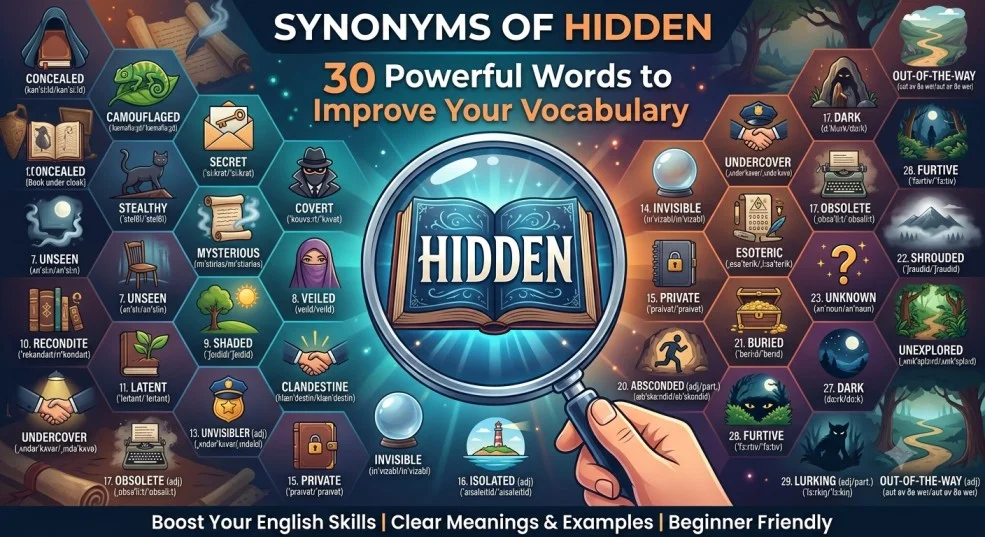
This article explains the meaning of “hidden” along with thirty great synonyms.
We will look at their exact meanings, example sentences, word histories, pronunciations, and grammar rules. You will also learn how to group these words into different categories to choose the best option for your writing.
Meaning of Hidden
Definition
- hidden (adjective): Kept out of sight or purposedly placed where people cannot see or find it.
Examples
- The dog found a hidden bone under the soft garden soil.
- She kept a hidden key under the flowerpot near the front door.
Connotative Meaning
- Positive tone: Suggests a pleasant surprise, safety, or a treasure waiting to be found (like a hidden gem or a hidden talent).
- Negative tone: Suggests deceit, danger, lies, or a scary trap (like a hidden camera or a hidden motive).
- Neutral tone: Simply describes something out of plain sight with no emotional feeling (like a hidden pipe behind a wall).
- (Connotation is the emotional feeling or extra meaning that a word brings, beyond its basic dictionary definition.)
Etymology
- Origin: “Hidden” comes from the Old English word hydan, which means to hide, conceal, or preserve.
- Old English (450–1100): The verb was hydan. It meant to keep safe or cover up.
- Middle English (1100–1500): The word became hiden. People started using the form hidden as an adjective to describe objects.
- Modern English (1500–Present): The spelling became fixed as hidden. Today, it is one of the most common words for things that are out of sight.
Pronunciation (US & UK – IPA)
- US: /ˈhɪd.ən/
- UK: /ˈhɪd.ən/
Syllables
- hid-den
Affixation Pattern of Hidden
- Root: hide (verb)
- Prefix: None
- Suffix: -en (used to form adjectives from past participles)
- Word formations:
- Hide (verb): To put out of sight.
- Hider (noun): A person who hides.
- Hiding (noun): The state of being out of sight.
- Hiddenly (adverb): In a secret or concealed manner.
A List of wonderful Synonyms of Hidden
1. Concealed (adjective)
- US: /kənˈsild/ | UK: /kənˈsiːld/
- Meaning: Kept secret or hidden from sight.
- Examples:
- He kept a concealed map inside his heavy winter coat.
- The box was concealed behind a large stack of books.
2. Camouflaged (adjective)
- US: /ˈkæm.ə.flɑːʒd/ | UK: /ˈkæm.ə.flɑːʒd/
- Meaning: Hidden by blending in with the surrounding environment.
- Examples:
- The camouflaged lizard sat perfectly still on the green leaf.
- Soldiers wear camouflaged uniforms to blend into the dark forest.
3. Covert (adjective)
- US: /ˈkoʊ.vɝːt/ | UK: /ˈkʌv.ət/
- Meaning: Done in a secret and hidden way, especially for military or police tasks.
- Examples:
- The spy planned a covert mission to get the secret plans.
- They took part in a covert meeting late at night.
4. Secret (adjective)
- US: /ˈsiː.krət/ | UK: /ˈsiː.krət/
- Meaning: Kept from the knowledge of other people.
- Examples:
- We built a secret treehouse deep inside the woods.
- She shared a secret recipe for chocolate chip cookies.
5. Obscure (adjective)
- US: /əbˈskjʊr/ | UK: /əbˈskjʊə/
- Meaning: Not clear or difficult to see and understand.
- Examples:
- The tiny cabin was built in an obscure corner of the mountain.
- His explanation was too obscure for the young students.
6. Cryptic (adjective)
- US: /ˈkrɪp.tɪk/ | UK: /ˈkrɪp.tɪk/
- Meaning: Having a hidden, mysterious, or puzzling meaning.
- Examples:
- She left a cryptic note on the kitchen table before she left.
- The ancient map had cryptic symbols that no one could read.
7. Veiled (adjective)
- US: /veɪld/ | UK: /veɪld/
- Meaning: Partially hidden or expressed in an indirect way.
- Examples:
- There was a veiled threat in his polite warning.
- The mountaintop was veiled in thick white fog.
8. Cloaked (adjective)
- US: /kloʊkt/ | UK: /kləʊkt/
- Meaning: Covered or hidden as if with a large cape.
- Examples:
- The old castle was cloaked in total darkness.
- He kept his true intentions cloaked from his friends.
9. Masked (adjective)
- US: /mæskt/ | UK: /mɑːskt/
- Meaning: Hidden or disguised so that the true nature is not seen.
- Examples:
- The thief was a masked man who wore a black hat.
- Her polite smile masked her deep sadness.
10. Invisible (adjective)
- US: /ɪnˈvɪz.ə.bəl/ | UK: /ɪnˈvɪz.ə.bəl/
- Meaning: Impossible to see with the naked eye.
- Examples:
- Air is invisible, but we can feel it move.
- The ink becomes invisible once it dries on paper.
11. Unseen (adjective)
- US: /ʌnˈsiːn/ | UK: /ʌnˈsiːn/
- Meaning: Not noticed or observed by anyone.
- Examples:
- The cat slipped through the door unseen by the dog.
- An unseen danger made the travelers stop walking.
12. Private (adjective)
- US: /ˈpraɪ.vət/ | UK: /ˈpraɪ.vət/
- Meaning: Restricted to the use of a particular person or group and kept hidden from the public.
- Examples:
- They walk along a private path behind their house.
- Keep your private thoughts written in your personal diary.
13. Stealthy (adjective)
- US: /ˈstel.θi/ | UK: /ˈstel.θi/
- Meaning: Quiet, slow, and cautious to avoid being seen or heard.
- Examples:
- The stealthy tiger moved slowly through the tall grass.
- She took a stealthy step backward to stay out of sight.
14. Surreptitious (adjective)
- US: /ˌsɝː.əpˈtɪʃ.əs/ | UK: /ˌsʌr.əpˈtɪʃ.əs/
- Meaning: Done secretly, especially because it would not be approved of.
- Examples:
- He took a surreptitious glance at his watch during the long test.
- They made a surreptitious deal behind closed doors.
15. Furtive (adjective)
- US: /ˈfɝː.t̬ɪv/ | UK: /ˈfɜː.tɪv/
- Meaning: Attempting to avoid notice or attention, often due to guilt.
- Examples:
- The boy cast a furtive look at the cookie jar on the counter.
- They shared a furtive whisper in the back of the classroom.
16. Latent (adjective)
- US: /ˈleɪ.tənt/ | UK: /ˈleɪ.tənt/
- Meaning: Existing but not yet active, visible, or developed.
- Examples:
- The child has a latent talent for playing the piano.
- The virus can remain latent in the body for many years.
17. Underground (adjective)
- US: /ˌʌn.dɚˈɡraʊnd/ | UK: /ˌʌn.dəˈɡraʊnd/
- Meaning: Situated below the surface of the earth, or secret from general society.
- Examples:
- They explored an underground cave filled with cool water.
- The rebels ran an underground newspaper during the war.
18. Mystical (adjective)
- US: /ˈmɪs.tɪ.kəl/ | UK: /ˈmɪs.tɪ.kəl/
- Meaning: Having a spiritual meaning that is hidden from human senses.
- Examples:
- The old forest had a mystical feeling that cheered the travelers.
- They studied the mystical teachings of ancient philosophers.
19. Occult (adjective)
- US: /əˈkʌlt/ | UK: /ɒˈkʌlt/
- Meaning: Relating to supernatural, mystical, or magical powers that are kept hidden.
- Examples:
- The writer loved to read books about occult practices.
- They discovered an occult symbol carved into the old stone wall.
20. Recondite (adjective)
- US: /ˈrek.ən.daɪt/ | UK: /rɪˈkɒn.daɪt/
- Meaning: Dealing with difficult subject matter that is hidden from common knowledge.
- Examples:
- The professor wrote a book on recondite physics theories.
- She possessed recondite knowledge about ancient languages.
21. Esoteric (adjective)
- US: /ˌes.əˈter.ɪk/ | UK: /ˌes.əˈter.ɪk/
- Meaning: Intended for or likely to be understood by only a small number of people with special knowledge.
- Examples:
- The computer programmers used an esoteric language to chat.
- His lecture was too esoteric for the general public.
22. Abstruse (adjective)
- US: /æbˈstruːs/ | UK: /əbˈstruːs/
- Meaning: Difficult to understand or comprehend because it is obscure.
- Examples:
- The legal document was filled with abstruse terms.
- I found his philosophical argument rather abstruse.
23. Clandestine (adjective)
- US: /klænˈdes.tɪn/ | UK: /klænˈdes.tɪn/
- Meaning: Planned or done in secret, often because it is illegal.
- Examples:
- The spies had a clandestine meeting under the city bridge.
- They conducted clandestine business deals to avoid paying taxes.
24. Disguised (adjective)
- US: /dɪsˈɡaɪzd/ | UK: /dɪsˈɡaɪzd/
- Meaning: Having an altered appearance to conceal one’s identity.
- Examples:
- The disguised princess walked safely through the busy market.
- He spoke in a disguised voice over the telephone.
25. Inner (adjective)
- US: /ˈɪn.ɚ/ | UK: /ˈɪn.ə/
- Meaning: Hidden deep inside; private or mental.
- Examples:
- Meditation helps you find your inner peace and strength.
- She kept her inner thoughts to herself during the meeting.
26. Out-of-the-way (adjective)
- US: /ˌaʊt.əv.ðəˈweɪ/ | UK: /ˌaʊt.əv.ðəˈweɪ/
- Meaning: Remote, secluded, or far from busy areas.
- Examples:
- We stayed at a quiet, out-of-the-way cottage in the countryside.
- They found an out-of-the-way spot to park their car.
27. Isolated (adjective)
- US: /ˈaɪ.sə.leɪ.t̬ɪd/ | UK: /ˈaɪ.sə.leɪ.tɪd/
- Meaning: Far away from other places, buildings, or people.
- Examples:
- The isolated lighthouse stood alone on the rocky shore.
- He lived an isolated life in the deep northern mountains.
28. Remote (adjective)
- US: /rɪˈmoʊt/ | UK: /rɪˈməʊt/
- Meaning: Situated far from main centers of population; distant.
- Examples:
- The team traveled to a remote island to study rare birds.
- Their village is so remote that it has no internet access.
29. Secluded (adjective)
- US: /sɪˈkluː.dɪd/ | UK: /sɪˈkluː.dɪd/
- Meaning: Sheltered, quiet, and hidden from general view.
- Examples:
- We spent a relaxing afternoon on a secluded sandy beach.
- The cabin is secluded among tall pine trees.
30. Undercover (adjective)
- US: /ˌʌn.dɚˈkʌv.ɚ/ | UK: /ˌʌn.dəˈkʌv.ə/
- Meaning: Working secretly to investigate crimes or gather information.
- Examples:
- An undercover police officer solved the bank robbery.
- She went undercover as a student to write her news story.
Prototype Meaning
When people hear the word “hidden,” they usually imagine a wooden treasure chest buried deep under yellow sand. They think of something physical that is placed out of sight so that other people cannot find it easily. It brings up images of mysteries, old maps, dark closets, and secret keys. It is the classic picture of keeping a physical object safe and protected from the rest of the world.
Prototype Categorization
Grouping these synonyms into categories makes it much easier to select the right word for your sentence:
- Physical Protection: Concealed, cloaked, masked, disguised. (Use these when you physically cover something up.)
- Nature & Colors: Camouflaged, unseen, invisible. (Use these when something blends in with its surroundings.)
- Places & Distance: Isolated, remote, secluded, out-of-the-way. (Use these to describe places that are far from cities.)
- Secrets & Crime: Covert, secret, clandestine, surreptitious, furtive, undercover. (Use these when people are sneaky, quiet, or breaking rules.)
- Mind & Magic: Cryptic, latent, esoteric, occult, recondite, abstruse. (Use these for ideas, feelings, or knowledge that are hard to understand.)
By using these clear categories, writers can quickly find the exact word that fits their context. It prevents you from choosing a word that sounds awkward.
Antonyms of Hidden
- Open (adjective): Not closed or covered; accessible to all.
- Public (adjective): Open to or shared by all the people in an area.
- Visible (adjective): Able to be seen clearly by the eyes.
- Exposed (adjective): Left without protection or cover; easily seen.
- Obvious (adjective): Very easy to see, notice, or understand.
Short Questions and Answers
- What does hidden mean?
- It describes something that is kept out of sight, covered up, or placed where people cannot see it.
- When should hidden be used?
- Use it when you want to describe regular objects, keys, feelings, or secrets that are not in plain view.
- Is hidden positive or negative?
- It can be both. A hidden treasure is positive. A hidden weapon or a hidden lie is negative. It depends entirely on the situation.
- How is it different from similar words?
- “Hidden” is a general word. “Camouflaged” means hidden by blending into the background, while “covert” means hidden because it is a secret plan.
Conclusion
Learning the word “hidden” and its thirty powerful synonyms is a fantastic way to boost your English skills. When you use different words like “covert,” “secluded,” or “latent,” you make your writing exciting and clear. You avoid using the same simple words over and over again. This builds your confidence when speaking with friends or writing essays for school. Make it a fun habit to practice at least one new synonym every single day. Soon, your vocabulary will be richer, and your writing will truly shine!

I am a linguist with 15 years of experience in English language teaching, including postgraduate-level instruction. My expertise includes English grammar, and I contribute as a content and blog writer, producing scholarly and educational language resources.