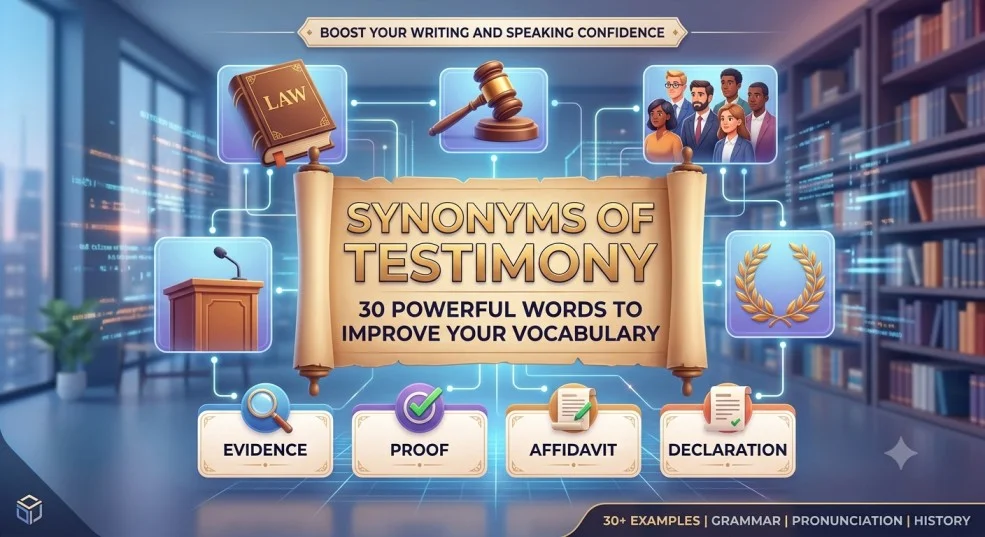
Imagine walking into a courtroom where a witness takes the stand, raises their hand, and shares a truthful account that sways the entire case. That sworn statement is a testimony, a word used to describe formal proof or clear evidence of a fact. We frequently rely on this term in law, religion, public speaking, and everyday storytelling to show that something is real.
For English learners and content writers, sticking to a single word over and over can make your writing feel repetitive and dull. Expanding your vocabulary with diverse synonyms allows you to express exact shades of meaning, match the right tone, and keep your audience engaged.
This guide explores the meaning of testimony along with its primary synonyms, offering clear example sentences, grammatical usage, historical origins, IPA pronunciations, and semantic categories. Everything is laid out in simple, easy-to-read sentences to help you elevate your English communication effortlessly.
Meaning of Testimony
Definition
Testimony (Noun): A formal written or spoken statement given as evidence, often in a court of law or as proof of something.
Examples
The witness gave her testimony in court today.
Her success is a clear testimony to her hard work.
Connotative Meaning
- Positive tone: Expresses honor, proof of greatness, or high achievement, such as when someone gives a heartfelt testimony of gratitude.
- Negative tone: Appears in criminal trials or investigations where a statement exposes wrongdoing, harm, or guilt.
- Neutral tone: Serves as a standard legal term referring to factual statements or evidence provided without emotional bias.
- (Connotation is the emotional feeling or implied meaning that a word carries beyond its literal dictionary definition.)
Etymology
- Source language: Latin (testimonium), derived from testis, meaning a witness.
- Old English (450–1100): The exact word did not exist in Old English; early speakers used terms like gewitnes (witness).
- Middle English (1100–1500): Adopted from Anglo-French and Old French as testimonie, referring directly to legal evidence and proof.
- Modern English (1500–Present): Expanded beyond legal settings to describe any outward sign, proof, or public declaration.
Pronunciation
- US: /ˈtɛstəˌmoʊni/
- UK: /ˈtɛstɪməni/
Syllables
tes-ti-mo-ny
Affixation Pattern of Testimony
- Root: Test (from Latin testis, meaning witness)
- Prefix: None
- Suffix: -mony (noun-forming suffix indicating a state, condition, or result)
- Word formation:
- Testify (Verb)
- Testimonial (Noun / Adjective)
- Testifier (Noun)
A List of wonderful Synonyms of Testimony
1. Evidence (Noun)
US: /ˈɛvədəns/ | UK: /ˈɛvɪdəns/
Meaning: Facts or signs that help prove if something is true or real.
- The police found clear evidence at the scene.
- Her big smile was evidence of her happiness.
2. Proof (Noun)
US: /pruf/ | UK: /pruːf/
Meaning: Information or an object that shows beyond doubt that something is true.
- You need proof to show that you bought the ticket.
- His test score is proof that he studied hard.
3. Statement (Noun)
US: /ˈsteɪtmənt/ | UK: /ˈsteɪtmənt/
Meaning: Something that you say or write officially to give information.
- The officer wrote down the driver’s statement.
- She made a brief statement to the reporters.
4. Declaration (Noun)
US: /ˌdɛkləˈreɪʃən/ | UK: /ˌdɛkləˈreɪʃn/
Meaning: An official or strong announcement made in public.
- He signed a formal declaration of support.
- Her speech was a bold declaration of independence.
5. Affidavit (Noun)
US: /ˌæfəˈdeɪvət/ | UK: /ˌæfɪˈdeɪvɪt/
Meaning: A written statement made under oath to be used in court.
- The lawyer prepared an affidavit for the witness.
- She signed the affidavit in front of a judge.
6. Attestation (Noun)
US: /ˌætəˈsteɪʃən/ | UK: /ˌætɛˈsteɪʃn/
Meaning: Formal confirmation that something is true or genuine.
- The document required an official attestation.
- His signature serves as an attestation of truth.
7. Deposition (Noun)
US: /ˌdɛpəˈzɪʃən/ | UK: /ˌdɛpəˈzɪʃn/
Meaning: Sworn testimony given out of court and written down for later use.
- The lawyer took a video deposition from the doctor.
- Her deposition was read aloud during the trial.
8. Confirmation (Noun)
US: /ˌkɑnfərˈmeɪʃən/ | UK: /ˌkɒnfəˈmeɪʃn/
Meaning: A statement or proof that makes something certain.
- We received confirmation about our hotel booking.
- The news gave us confirmation of the victory.
9. Verification (Noun)
US: /ˌvɛrəfəˈkeɪʃən/ | UK: /ˌvɛrɪfɪˈkeɪʃn/
Meaning: The process of checking or proving that something is correct.
- The bank requested verification of his identity.
- Quick verification prevented an online fraud attempt.
10. Corroboration (Noun)
US: /kəˌrɑbəˈreɪʃən/ | UK: /kəˌrɒbəˈreɪʃn/
Meaning: Additional evidence that supports or confirms a story.
- The detective searched for corroboration of the claim.
- Video footage provided key corroboration for her story.
11. Affirmation (Noun)
US: /ˌæfərˈmeɪʃən/ | UK: /ˌæfəˈmeɪʃn/
Meaning: A firm statement that something is true or valid.
- He gave an affirmation of his commitment to work.
- Her warm words offered reassurance and affirmation.
12. Asseveration (Noun)
US: /əˌsɛvəˈreɪʃən/ | UK: /əˌsɛvəˈreɪʃn/
Meaning: An earnest, serious, or solemn declaration of fact.
- She repeated her claim with quiet asseveration.
- His solemn asseveration convinced the entire jury.
13. Avowal (Noun)
US: /əˈvaʊəl/ | UK: /əˈvaʊəl/
Meaning: An open and public confession or statement of belief.
- The leader made a public avowal of his mistakes.
- Her avowal of friendship was deeply genuine.
14. Profession (Noun)
US: /prəˈfɛʃən/ | UK: /prəˈfɛʃn/
Meaning: A formal declaration or expression of a feeling or belief.
- His profession of loyalty pleased the manager.
- She made a profession of faith before the church.
15. Submission (Noun)
US: /səbˈmɪʃən/ | UK: /səbˈmɪʃn/
Meaning: Documents or arguments presented formally for consideration.
- The legal team prepared their submission for court.
- The judge carefully reviewed each written submission.
16. Record (Noun)
US: /ˈrɛkərd/ | UK: /ˈrɛkɔːd/
Meaning: A written or recorded account of events and facts.
- The court record includes all witness accounts.
- Keep an accurate record of your expenses.
17. Witness (Noun)
US: /ˈwɪtnəs/ | UK: /ˈwɪtnəs/
Meaning: A person’s spoken account or personal knowledge of an event.
- Her eyewitness account gave strength to the case.
- He offered his personal witness to the accident.
18. Demonstration (Noun)
US: /ˌdɛmənˈstreɪʃən/ | UK: /ˌdɛmənˈstreɪʃn/
Meaning: Clear proof showing that a quality or skill exists.
- The science experiment was a great demonstration of force.
- Her brave reaction was a demonstration of strength.
19. Manifestation (Noun)
US: /ˌmænəfɛˈsteɪʃən/ | UK: /ˌmænɪfɛˈsteɪʃn/
Meaning: An visible sign or clear indication that something is present.
- High fever is a common manifestation of illness.
- The city festival was a manifestation of local joy.
20. Indication (Noun)
US: /ˌɪndəˈkeɪʃən/ | UK: /ˌɪndɪˈkeɪʃn/
Meaning: A sign or suggestion that points to a specific truth.
- Dark clouds are a clear indication of coming rain.
- Her smile gave an indication that she agreed.
21. Suggestion (Noun)
US: /səɡˈdʒɛstʃən/ | UK: /səˈdʒɛstʃən/
Meaning: An indirect sign or hint pointing toward a conclusion.
- There was no suggestion of unfair play in the game.
- The subtle test results carry a suggestion of success.
22. Reflection (Noun)
US: /rɪˈflɛkʃən/ | UK: /rɪˈflɛkʃn/
Meaning: A clear result or sign that shows the nature of something.
- Good grades are a reflection of consistent effort.
- The clean streets are a reflection of city care.
23. Testimonial (Noun)
US: /ˌtɛstəˈmoʊniəl/ | UK: /ˌtɛstɪˈməʊniəl/
Meaning: A recommendation praising the value, quality, or character of someone or something.
- The happy customer wrote a glowing testimonial.
- Her resume includes a strong testimonial from her boss.
24. Tribute (Noun)
US: /ˈtrɪbjut/ | UK: /ˈtrɪbjuːt/
Meaning: An act, statement, or gift showing respect and admiration.
- The monument stands as a tribute to brave soldiers.
- His speech was a loving tribute to his mother.
25. Warrant (Noun)
US: /ˈwɔrənt/ | UK: /ˈwɒrənt/
Meaning: Written authorization or justification that provides official backing.
- The officer showed a legal warrant to enter.
- His past success gives warrant to our trust.
26. Certificate (Noun)
US: /sərˈtɪfɪkət/ | UK: /səˈtɪfɪkət/
Meaning: An official document confirming that a fact or event is true.
- She received a birth certificate for her newborn.
- He proudly framed his graduation certificate.
27. Documentation (Noun)
US: /ˌdɑkjəmɛnˈteɪʃən/ | UK: /ˌdɒkjumɛnˈteɪʃn/
Meaning: Official papers or records used to prove or support facts.
- Please show proper documentation at the border.
- The medical team kept careful documentation.
28. Subpoena (Noun)
US: /səˈpinə/ | UK: /səˈpiːnə/
Meaning: A official court order requiring someone to appear and give testimony.
- The witness received a court subpoena in the mail.
- He was forced to answer the subpoena directly.
29. Disclosure (Noun)
US: /dɪsˈkloʊʒər/ | UK: /dɪsˈkləʊʒə/
Meaning: The act of revealing new or secret information publicly.
- The sudden disclosure shocked everyone in the room.
- Financial disclosure is required by national law.
30. Profession of Faith (Noun)
US: /prəˈfɛʃən ʌv feɪθ/ | UK: /prəˈfɛʃn ɒv feɪθ/
Meaning: A public declaration of religious beliefs and convictions.
- She made her profession of faith during the service.
- The ritual includes a sincere profession of faith.
Prototype Meaning
The prototype meaning of testimony centers on formal, sworn evidence presented in a courtroom setting. When people hear this word, they typically picture a witness sitting in a designated stand, placing a hand on a holy book or making an oath, and speaking truthfully to a judge and jury about what they observed.
Prototype Categorization
Categorizing synonyms helps writers choose the exact term needed for legal, general, or symbolic contexts:
- Legal & Official Statements: Affidavit, Deposition, Attestation, Subpoena, Submission. (Used in official, legal, or courtroom settings).
- Direct Proof & Evidence: Evidence, Proof, Verification, Corroboration, Documentation, Certificate, Warrant. (Used to show clear, factual backing).
- Public & Open Declarations: Declaration, Affirmation, Avowal, Asseveration, Profession, Disclosure, Statement. (Used when publicly stating beliefs or truths).
- Indirect Signs & Reflections: Demonstration, Manifestation, Indication, Reflection, Suggestion, Witness. (Used when an action or object shows an underlying truth).
- Praise & Honors: Testimonial, Tribute. (Used when speaking positively about character or quality).
Antonyms of Testimony
- Denial (Noun): A statement claiming that something is not true or did not happen.
- Refusal (Noun): An act of showing that you will not accept, give, or do something.
- Contradiction (Noun): A combination of statements or ideas that oppose one another.
- Disproof (Noun): Evidence or reasoning that proves a statement or theory to be false.
- Rebuttal (Noun): A response that presents arguments or evidence against an accusation.
- Concealment (Noun): The action of hiding or preventing something from being known.
Short Questions and Answers
- What does testimony mean?
- It is a formal written or spoken statement used as evidence or proof of a fact.
- When should testimony be used?
- Use it when discussing legal evidence, formal sworn statements, or strong proof of a quality or achievement.
- Is testimony positive or negative?
- It is neutral by default, but it becomes positive when referring to achievements (e.g., “a testimony to her skill”) or negative during criminal proceedings.
- How is it different from similar words?
- Unlike general evidence or proof, a testimony usually comes from a spoken or written personal statement made by a person under obligation to tell the truth.
Conclusion
Mastering the word testimony alongside its 30 synonyms is an excellent way to elevate your English vocabulary. Expanding your word choices allows you to write with precise nuance, eliminate repetitive language, and tailor your tone to legal, professional, or creative contexts. Practicing these synonyms daily will strengthen both your speaking and writing skills, boosting your overall confidence as an English communicator.

I am a linguist with 15 years of experience in English language teaching, including postgraduate-level instruction. My expertise includes English grammar, and I contribute as a content and blog writer, producing scholarly and educational language resources.