The word masturbate refers to the act of stimulating one’s own sexual organs for pleasure. It is a common word in medical, educational, psychological, and everyday discussions about human sexuality. For example, a student studying human biology may encounter this term in a textbook, while a healthcare professional may use it when discussing sexual health and wellness.
Learning synonyms of masturbate helps English learners, writers, researchers, and content creators understand different levels of formality, tone, and context. Some synonyms are clinical and neutral, while others are informal, slang-based, humorous, or even offensive. Understanding these differences improves vocabulary, strengthens communication skills, and helps avoid inappropriate word choices. This article explores the meaning of masturbate, its pronunciation, history, grammar, connotations, and thirty related synonyms with definitions and examples.
Meaning of Masturbate
Definition
Masturbate (verb): To stimulate one’s own sexual organs or another person’s sexual organs for sexual pleasure, usually by touching.
Examples
- He learned about sexual health and masturbation during a biology class.
- Healthcare professionals often discuss masturbation as a normal human behavior.
Connotative Meaning
(Connotation: the emotional or cultural meaning associated with a word beyond its dictionary definition.)
- Positive tone: May suggest healthy sexual expression or self-exploration in educational or medical contexts.
- Negative tone: May carry social stigma, embarrassment, or disapproval in some cultures.
- Neutral tone: Often used in medical, psychological, and educational discussions.
Etymology
- Source language: Latin
- Original meaning: The exact origin is debated, but it is generally linked to Latin roots relating to “manual stimulation.”
Short History of the Keyword
- Old English (450–1100): No direct equivalent existed.
- Middle English (1100–1500): The concept was described using phrases rather than a single term.
- Modern English (1500–Present): The word masturbate entered English scholarly and medical vocabulary during the eighteenth century.
Pronunciation (US & UK – IPA)
- US: /ˈmæs.tɚ.beɪt/
- UK: /ˈmæs.tə.beɪt/
Syllables
mas-tur-bate
Affixation Pattern of Masturbate
- Root: masturb-
- Prefix: None
- Suffix: -ate
Word Formation of the Keyword
- masturbate (verb)
- masturbation (noun)
- masturbatory (adjective)
- masturbator (noun)
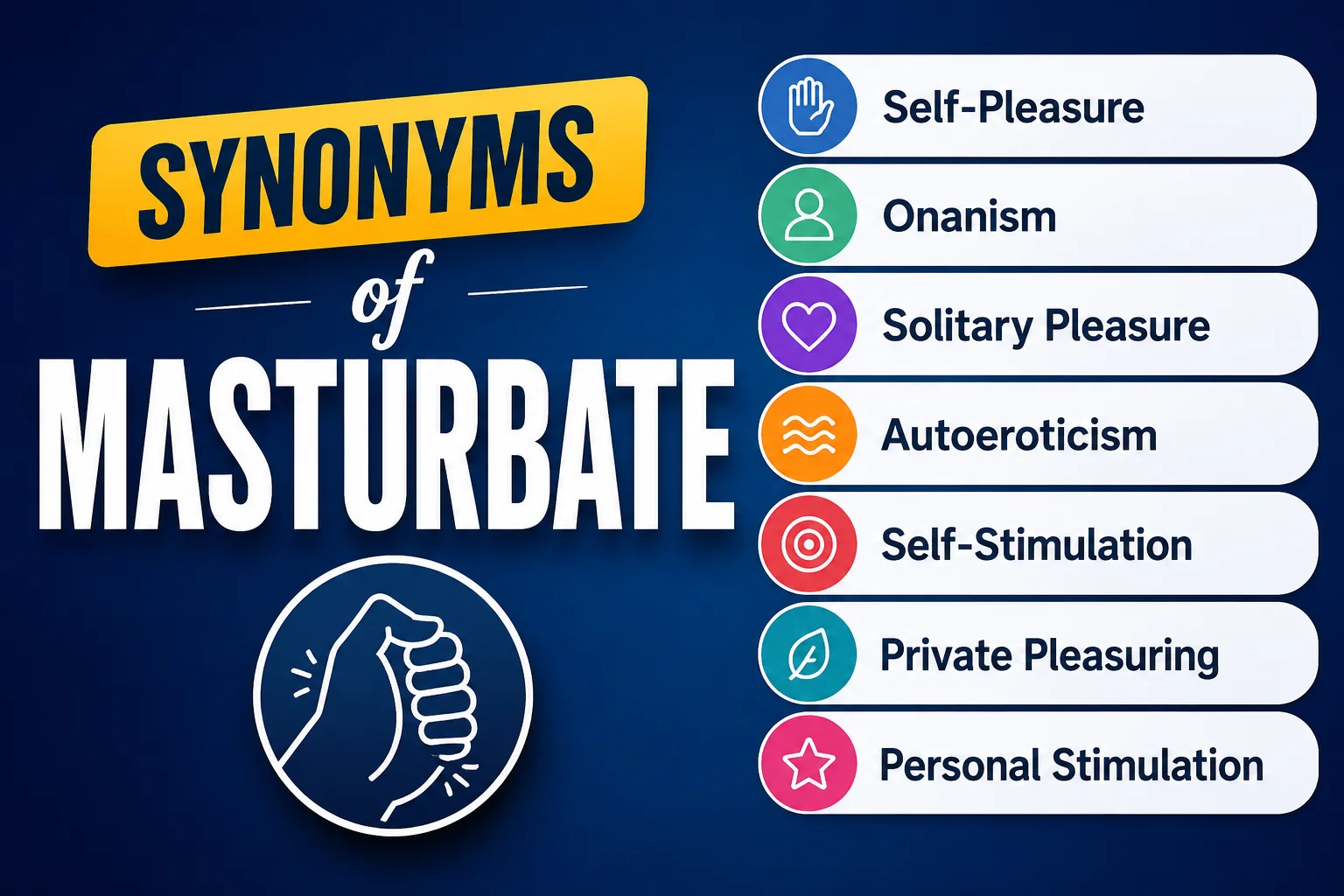
Synonyms of Masturbate
Note: Many synonyms below are slang, informal, euphemistic, or vulgar. Their appropriateness depends heavily on context.
1. Self-stimulate (verb)
US: /ˌself ˈstɪmjəˌleɪt/ | UK: /ˌself ˈstɪmjʊleɪt/
Meaning: To stimulate oneself sexually.
Examples:
- He discussed self-stimulation during a health education course.
- Medical texts sometimes use the term self-stimulate.
2. Self-pleasure (verb)
US: /ˌself ˈplɛʒər/ | UK: /ˌself ˈpleʒə/
Meaning: To give oneself sexual pleasure.
Examples:
- Some educational materials use self-pleasure as a euphemism.
- The article discussed self-pleasure and sexual wellness.
3. Autoeroticize (verb)
US: /ˌɔtoʊɪˈrɑtɪsaɪz/ | UK: /ˌɔːtəʊɪˈrɒtɪsaɪz/
Meaning: To stimulate oneself sexually.
Examples:
- Researchers occasionally use the term autoeroticize.
- The psychological paper referenced autoerotic behavior.
4. Pleasure oneself (verb)
US: /ˈplɛʒər wʌnˈsɛlf/ | UK: /ˈpleʒə wʌnˈself/
Meaning: To obtain sexual pleasure through self-stimulation.
Examples:
- The phrase appears in educational literature.
- He used a euphemism to describe pleasing oneself.
5. Self-gratify (verb)
US: /ˌself ˈɡrætəfaɪ/ | UK: /ˌself ˈɡrætɪfaɪ/
Meaning: To satisfy one’s own desires sexually.
Examples:
- Older texts sometimes use self-gratify.
- The expression is considered formal and outdated.
6. Engage in self-stimulation (verb phrase)
US: /ɛnˈɡeɪdʒ ɪn self ˌstɪmjəˈleɪʃən/ | UK: /ɪnˈɡeɪdʒ ɪn self ˌstɪmjʊˈleɪʃən/
Meaning: To perform sexual self-stimulation.
Examples:
- The medical report used this phrase.
- Educational programs sometimes prefer this wording.
7. Self-touch (verb)
US: /ˌself ˈtʌtʃ/ | UK: /ˌself ˈtʌtʃ/
Meaning: To touch oneself sexually.
Examples:
- The therapist discussed healthy self-touch.
- The educational guide explained the concept.
8. Practice self-pleasure (verb phrase)
US: /ˈpræktɪs self ˈplɛʒər/ | UK: /ˈpræktɪs self ˈpleʒə/
Meaning: To masturbate.
Examples:
- The article used this phrase in a neutral context.
- Sexual health experts sometimes prefer this wording.
9. Stimulate oneself (verb phrase)
US: /ˈstɪmjəˌleɪt wʌnˈsɛlf/ | UK: /ˈstɪmjʊleɪt wʌnˈself/
Meaning: To create sexual pleasure through self-touch.
Examples:
- The textbook used this phrase.
- The doctor explained that many people stimulate themselves.
10. Engage in autoerotic behavior (verb phrase)
US: /ˌɔtoʊɪˈrɑtɪk/ | UK: /ˌɔːtəʊɪˈrɒtɪk/
Meaning: To participate in sexual activity directed toward oneself.
Examples:
- The psychology study used this expression.
- Researchers classified it as autoerotic behavior.
11–30. Common Informal and Slang Synonyms
The following expressions are primarily slang, colloquial, humorous, or vulgar:
11. Jerk off (verb)
12. Jack off (verb)
13. Wank (verb)
14. Wank off (verb)
15. Beat off (verb)
16. Rub one out (verb)
17. Have a wank (verb phrase)
18. Have a tug (verb phrase)
19. Stroke oneself (verb phrase)
20. Play with oneself (verb phrase)
21. Fiddle with oneself (verb phrase)
22. Pleasure yourself (verb phrase)
23. Have some alone time (euphemistic phrase)
24. Relieve oneself sexually (verb phrase)
25. Engage in self-gratification (verb phrase)
26. Handle oneself (verb phrase)
27. Touch oneself (verb phrase)
28. Indulge in self-pleasure (verb phrase)
29. Perform manual self-stimulation (verb phrase)
30. Practice autoerotic stimulation (verb phrase)
Note: These expressions vary greatly in formality and acceptability. Clinical and educational contexts generally prefer terms such as self-stimulate, self-pleasure, or masturbate.
Prototype Meaning
The most typical meaning of masturbate is the act of a person stimulating their own sexual organs to experience sexual pleasure. When people hear this word, they usually imagine private sexual self-stimulation discussed in medical, educational, psychological, or everyday contexts.
Prototype Categorization
Grouping synonyms into categories helps writers choose the most appropriate word for a specific audience and situation.
- Medical and Clinical Terms:
- self-stimulate
- autoeroticize
- stimulate oneself
- perform manual self-stimulation
- Educational and Neutral Terms:
- self-pleasure
- pleasure oneself
- self-touch
- engage in self-stimulation
- Informal Expressions:
- play with oneself
- touch oneself
- pleasure yourself
- handle oneself
- Slang and Vulgar Terms:
- jerk off
- jack off
- wank
- beat off
- rub one out
Antonyms of Masturbate
- Abstain (verb): To deliberately avoid sexual activity.
- Refrain (verb): To choose not to engage in an activity.
- Suppress (verb): To hold back desires or actions.
- Restrain (verb): To exercise self-control.
- Avoid (verb): To stay away from an activity.
Short Questions and Answers
- What does masturbate mean?
- It means stimulating sexual organs for sexual pleasure, usually through self-touch.
- When should masturbate be used?
- It is best used in medical, educational, scientific, or serious discussions.
- Is masturbate positive or negative?
- The meaning depends on cultural, social, and personal context. In medicine, it is generally considered neutral.
- How is it different from similar words?
- Masturbate is the standard formal term, while many synonyms are slang, humorous, euphemistic, or clinical.
Conclusion
Learning the word masturbate and its synonyms helps English learners understand differences in tone, formality, and context. Building vocabulary in this area improves reading comprehension, strengthens speaking and writing skills, and helps avoid repetitive language. Understanding the distinctions between medical, educational, informal, and slang expressions also allows writers to communicate more accurately and appropriately for different audiences. Regular vocabulary practice, combined with studying pronunciation, history, and usage, builds confidence and helps learners become more effective English communicators.

I am a linguist with 15 years of experience in English language teaching, including postgraduate-level instruction. My expertise includes English grammar, and I contribute as a content and blog writer, producing scholarly and educational language resources.