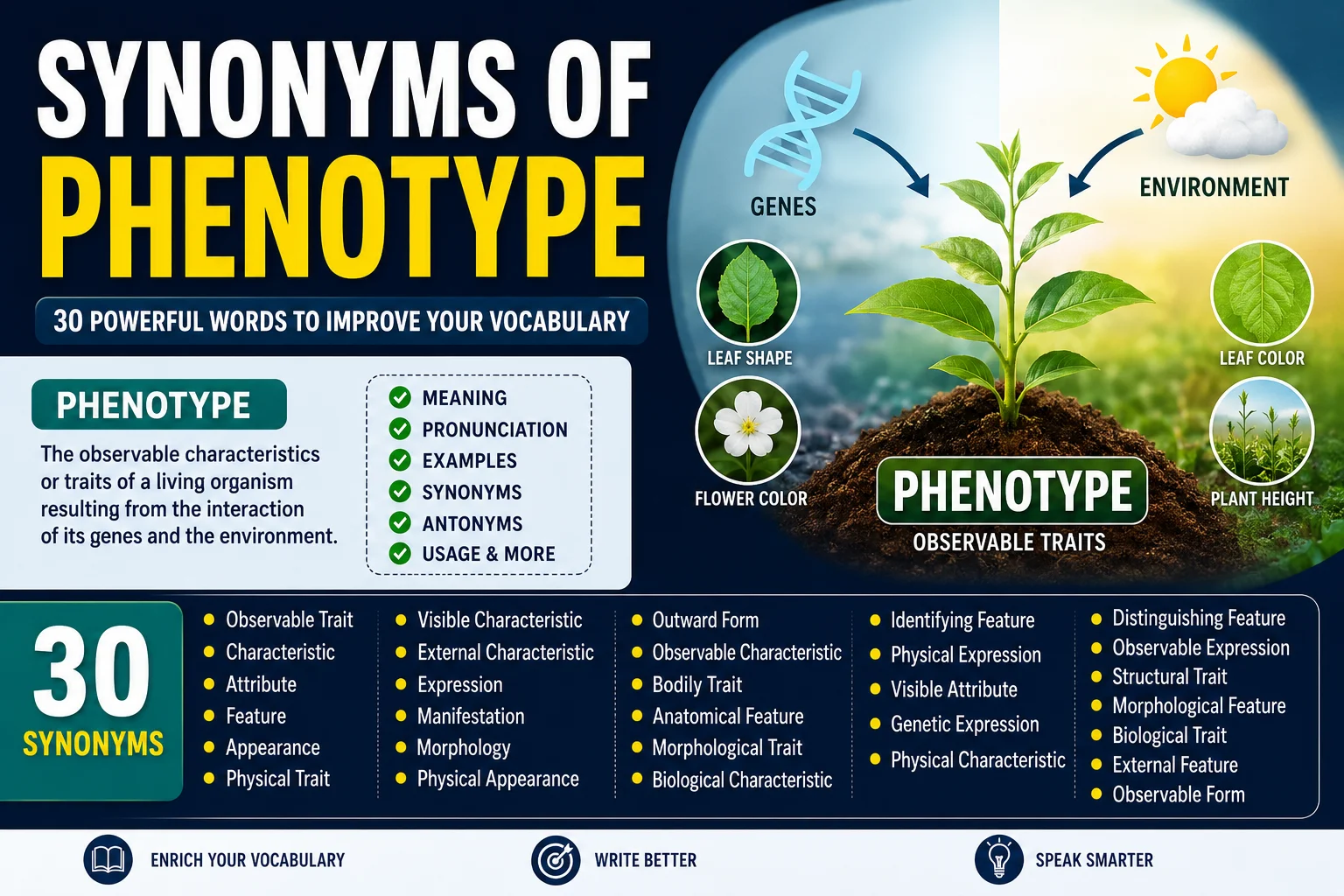
A phenotype is the set of observable traits or characteristics of a living organism. These traits include things like eye color, height, hair texture, flower color, body shape, or behavior. Imagine two siblings. They may have the same parents, but one has blue eyes while the other has brown eyes. These visible differences are part of their phenotypes.
The word phenotype is common in biology, genetics, medicine, agriculture, and scientific research. Students, teachers, researchers, and writers often use it when talking about inherited traits and how genes interact with the environment.
Learning the synonyms of phenotype helps English learners understand scientific texts more easily and allows writers to avoid repeating the same word. In this article, you will learn the meaning of phenotype, its pronunciation, grammar, history, connotation, word formation, and 30 useful synonyms with simple explanations and examples.
Meaning of Phenotype
Definition
Phenotype (Noun):
The visible or measurable characteristics of an organism that result from the interaction between its genes and the environment.
Examples
- The scientist studied the phenotype of the new plant species.
- Eye color is an important part of a person’s phenotype.
Connotative Meaning
(Connotation means the emotional or implied meaning that a word carries beyond its basic dictionary definition.)
- Positive tone: Used to describe healthy, unique, or beneficial traits.
- Negative tone: May describe harmful or diseased characteristics in medical discussions.
- Neutral tone: Most commonly used as a scientific term without emotion.
Etymology
- Source language: Greek
- Derived from phainein, meaning to show, appear, or make visible, and typos, meaning type, form, or pattern.
- The word literally means the visible form or appearance.
Short History of the Keyword
- Old English (450–1100):
- The word phenotype did not exist during this period.
- Middle English (1100–1500):
- The word had not yet entered English, although early scientific ideas about inheritance began to develop.
- Modern English (1500–Present):
- The term phenotype was introduced in the early 1900s after advances in genetics.
- It became widely used in biology, medicine, agriculture, and evolutionary science.
Pronunciation (US & UK – IPA)
- US: /ˈfiː.nə.taɪp/
- UK: /ˈfiː.nə.taɪp/
Syllables
phe-no-type
Affixation Pattern of Phenotype
- Root: type
- Prefix: pheno-
- Suffix: None
Word Formation of the Keyword
- Phenotype (noun) – observable characteristics
- Phenotypic (adjective) – relating to a phenotype
- Phenotypically (adverb) – in terms of phenotype
- Phenotyping (noun/verb) – the process of identifying phenotypes
- Phenotyped (verb) – identified by phenotype
- Phenotype-based (adjective) – based on observable traits
Synonyms of Phenotype
1. Observable Trait (Noun)
US: /əbˈzɝː.və.bəl treɪt/
UK: /əbˈzɜː.və.bəl treɪt/
Meaning: A characteristic that can be seen or measured.
Examples
- Scientists recorded every observable trait of the plants.
- Eye color is an observable trait in humans.
2. Characteristic (Noun)
US: /ˌker.ək.təˈrɪs.tɪk/
UK: /ˌkær.ək.təˈrɪs.tɪk/
Meaning: A feature or quality that makes something different.
Examples
- Curly hair is one characteristic of the child.
- Each animal has its own physical characteristics.
3. Attribute (Noun)
US: /ˈæt.rɪ.bjuːt/
UK: /ˈæt.rɪ.bjuːt/
Meaning: A quality or feature belonging to someone or something.
Examples
- Height is an important genetic attribute.
- The doctor examined every physical attribute.
4. Feature (Noun)
US: /ˈfiː.tʃɚ/
UK: /ˈfiː.tʃə/
Meaning: A noticeable part or quality of something.
Examples
- Blue eyes are a common feature in the family.
- The flower has many unique features.
5. Appearance (Noun)
US: /əˈpɪr.əns/
UK: /əˈpɪə.rəns/
Meaning: The way someone or something looks.
Examples
- The disease changed the bird’s appearance.
- Climate can affect the appearance of plants.
6. Physical Trait (Noun)
US: /ˈfɪz.ɪ.kəl treɪt/
UK: /ˈfɪz.ɪ.kəl treɪt/
Meaning: A visible body characteristic.
Examples
- Hair color is a physical trait.
- Scientists compared several physical traits.
7. External Characteristic (Noun)
US: /ɪkˈstɝː.nəl ˌker.ək.təˈrɪs.tɪk/
UK: /ɪkˈstɜː.nəl ˌkær.ək.təˈrɪs.tɪk/
Meaning: A feature visible on the outside.
Examples
- Leaf shape is an external characteristic.
- External characteristics help identify species.
8. Expression (Noun)
US: /ɪkˈspreʃ.ən/
UK: /ɪkˈspreʃ.ən/
Meaning: The visible result of genetic activity.
Examples
- The gene’s expression changed the flower color.
- Scientists studied the expression of inherited traits.
9. Manifestation (Noun)
US: /ˌmæn.ə.fəˈsteɪ.ʃən/
UK: /ˌmæn.ɪ.fesˈteɪ.ʃən/
Meaning: A clear sign or visible form of something.
Examples
- The mutation was a visible manifestation.
- The disease showed an early manifestation.
10. Morphology (Noun)
US: /mɔːrˈfɑː.lə.dʒi/
UK: /mɔːˈfɒl.ə.dʒi/
Meaning: The study or form of an organism’s physical structure.
Examples
- Scientists examined the plant’s morphology.
- Bird morphology differs between species.
11. Physical Appearance (Noun)
US: /ˈfɪz.ɪ.kəl əˈpɪr.əns/
UK: /ˈfɪz.ɪ.kəl əˈpɪə.rəns/
Meaning: The outward look or visible form of a living organism.
Examples
- The twins had a similar physical appearance.
- Nutrition can influence physical appearance.
12. Visible Characteristic (Noun)
US: /ˈvɪz.ə.bəl ˌker.ək.təˈrɪs.tɪk/
UK: /ˈvɪz.ə.bəl ˌkær.ək.təˈrɪs.tɪk/
Meaning: A feature that can be seen with the eyes.
Examples
- Skin color is a visible characteristic.
- The researcher recorded every visible characteristic.
13. Outward Form (Noun)
US: /ˈaʊt.wɚd fɔːrm/
UK: /ˈaʊt.wəd fɔːm/
Meaning: The external shape or appearance of something.
Examples
- The butterfly’s outward form changed after metamorphosis.
- The outward form reflected its healthy growth.
14. Observable Characteristic (Noun)
US: /əbˈzɝː.və.bəl ˌker.ək.təˈrɪs.tɪk/
UK: /əbˈzɜː.və.bəl ˌkær.ək.təˈrɪs.tɪk/
Meaning: A feature that can be observed or measured.
Examples
- Height is an observable characteristic.
- Researchers compared several observable characteristics.
15. Bodily Trait (Noun)
US: /ˈbɑː.də.li treɪt/
UK: /ˈbɒd.ɪ.li treɪt/
Meaning: A physical feature of the body.
Examples
- Finger length is a bodily trait.
- Every bodily trait was carefully measured.
16. Anatomical Feature (Noun)
US: /ˌæn.əˈtɑː.mɪ.kəl ˈfiː.tʃɚ/
UK: /ˌæn.əˈtɒm.ɪ.kəl ˈfiː.tʃə/
Meaning: A body structure or physical part.
Examples
- The bird’s beak is an important anatomical feature.
- Scientists studied each anatomical feature.
17. Morphological Trait (Noun)
US: /ˌmɔːr.fəˈlɑː.dʒɪ.kəl treɪt/
UK: /ˌmɔː.fəˈlɒdʒ.ɪ.kəl treɪt/
Meaning: A physical feature related to an organism’s form or structure.
Examples
- Leaf shape is a morphological trait.
- Morphological traits help identify species.
18. Biological Characteristic (Noun)
US: /ˌbaɪ.əˈlɑː.dʒɪ.kəl ˌker.ək.təˈrɪs.tɪk/
UK: /ˌbaɪ.əˈlɒdʒ.ɪ.kəl ˌkær.ək.təˈrɪs.tɪk/
Meaning: A feature of a living organism.
Examples
- Blood type is a biological characteristic.
- Every biological characteristic was examined.
19. Identifying Feature (Noun)
US: /aɪˈden.t̬ə.faɪ.ɪŋ ˈfiː.tʃɚ/
UK: /aɪˈden.tɪ.faɪ.ɪŋ ˈfiː.tʃə/
Meaning: A feature used to recognize or distinguish something.
Examples
- The long tail is the bird’s identifying feature.
- Eye shape became the identifying feature.
20. Physical Expression (Noun)
US: /ˈfɪz.ɪ.kəl ɪkˈspreʃ.ən/
UK: /ˈfɪz.ɪ.kəl ɪkˈspreʃ.ən/
Meaning: The visible result of genetic information.
Examples
- Hair texture is a physical expression of genes.
- The disease altered the physical expression of the trait.
21. Visible Attribute (Noun)
US: /ˈvɪz.ə.bəl ˈæt.rɪ.bjuːt/
UK: /ˈvɪz.ə.bəl ˈæt.rɪ.bjuːt/
Meaning: A quality or feature that can be easily seen.
Examples
- Eye color is a visible attribute of the child.
- Scientists measured each visible attribute.
22. Genetic Expression (Noun)
US: /dʒəˈnet̬.ɪk ɪkˈspreʃ.ən/
UK: /dʒəˈnet.ɪk ɪkˈspreʃ.ən/
Meaning: The way genetic information produces observable traits.
Examples
- Genetic expression affects flower color.
- Temperature can influence genetic expression.
23. Physical Characteristic (Noun)
US: /ˈfɪz.ɪ.kəl ˌker.ək.təˈrɪs.tɪk/
UK: /ˈfɪz.ɪ.kəl ˌkær.ək.təˈrɪs.tɪk/
Meaning: A visible feature of a living organism.
Examples
- Height is a physical characteristic.
- The scientist compared physical characteristics.
24. Distinguishing Feature (Noun)
US: /dɪˈstɪŋ.ɡwɪ.ʃɪŋ ˈfiː.tʃɚ/
UK: /dɪˈstɪŋ.ɡwɪ.ʃɪŋ ˈfiː.tʃə/
Meaning: A feature that makes someone or something different from others.
Examples
- The bright feathers are the bird’s distinguishing feature.
- Leaf shape is a distinguishing feature of the species.
25. Observable Expression (Noun)
US: /əbˈzɝː.və.bəl ɪkˈspreʃ.ən/
UK: /əbˈzɜː.və.bəl ɪkˈspreʃ.ən/
Meaning: A visible result of genes or biological processes.
Examples
- Eye color is an observable expression of genetics.
- Researchers studied the observable expression of the mutation.
26. Structural Trait (Noun)
US: /ˈstrʌk.tʃɚ.əl treɪt/
UK: /ˈstrʌk.tʃər.əl treɪt/
Meaning: A feature related to the structure of an organism.
Examples
- Bone size is a structural trait.
- The structural traits differed between species.
27. Morphological Feature (Noun)
US: /ˌmɔːr.fəˈlɑː.dʒɪ.kəl ˈfiː.tʃɚ/
UK: /ˌmɔː.fəˈlɒdʒ.ɪ.kəl ˈfiː.tʃə/
Meaning: A physical feature related to shape or structure.
Examples
- Wing length is a morphological feature.
- Scientists measured each morphological feature carefully.
28. Biological Trait (Noun)
US: /ˌbaɪ.əˈlɑː.dʒɪ.kəl treɪt/
UK: /ˌbaɪ.əˈlɒdʒ.ɪ.kəl treɪt/
Meaning: A characteristic found in living organisms.
Examples
- Blood group is a biological trait.
- Every biological trait has a genetic basis.
29. External Feature (Noun)
US: /ɪkˈstɝː.nəl ˈfiː.tʃɚ/
UK: /ɪkˈstɜː.nəl ˈfiː.tʃə/
Meaning: A visible feature found on the outside.
Examples
- Fur color is an external feature.
- The external features helped identify the animal.
30. Observable Form (Noun)
US: /əbˈzɝː.və.bəl fɔːrm/
UK: /əbˈzɜː.və.bəl fɔːm/
Meaning: The visible form or appearance of an organism.
Examples
- The observable form changed as the plant matured.
- Scientists documented the observable form of every specimen.
Notes on the Synonyms
Not all of these are perfect dictionary synonyms of phenotype. This is because phenotype is a specialized biological term with no large set of exact one-word English equivalents. The list includes:
- Exact scientific equivalents
- Near synonyms
- Biology-related expressions
- Contextual alternatives commonly used in genetics, biology, and scientific writing
Prototype Meaning
When people hear the word phenotype, they usually think of the visible traits of a living organism. These are the characteristics that can be seen or measured, such as eye color, hair color, height, skin color, flower color, leaf shape, or body size. A phenotype is the result of both an organism’s genes and the environment. For example, two plants may have the same genes, but different amounts of sunlight or water can produce different phenotypes. In biology, the phenotype is the outward expression of genetic information.
Prototype Categorization
Grouping synonyms into categories helps writers choose the most accurate word for different situations. Instead of using the same word repeatedly, you can select a synonym that best matches your context.
- General Physical Traits
- Characteristic
- Feature
- Attribute
- Physical Trait
- Physical Characteristic
- Visible Appearance
- Appearance
- Observable Trait
- Observable Form
- Visible Characteristic
- Visible Attribute
- External Feature
- Outward Form
- Genetics and Biology
- Genetic Expression
- Physical Expression
- Expression
- Biological Trait
- Biological Characteristic
- Observable Expression
- Structure and Form
- Morphology
- Morphological Trait
- Morphological Feature
- Anatomical Feature
- Structural Trait
- Identification
- Identifying Feature
- Distinguishing Feature
Why Categorization Matters
Categorizing synonyms makes writing clearer and more precise. Scientific writers can choose technical terms like genetic expression or morphological trait, while general writers may prefer simpler words such as feature, appearance, or characteristic. This improves readability and avoids unnecessary repetition.
Antonyms of Phenotype
- Genotype (Noun) – The genetic makeup of an organism rather than its visible traits.
- Genetic Composition (Noun) – The complete set of genes an organism possesses.
- Genetic Blueprint (Noun) – The inherited genetic information that guides development.
- DNA Sequence (Noun) – The order of nucleotides in DNA that determines genetic information.
- Inherited Genome (Noun) – The complete inherited genetic material of an organism.
Note: There is no perfect direct antonym of phenotype in English. The closest opposite concept is genotype, which refers to an organism’s genetic makeup instead of its observable characteristics.
Short Questions and Answers
- What does phenotype mean?
Answer: A phenotype is the observable characteristics or traits of a living organism that result from the interaction of its genes and the environment. - When should phenotype be used?
Answer: Use phenotype when discussing visible or measurable traits in biology, genetics, medicine, agriculture, or scientific research. - Is phenotype positive or negative?
Answer: Neither. It is generally a neutral scientific term. Depending on the context, it can describe beneficial, harmful, or ordinary traits. - How is it different from similar words?
Answer: Words like feature, trait, and characteristic describe qualities in general. Phenotype specifically refers to the observable characteristics of an organism that result from both genetics and environmental influences.
Conclusion
Learning the word phenotype helps you understand important ideas in biology, genetics, and everyday science. It also expands your English vocabulary and makes your writing more accurate. By knowing different synonyms, you can avoid repeating the same word and choose the best expression for each situation. Whether you are a student, teacher, researcher, content writer, or English learner, understanding phenotype and its related terms will improve your reading, writing, and speaking skills. Make vocabulary learning a daily habit. Every new word you master increases your confidence and helps you communicate more clearly in both academic and professional settings.

I am a linguist with 15 years of experience in English language teaching, including postgraduate-level instruction. My expertise includes English grammar, and I contribute as a content and blog writer, producing scholarly and educational language resources.