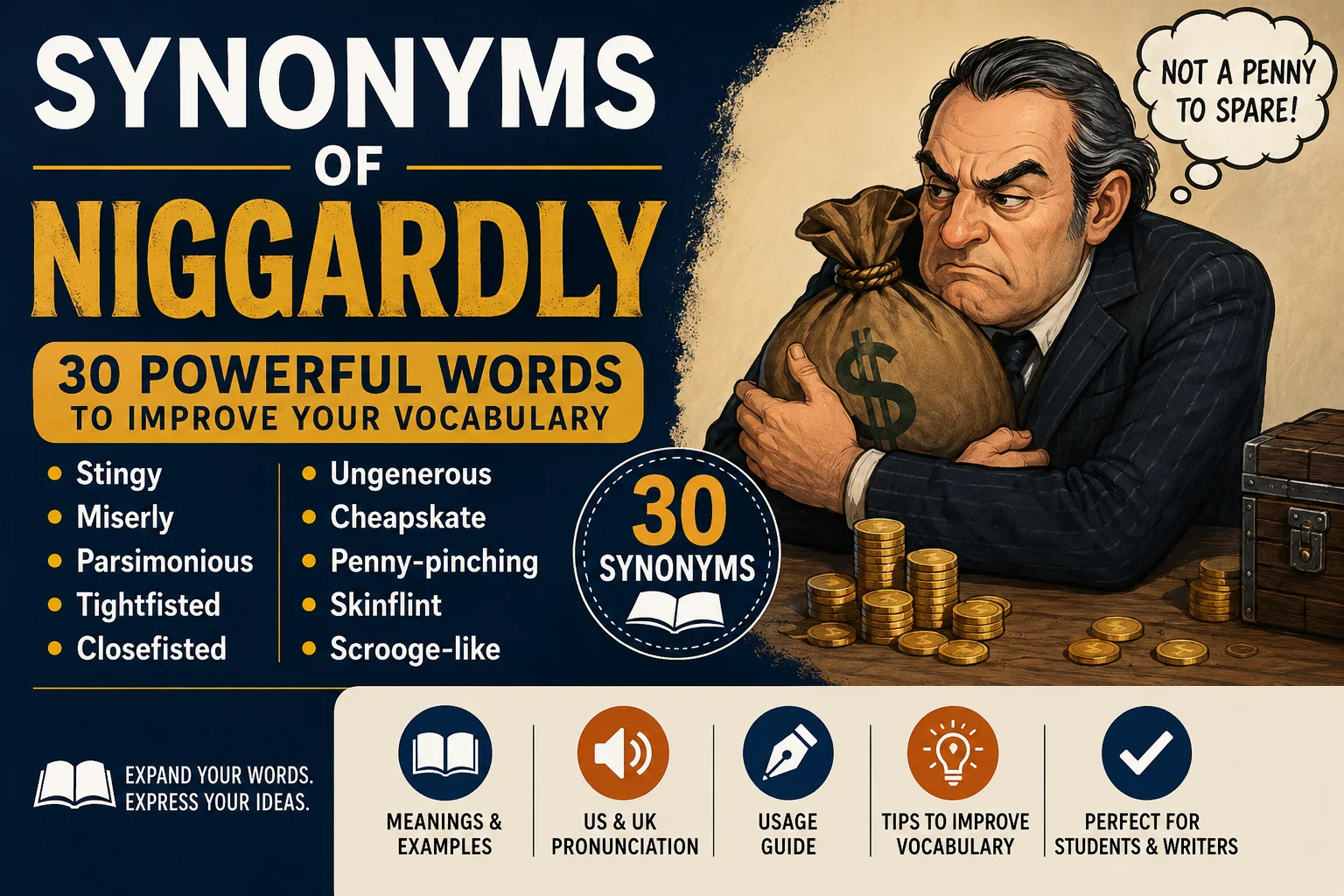
The word niggardly means unwilling to spend money or give anything generously. Imagine a person who has plenty of money but never helps others or even spends a little on necessary things. Many people would describe that person as niggardly. Although this word is old and uncommon today, it still appears in books, dictionaries, and advanced English writing.
Learning synonyms of niggardly helps English learners, students, writers, and content creators express ideas more clearly. Different synonyms have different tones. Some are formal, some are informal, and some are stronger than others.
In this article, you will learn the meaning of niggardly, its pronunciation, grammar, history, connotations, and many useful synonyms with easy examples. This knowledge will help you improve your vocabulary and write with greater confidence.
Meaning of Niggardly
Definition
Niggardly (Adjective):
Unwilling to spend money, time, or resources; not generous; extremely stingy.
Examples
- The landlord was niggardly with repairs, even when they were necessary.
- She received only a niggardly amount of support for her project.
Connotative Meaning
(Connotation is the emotional or cultural feeling associated with a word beyond its dictionary meaning.)
- Positive tone:
- Rarely positive.
- May suggest careful spending in limited situations.
- Negative tone:
- Usually describes someone as selfish, stingy, or ungenerous.
- Neutral tone:
- Sometimes used in historical or academic writing without emotional judgment.
Etymology
- Source language: Old Norse
- Original root: hnøggr or related Scandinavian words meaning “miserly” or “stingy.”
- Important note: Although it resembles a racial slur in spelling, niggardly has no historical or linguistic connection to that word.
Short History of the Keyword
- Old English (450–1100):
- The exact word was not commonly used.
- Middle English (1100–1500):
- Forms related to nigard appeared, meaning a miser or stingy person.
- Modern English (1500–Present):
- Niggardly became an established adjective meaning unwilling to give or spend generously. Today it is less common because its spelling may cause misunderstanding.
Pronunciation (US & UK – IPA)
- US: /ˈnɪɡərdli/
- UK: /ˈnɪɡədli/
Syllables
nig-gard-ly
Affixation Pattern of Niggardly
- Root: niggard
- Prefix: None
- Suffix: -ly
Word Formation
- niggard (noun)
- niggardly (adjective)
- niggardliness (noun)
Synonyms of Niggardly
1. Stingy (Adjective)
US IPA | UK IPA
US: /ˈstɪndʒi/ | UK: /ˈstɪndʒi/
Meaning:
Not willing to spend or share money.
Examples
- He is stingy with his money.
- The company offered a stingy salary increase.
2. Miserly (Adjective)
US IPA | UK IPA
US: /ˈmaɪzərli/ | UK: /ˈmaɪzəli/
Meaning:
Extremely unwilling to spend money.
Examples
- The old man lived a miserly life.
- She received a miserly payment.
3. Cheap (Adjective)
US IPA | UK IPA
US: /tʃiːp/ | UK: /tʃiːp/
Meaning:
Unwilling to spend money generously.
Examples
- He is too cheap to buy quality shoes.
- Don’t be cheap when helping others.
4. Parsimonious (Adjective)
US IPA | UK IPA
US: /ˌpɑrsəˈmoʊniəs/ | UK: /ˌpɑːsɪˈməʊniəs/
Meaning:
Very unwilling to spend money.
Examples
- The owner remained parsimonious.
- His parsimonious habits annoyed everyone.
5. Frugal (Adjective)
US IPA | UK IPA
US: /ˈfruːɡəl/ | UK: /ˈfruːɡəl/
Meaning:
Careful with money and avoiding waste.
Examples
- She lives a frugal lifestyle.
- Being frugal helped him save money.
6. Mean (Adjective)
US IPA | UK IPA
US: /miːn/ | UK: /miːn/
Meaning:
Ungenerous or unwilling to share.
Examples
- He was mean with his money.
- Don’t be mean toward people in need.
7. Closefisted (Adjective)
US IPA | UK IPA
US: /ˌkloʊsˈfɪstɪd/ | UK: /ˌkləʊsˈfɪstɪd/
Meaning:
Very unwilling to spend money.
Examples
- Everyone knew the businessman was closefisted.
- His closefisted attitude upset his family.
8. Tightfisted (Adjective)
US IPA | UK IPA
US: /ˌtaɪtˈfɪstɪd/ | UK: /ˌtaɪtˈfɪstɪd/
Meaning:
Extremely reluctant to spend money.
Examples
- She has a tightfisted approach to spending.
- The manager was tightfisted with bonuses.
9. Ungenerous (Adjective)
US IPA | UK IPA
US: /ʌnˈdʒenərəs/ | UK: /ʌnˈdʒenərəs/
Meaning:
Not willing to give freely.
Examples
- His ungenerous behavior disappointed everyone.
- The donation was surprisingly ungenerous.
10. Penurious (Adjective)
US IPA | UK IPA
US: /pəˈnʊriəs/ | UK: /pəˈnjʊəriəs/
Meaning:
Extremely unwilling to spend, or very poor.
Examples
- The novel described a penurious merchant.
- His penurious habits became famous.
11. Scrooge-like (Adjective)
US IPA | UK IPA
US: /ˈskruːdʒ laɪk/ | UK: /ˈskruːdʒ laɪk/
Meaning:
Behaving like a person who hates spending money or giving to others.
Examples
- His Scrooge-like attitude annoyed his employees.
- Everyone laughed at his Scrooge-like behavior during the holidays.
12. Money-grubbing (Adjective)
US IPA | UK IPA
US: /ˈmʌni ˌɡrʌbɪŋ/ | UK: /ˈmʌni ˌɡrʌbɪŋ/
Meaning:
Excessively concerned with getting or keeping money.
Examples
- People criticized the company for its money-grubbing policies.
- His money-grubbing nature damaged his reputation.
13. Penny-pinching (Adjective)
US IPA | UK IPA
US: /ˈpeni ˌpɪntʃɪŋ/ | UK: /ˈpeni ˌpɪntʃɪŋ/
Meaning:
Trying to save every small amount of money.
Examples
- Their penny-pinching habits became well known.
- The business followed a penny-pinching budget.
14. Cheapskate (Noun)
US IPA | UK IPA
US: /ˈtʃiːpˌskeɪt/ | UK: /ˈtʃiːpˌskeɪt/
Meaning:
A person who hates spending money.
Examples
- Don’t be such a cheapskate.
- Everyone called him a cheapskate because he never paid his share.
15. Miser (Noun)
US IPA | UK IPA
US: /ˈmaɪzər/ | UK: /ˈmaɪzə/
Meaning:
A person who saves money obsessively and spends as little as possible.
Examples
- The old miser refused to repair his house.
- The story’s main character was a lonely miser.
16. Skinflint (Noun)
US IPA | UK IPA
US: /ˈskɪnflɪnt/ | UK: /ˈskɪnflɪnt/
Meaning:
Someone who is extremely unwilling to spend money.
Examples
- Everyone thought the landlord was a skinflint.
- Don’t be a skinflint when buying gifts.
17. Penny-wise (Adjective)
US IPA | UK IPA
US: /ˌpeni ˈwaɪz/ | UK: /ˌpeni ˈwaɪz/
Meaning:
Very careful about small amounts of money, sometimes too careful.
Examples
- He was penny-wise but ignored bigger financial problems.
- Being penny-wise is useful when creating a budget.
Note: This expression is often used in the phrase “penny-wise and pound-foolish.” It is not always negative.
18. Selfish (Adjective)
US IPA | UK IPA
US: /ˈselfɪʃ/ | UK: /ˈselfɪʃ/
Meaning:
Caring mainly about yourself and unwilling to help or share.
Examples
- His selfish attitude hurt his friends.
- It was selfish to refuse all requests for help.
19. Greedy (Adjective)
US IPA | UK IPA
US: /ˈɡriːdi/ | UK: /ˈɡriːdi/
Meaning:
Wanting more money or possessions than you need.
Examples
- The greedy businessman ignored his workers.
- Greedy behavior often destroys trust.
Note: Greedy emphasizes wanting more, while niggardly emphasizes unwillingness to give or spend.
20. Covetous (Adjective)
US IPA | UK IPA
US: /ˈkʌvɪtəs/ | UK: /ˈkʌvɪtəs/
Meaning:
Strongly desiring other people’s money or possessions.
Examples
- The novel described a covetous ruler.
- His covetous nature led him into trouble.
Quick Comparison of Synonyms (11–20)
| Word | Part of Speech | Strength | Common Usage |
| Scrooge-like | Adjective | Strong | Informal |
| Money-grubbing | Adjective | Strong | Informal |
| Penny-pinching | Adjective | Moderate | Very Common |
| Cheapskate | Noun | Strong | Informal |
| Miser | Noun | Very Strong | Common |
| Skinflint | Noun | Strong | Common |
| Penny-wise | Adjective | Mild | Common |
| Selfish | Adjective | Moderate | Very Common |
| Greedy | Adjective | Strong | Very Common |
| Covetous | Adjective | Moderate | Literary |
Synonyms of Niggardly (21–30)
21. Money-conscious (Adjective)
US IPA | UK IPA
US: /ˈmʌni ˌkɑːnʃəs/ | UK: /ˈmʌni ˌkɒnʃəs/
Meaning:
Very careful about spending money.
Examples
- She is money-conscious and plans every expense.
- Many students become money-conscious while studying abroad.
Note: This word is usually neutral or positive, unlike niggardly.
22. Thrifty (Adjective)
US IPA | UK IPA
US: /ˈθrɪfti/ | UK: /ˈθrɪfti/
Meaning:
Using money wisely and avoiding waste.
Examples
- My grandmother is thrifty and never wastes food.
- A thrifty lifestyle can help people save for the future.
Note: Thrifty suggests wise financial management, not selfishness.
23. Economical (Adjective)
US IPA | UK IPA
US: /ˌiːkəˈnɑːmɪkəl/ | UK: /ˌiːkəˈnɒmɪkəl/
Meaning:
Using money, time, or resources carefully and efficiently.
Examples
- This car is economical to maintain.
- The company adopted economical business practices.
24. Sparing (Adjective)
US IPA | UK IPA
US: /ˈsperɪŋ/ | UK: /ˈspeərɪŋ/
Meaning:
Giving or using only a small amount.
Examples
- The teacher was sparing with praise.
- They were sparing in their use of resources.
25. Restricted (Adjective)
US IPA | UK IPA
US: /rɪˈstrɪktɪd/ | UK: /rɪˈstrɪktɪd/
Meaning:
Limited or allowing only a small amount.
Examples
- The project had a restricted budget.
- Spending remained restricted throughout the year.
26. Scant (Adjective)
US IPA | UK IPA
US: /skænt/ | UK: /skænt/
Meaning:
Very small in amount; barely enough.
Examples
- They survived on scant resources.
- The report provided scant information.
27. Meager (Adjective)
US IPA | UK IPA
US: /ˈmiːɡər/ | UK: /ˈmiːɡə/
Meaning:
Small or insufficient in quantity.
Examples
- Workers received meager wages.
- The family lived on a meager income.
28. Paltry (Adjective)
US IPA | UK IPA
US: /ˈpɔːltri/ | UK: /ˈpɔːltri/
Meaning:
Very small or unimportant; disappointingly little.
Examples
- They offered him a paltry reward.
- The donation was paltry compared to their wealth.
29. Scrimpy (Adjective)
US IPA | UK IPA
US: /ˈskrɪmpi/ | UK: /ˈskrɪmpi/
Meaning:
Providing too little; extremely stingy or inadequate.
Examples
- The restaurant served scrimpy portions.
- His scrimpy spending frustrated everyone.
30. Grasping (Adjective)
US IPA | UK IPA
US: /ˈɡræspɪŋ/ | UK: /ˈɡrɑːspɪŋ/
Meaning:
Always trying to get more money or advantage for yourself.
Examples
- The grasping landlord demanded higher rent.
- People disliked his grasping personality.
Prototype Meaning
The best and most direct synonym of niggardly is stingy.
It describes a person who is unwilling to spend money, share resources, or act generously, even when they easily could.
Example
- The millionaire was so stingy that he refused to donate even a small amount to charity.
- Her niggardly attitude made working with her difficult.
Categorization of Synonyms
Strongest Synonyms
- Stingy
- Miserly
- Parsimonious
- Tightfisted
- Closefisted
- Skinflint
- Miser
- Cheapskate
Formal Synonyms
- Parsimonious
- Penurious
- Ungenerous
- Sparing
- Meager
- Paltry
Informal Synonyms
- Cheap
- Stingy
- Tightfisted
- Penny-pinching
- Cheapskate
- Scrooge-like
Positive or Neutral Near-Synonyms
These words are not exact synonyms because they usually describe wise spending, not selfishness.
- Frugal
- Thrifty
- Economical
- Money-conscious
Antonyms of Niggardly
| Antonym | Meaning |
| Generous | Willing to give freely |
| Charitable | Giving to people in need |
| Liberal | Open-handed and generous |
| Bountiful | Giving in large amounts |
| Openhanded | Freely sharing with others |
| Magnanimous | Extremely generous and forgiving |
| Unselfish | Putting others before yourself |
| Benevolent | Kind and generous |
| Giving | Ready to help others |
| Munificent | Very generous, especially with money |
Difference Between Frugal and Niggardly
Many English learners confuse these two words.
| Frugal | Niggardly |
| Positive or neutral | Negative |
| Saves money wisely | Refuses to spend even when necessary |
| Avoids waste | Avoids generosity |
| Financially responsible | Selfishly unwilling to give |
Examples
✅ She is frugal, so she compares prices before buying.
❌ He is niggardly, so he refuses to help anyone with money.
Common Mistakes
1. Thinking niggardly is related to a racial slur
It is not. The two words have completely different origins and histories.
2. Using it to describe poor people
Someone can be poor without being niggardly.
3. Confusing it with frugal
A frugal person spends wisely.
A niggardly person refuses to spend or share.
4. Using it in casual conversation
Because many people misunderstand the spelling, writers often choose stingy, miserly, or tightfisted instead.
Frequently Asked Questions (FAQs)
What does niggardly mean?
It means extremely unwilling to spend money or give generously.
Is niggardly an offensive word?
No. It is not a racial slur and has no historical or linguistic connection to one. However, because of its spelling, some readers may misunderstand it.
What is the best synonym for niggardly?
Stingy is the most common and easiest synonym.
Is frugal the same as niggardly?
No.
Frugal means careful with money.
Niggardly means ungenerous or unwilling to spend.
Is parsimonious stronger than stingy?
Yes.
Parsimonious is a more formal word and is often used in academic or professional writing.
Can niggardly describe things instead of people?
Yes.
It can describe amounts, resources, support, or budgets.
Example:
- The charity received only a niggardly donation.
- Employees were given a niggardly pay raise.
Conclusion
The word niggardly describes someone who is unwilling to spend money, share resources, or act generously. Although it is less common in modern English, understanding its meaning helps you read advanced books, articles, and academic writing with confidence.
Among its many synonyms, stingy, miserly, parsimonious, tightfisted, and closefisted are the closest in meaning. Words such as frugal, thrifty, and economical are only near-synonyms because they describe careful spending rather than selfishness.
Learning these 30 powerful synonyms will expand your vocabulary, improve your writing, and help you choose the most accurate word for every situation.

I am a linguist with 15 years of experience in English language teaching, including postgraduate-level instruction. My expertise includes English grammar, and I contribute as a content and blog writer, producing scholarly and educational language resources.