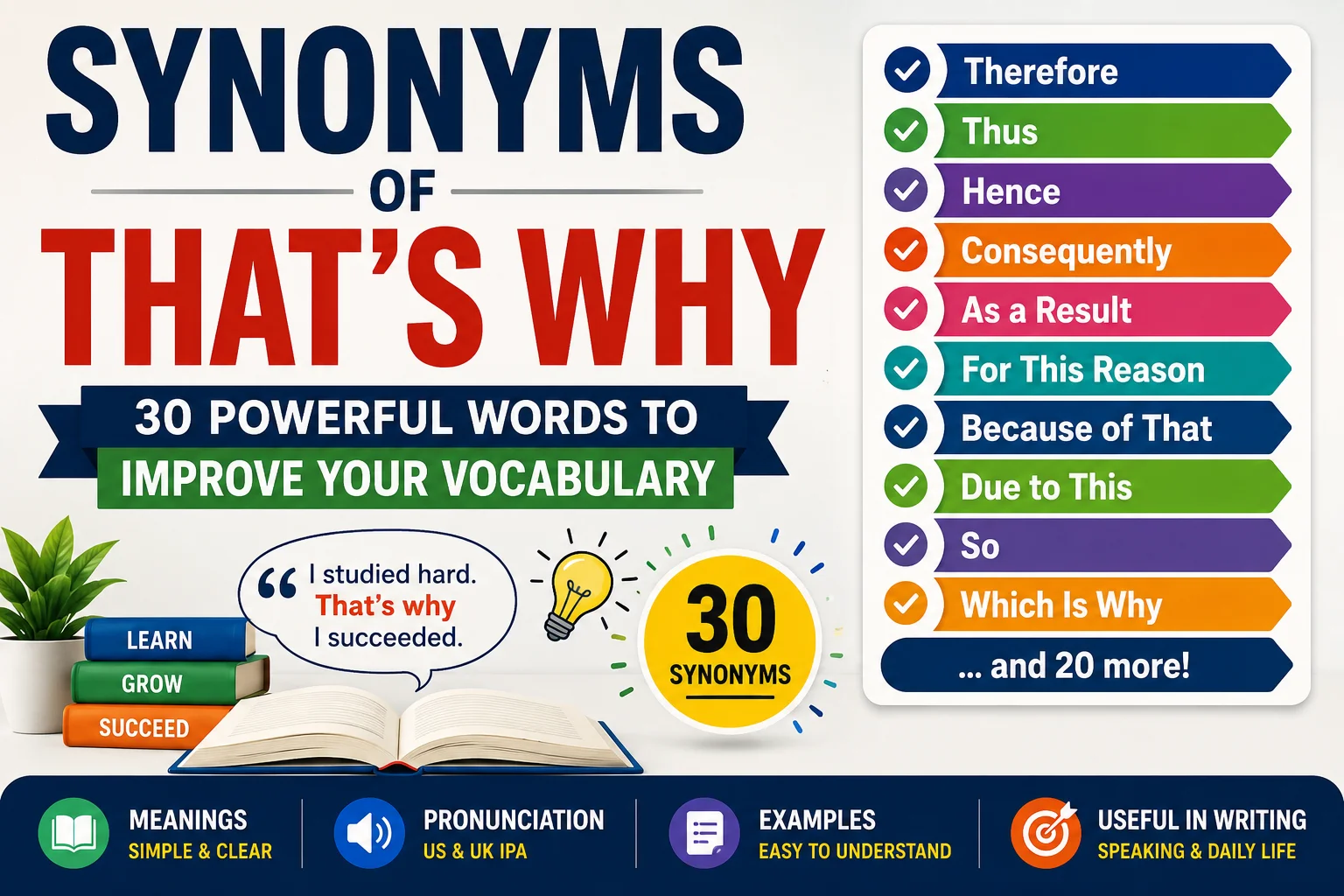
“That’s why” is a common English phrase used to explain the reason or result of something. People use it every day in conversations, emails, articles, and stories. For example, if you studied hard and passed your exam, you might say, “I studied every day. That’s why I passed.” This phrase helps connect ideas in a clear and natural way.
Learning synonyms of “that’s why” is useful because repeating the same phrase can make your writing sound dull. English learners, students, bloggers, and content writers can improve their vocabulary by using different expressions for different situations.
In this article, you will learn the meaning of “that’s why,” its pronunciation, grammar, history, connotation, and 30 useful synonyms with simple meanings and examples. By the end, you will be able to express reasons more naturally and confidently.
Meaning of That’s Why
Definition
That’s why (Phrase)
A phrase used to explain the reason, cause, or result of something that was mentioned before.
Examples
- I forgot to set my alarm. That’s why I was late for work.
- The weather was very cold. That’s why everyone stayed indoors.
Connotative Meaning
(Connotation means the emotional feeling or idea that a word or phrase suggests beyond its basic dictionary meaning.)
- Positive tone: Explains a happy or successful result.
- Negative tone: Explains a problem, mistake, or bad outcome.
- Neutral tone: Simply connects a reason with its result without emotion.
Etymology
- Source language: Modern English
- Original meaning: A combination of the words “that,” “is,” “why,” used to introduce the reason for something previously mentioned.
- It developed naturally in spoken English as a simple way to explain causes and results.
Short History of the Keyword
- Old English (450–1100): The words that and why existed separately but were not commonly used together as a fixed phrase.
- Middle English (1100–1500): Writers increasingly combined these words to explain reasons in stories and legal writing.
- Modern English (1500–Present): That’s why became one of the most common expressions for giving explanations in everyday speech and writing.
Pronunciation (US & UK – IPA)
US: /ðæts waɪ/
UK: /ðæts waɪ/
Syllables
That’s why
- that’s
- why
(Two spoken syllables)
Affixation Pattern of That’s Why
Root: that + why
Prefix: None
Suffix: None
Word Formation of the Keyword
- that (pronoun/determiner)
- is (verb – contracted as ‘s)
- why (adverb/interrogative word)
- that’s why (fixed explanatory phrase)
Synonyms of That’s Why
1. Therefore (Adverb)
US IPA | UK IPA
US: /ˈðer.fɔːr/
UK: /ˈðeə.fɔː/
Meaning
For that reason; as a result.
Examples
- She practiced every day; therefore, she improved quickly.
- The road was closed; therefore, we took another route.
2. Thus (Adverb)
US IPA | UK IPA
US: /ðʌs/
UK: /ðʌs/
Meaning
As a result or in this way.
Examples
- He missed the bus, thus arriving late.
- The team worked together, thus finishing early.
3. Hence (Adverb)
US IPA | UK IPA
US: /hens/
UK: /hens/
Meaning
For this reason.
Examples
- She was ill; hence, she stayed home.
- Prices increased; hence, fewer people bought the product.
4. Consequently (Adverb)
US IPA | UK IPA
US: /ˈkɑːn.sə.kwənt.li/
UK: /ˈkɒn.sɪ.kwənt.li/
Meaning
As a direct result.
Examples
- He ignored the warning; consequently, he got hurt.
- It rained all night; consequently, the match was canceled.
5. Accordingly (Adverb)
US IPA | UK IPA
US: /əˈkɔːr.dɪŋ.li/
UK: /əˈkɔː.dɪŋ.li/
Meaning
In a way that matches the situation.
Examples
- The plan changed, and we acted accordingly.
- Everyone received the news and responded accordingly.
6. As a Result (Phrase)
US IPA | UK IPA
US: /æz ə rɪˈzʌlt/
UK: /æz ə rɪˈzʌlt/
Meaning
Because of something that happened before.
Examples
- She worked hard. As a result, she earned a promotion.
- The road was icy. As a result, traffic moved slowly.
7. For This Reason (Phrase)
US IPA | UK IPA
US: /fɔːr ðɪs ˈriː.zən/
UK: /fə ðɪs ˈriː.zən/
Meaning
Because of the reason already mentioned.
Examples
- The machine was broken. For this reason, production stopped.
- He was tired. For this reason, he went to bed early.
8. Because of That (Phrase)
US IPA | UK IPA
US: /bɪˈkʌz əv ðæt/
UK: /bɪˈkɒz əv ðæt/
Meaning
Due to what happened earlier.
Examples
- The shop closed early. Because of that, we couldn’t buy groceries.
- She practiced daily. Because of that, she became confident.
9. Due to This (Phrase)
US IPA | UK IPA
US: /duː tə ðɪs/
UK: /djuː tə ðɪs/
Meaning
Because of this particular reason.
Examples
- Flights were delayed due to this storm.
- Due to this mistake, the report had to be rewritten.
10. As Such (Phrase)
US IPA | UK IPA
US: /æz sʌtʃ/
UK: /æz sʌtʃ/
Meaning
Therefore; considering what has already been stated.
Examples
- She is the team leader and, as such, makes the final decision.
- The project is complete and, as such, ready for review.
11. Because (Conjunction)
US IPA | UK IPA
US: /bɪˈkʌz/
UK: /bɪˈkɒz/
Meaning
Used to give the reason for something.
Examples
- She smiled because she was happy.
- We stayed inside because it was raining.
12. Since (Conjunction)
US IPA | UK IPA
US: /sɪns/
UK: /sɪns/
Meaning
Because; for the reason that.
Examples
- Since you are here, let’s begin the meeting.
- We left early since the weather looked bad.
13. As (Conjunction)
US IPA | UK IPA
US: /æz/
UK: /æz/
Meaning
Because; for the reason that.
Examples
- As it was getting late, we went home.
- She stayed quiet as she felt nervous.
14. So (Conjunction / Adverb)
US IPA | UK IPA
US: /soʊ/
UK: /səʊ/
Meaning
For that reason; therefore.
Examples
- I was tired, so I went to bed.
- The shop was closed, so we returned home.
15. Thereby (Adverb)
US IPA | UK IPA
US: /ðerˈbaɪ/
UK: /ðeəˈbaɪ/
Meaning
By that action or result.
Examples
- She exercised daily, thereby improving her health.
- He invested wisely, thereby increasing his savings.
16. In Consequence (Phrase)
US IPA | UK IPA
US: /ɪn ˈkɑːn.sə.kwəns/
UK: /ɪn ˈkɒn.sɪ.kwəns/
Meaning
As a result of something.
Examples
- The company lost money. In consequence, several projects stopped.
- The bridge was damaged. In consequence, traffic was diverted.
17. On That Account (Phrase)
US IPA | UK IPA
US: /ɑːn ðæt əˈkaʊnt/
UK: /ɒn ðæt əˈkaʊnt/
Meaning
For that reason.
Examples
- He was honest. On that account, everyone trusted him.
- The road was flooded. On that account, the school closed.
18. In View of This (Phrase)
US IPA | UK IPA
US: /ɪn vjuː əv ðɪs/
UK: /ɪn vjuː əv ðɪs/
Meaning
Considering this fact.
Examples
- In view of this evidence, the decision changed.
- In view of this problem, we need a new plan.
19. Owing to This (Phrase)
US IPA | UK IPA
US: /ˈoʊ.ɪŋ tə ðɪs/
UK: /ˈəʊ.ɪŋ tə ðɪs/
Meaning
Because of this.
Examples
- Owing to this delay, the train arrived late.
- Owing to this mistake, we started again.
20. That Explains It (Expression)
US IPA | UK IPA
US: /ðæt ɪkˈspleɪnz ɪt/
UK: /ðæt ɪkˈspleɪnz ɪt/
Meaning
An expression used when the reason becomes clear.
Examples
- You forgot your keys? That explains it.
- The power went out. That explains why the computer stopped.
21. As a Consequence (Phrase)
US IPA | UK IPA
US: /æz ə ˈkɑːn.sə.kwəns/
UK: /æz ə ˈkɒn.sɪ.kwəns/
Meaning
As the direct result of something.
Examples
- The company reduced costs. As a consequence, profits increased.
- He ignored the doctor’s advice. As a consequence, his condition became worse.
22. Which Is Why (Phrase)
US IPA | UK IPA
US: /wɪtʃ ɪz waɪ/
UK: /wɪtʃ ɪz waɪ/
Meaning
Used to introduce the reason for the statement before it.
Examples
- The road is under repair, which is why traffic is slow.
- She practiced every day, which is why she won the competition.
23. For That Reason (Phrase)
US IPA | UK IPA
US: /fɔːr ðæt ˈriː.zən/
UK: /fə ðæt ˈriː.zən/
Meaning
Because of the reason already mentioned.
Examples
- The weather was dangerous. For that reason, the event was canceled.
- He was well prepared. For that reason, he felt confident.
24. In Light of This (Phrase)
US IPA | UK IPA
US: /ɪn laɪt əv ðɪs/
UK: /ɪn laɪt əv ðɪs/
Meaning
Considering the information or situation.
Examples
- In light of this evidence, the case was reopened.
- In light of this success, we will continue the project.
25. Resultantly (Adverb)
US IPA | UK IPA
US: /rɪˈzʌl.tənt.li/
UK: /rɪˈzʌl.tənt.li/
Meaning
As a result; consequently.
Examples
- The factory closed. Resultantly, many workers lost their jobs.
- The rules changed. Resultantly, the process became easier.
26. Ergo (Adverb)
US IPA | UK IPA
US: /ˈɝː.ɡoʊ/
UK: /ˈɜː.ɡəʊ/
Meaning
Therefore; for that reason (formal and literary).
Examples
- He had no ticket; ergo, he could not enter.
- She met every requirement; ergo, she qualified.
27. Accordingly Then (Phrase)
US IPA | UK IPA
US: /əˈkɔːr.dɪŋ.li ðen/
UK: /əˈkɔː.dɪŋ.li ðen/
Meaning
Therefore; in a way that matches the situation.
Examples
- Everyone understood the new rules and acted accordingly then.
- We received fresh instructions and responded accordingly then.
28. This Is the Reason (Phrase)
US IPA | UK IPA
US: /ðɪs ɪz ðə ˈriː.zən/
UK: /ðɪs ɪz ðə ˈriː.zən/
Meaning
Used to explain the exact cause of something.
Examples
- This is the reason I arrived early.
- This is the reason many people prefer online learning.
29. Which Means (Phrase)
US IPA | UK IPA
US: /wɪtʃ miːnz/
UK: /wɪtʃ miːnz/
Meaning
Used to explain the result or implication of something.
Examples
- The train is delayed, which means we will arrive late.
- She passed every exam, which means she will graduate.
30. For This Cause (Phrase)
US IPA | UK IPA
US: /fɔːr ðɪs kɔːz/
UK: /fə ðɪs kɔːz/
Meaning
Because of this reason or cause (formal).
Examples
- For this cause, the committee approved the proposal.
- The evidence was incomplete. For this cause, the decision was delayed.
Prototype Meaning
The most common meaning of “that’s why” is to explain the reason for something that has already been mentioned. When people hear this phrase, they usually think of someone connecting a cause with its result. It is one of the easiest and most natural ways to explain why something happened in everyday English.
Prototype Categorization
Different synonyms of “that’s why” fit different situations. Choosing the right one makes your writing clearer and more natural.
- Formal writing: Therefore, Thus, Hence, Consequently, Ergo, Accordingly
- Academic writing: Consequently, Therefore, Hence, In Light of This, In View of This
- Business communication: Accordingly, As a Result, For That Reason, In Consequence
- Everyday conversation: So, Because of That, Which Is Why, That Explains It
- Storytelling: As a Consequence, Which Means, This Is the Reason
- Legal or official writing: Owing to This, For This Cause, On That Account
Using categories helps writers avoid repeating the same phrase. It also helps them choose a synonym that matches the tone, audience, and purpose of their writing.
Antonyms of That’s Why
- However (Conjunctive Adverb) – Introduces a contrast instead of a reason.
- Nevertheless (Adverb) – Shows that something happened despite a previous fact.
- Nonetheless (Adverb) – Means “even so” or “despite that.”
- Yet (Conjunction/Adverb) – Introduces an unexpected contrast.
- Although (Conjunction) – Shows contrast between two ideas.
- Though (Conjunction/Adverb) – Expresses contrast rather than cause.
- Even So (Phrase) – Means despite the previous statement.
- Regardless (Adverb) – Means without considering previous facts.
- Still (Adverb) – Indicates continuation despite a reason against it.
- On the Other Hand (Phrase) – Introduces an opposing idea.
Short Questions and Answers
- What does “that’s why” mean?
Answer:
“That’s why” is a phrase used to explain the reason or result of something mentioned earlier. It connects a cause with its effect in a simple and natural way.
- When should “that’s why” be used?
Answer:
Use “that’s why” when you want to explain why something happened. It is common in everyday conversations, school assignments, business emails, articles, and stories. It helps readers and listeners clearly understand the connection between a reason and its result.
- Is “that’s why” positive or negative?
Answer:
“That’s why” is neutral by itself. It does not express a positive or negative feeling. The tone depends on the situation.
Positive example:- She practiced every day. That’s why she became a great musician.
- Negative example:
- He ignored the warning. That’s why he made a mistake.
- Neutral example:
- The office opens at 9 a.m. That’s why we arrived early.
- How is “that’s why” different from similar words?
Answer:
“That’s why” is mainly used in everyday English to explain a reason in a friendly and natural way. Words like therefore, thus, hence, and consequently have the same basic meaning but are more common in formal, academic, scientific, or professional writing. Choosing the right expression depends on your audience and the style of writing.
Conclusion
Learning “that’s why” and its synonyms is an easy way to make your English stronger and more natural. Instead of repeating the same phrase, you can choose expressions like therefore, thus, because of that, as a result, or for that reason to match different situations and writing styles. This improves your vocabulary, makes your writing smoother, and helps your speaking sound more confident. It also allows you to explain causes and results more clearly in conversations, essays, emails, and professional documents. The more synonyms you learn and practice, the easier it becomes to communicate your ideas without repetition. Try using a new synonym every day, and over time your English vocabulary, writing skills, and confidence will continue to grow

I am a linguist with 15 years of experience in English language teaching, including postgraduate-level instruction. My expertise includes English grammar, and I contribute as a content and blog writer, producing scholarly and educational language resources.