Have you ever found yourself repeating the exact same phrase over and over when asking someone to prove a point or display something? Picture this: you are working on a team project, and you tell your teammate, “Can you show me what you mean by that?” Then, five minutes later, you ask them for synonyms of show me their latest report.
Using this exact combination of words works fine in casual conversations because everyone knows what it means. However, relying on it too often can make your writing and speaking feel plain and repetitive. Learning new vocabulary helps students, professionals, and writers express their ideas with exact detail.
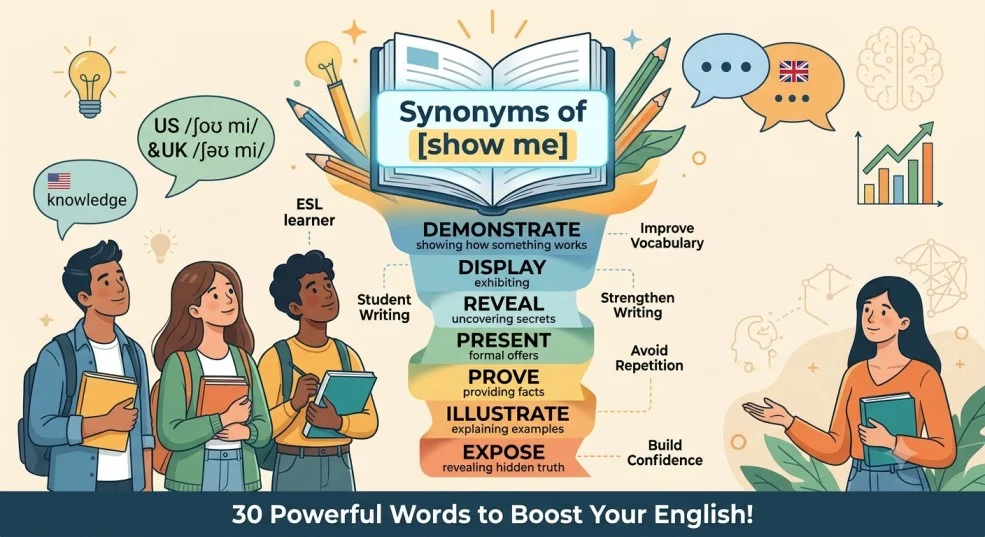
In this guide, you will learn the definition, grammar, origin, and pronunciation of this common request, followed by 30 strong alternative choices broken down by meaning and tone.
Meaning of Show Me
Definition
Show me (Verb Phrase):
To display, present, prove, or explain something to another person so they can see or understand it clearly.
Examples:
- Can you synonyms for showing me your new artwork when you finish it?
- Please show me how to fix this computer problem.
Connotative Meaning
Connotation is the emotional feeling or idea that a word carries beyond its exact literal dictionary definition.
- Positive tone: Expresses excitement, curiosity, learning, or a friendly request to see something nice.
- Negative tone: Expresses doubt, challenge, or demanding proof when you do not believe someone.
- Neutral tone: A direct, simple instruction to display an object, document, or step-by-step process without strong emotion.
Etymology
- Origin: Derived from Old English scawian (meaning “to look at, inspect, or watch”) combined with the Old English pronoun me (meaning “to or for me”).
- Old English (450–1100): The base verb was scawian, which originally meant looking closely at an object or paying attention to something.
- Middle English (1100–1500): The word evolved into schewen or showen, shifting its meaning from looking at something yourself to making something visible for another person to look at.
- Modern English (1500–Present): The phrase took on its modern form as a casual, direct verb phrase used daily in spoken and written English.
Pronunciation (US & UK – IPA)
- US: /ʃoʊ mi/
- UK: /ʃəʊ mi/
Syllables
show-me
Affixation Pattern of Show Me
- Root: show
- Prefix: None
- Suffix: None
Word Formation:
- Show (Verb): To display something to someone.
- Show (Noun): A public visual performance or display.
- Showy (Adjective): Having a grand or overly bright appearance.
- Showily (Adverb): Done in a way that attracts a lot of attention.
- Shower (Noun): A person who shows or displays something.
A List of Powerful Synonyms of Show Me
1. Demonstrate (Verb)
US: /ˈdɛm.ən.streɪt/ | UK: /ˈdɛm.ən.streɪt/
Meaning: To explain or show how something works by using actions or visual examples.
Examples:
- The teacher will demonstrate how to perform the science experiment safely.
- She used a mock setup to demonstrate her new software program.
2. Display (Verb)
US: /dɪˈspleɪ/ | UK: /dɪˈspleɪ/
Meaning: To put something in a place where people can easily see it.
Examples:
- The museum will display the old painting starting next week.
- He wanted to display his trophy collection in the living room.
3. Exhibit (Verb)
US: /ɪɡˈzɪb.ɪt/ | UK: /ɪɡˈzɪb.ɪt/
Meaning: To show something publicly in an exhibition, court, or formal space.
Examples:
- Local artists will exhibit their work at the community center tonight.
- The lawyer asked to exhibit the signed document to the jury.
4. Present (Verb)
US: /prɪˈzɛnt/ | UK: /prɪˈzɛnt
Meaning: To offer, show, or introduce something formally to an audience.
Examples:
- Our team needs to present the sales report to the manager.
- She will present her main research findings at the conference.
5. Reveal (Verb)
US: /rɪˈviːl/ | UK: /rɪˈviːl/
Meaning: To make something known or visible that was previously hidden.
Examples:
- The magician will reveal the secret behind his popular card trick.
- They pulled back the curtain to reveal the new car design.
6. Illustrate (Verb)
US: /ˈɪl.ə.streɪt/ | UK: /ˈɪl.ə.streɪt/
Meaning: To explain something by using picture evidence, diagrams, or clear examples.
Examples:
- The author used a personal story to illustrate his main point.
- Charts and graphs help illustrate complex financial details clearly.
7. Prove (Verb)
US: /pruːv/ | UK: /pruːv/
Meaning: To show that something is true by giving real facts and evidence.
Examples:
- You must prove your claim before everyone agrees with you.
- The test results prove that the new method works much faster.
8. Unveil (Verb)
US: /ʌnˈveɪl/ | UK: /ʌnˈveɪl/
Meaning: To show or introduce a new product or plan for the very first time.
Examples:
- The company plans to unveil its new smartphone model next month.
- The mayor will unveil the park statue during the town ceremony.
9. Expose (Verb)
US: /ɪkˈspoʊz/ | UK: /ɪkˈspəʊz/
Meaning: To uncover something so that it can be seen clearly by everyone.
Examples:
- The investigation helped expose the secret deal between the firms.
- Opening the box will expose the fragile items inside to sunlight.
10. Indicate (Verb)
US: /ˈɪn.dɪ.keɪt/ | UK: /ˈɪn.dɪ.keɪt/
Meaning: To point out or show something clearly using signs or markers.
Examples:
- Red arrows on the map indicate the best escape routes.
- High fever can indicate that your body is fighting a virus.
11. Clarify (Verb)
US: /ˈklɛr.ə.faɪ/ | UK: /ˈklær.ɪ.faɪ/
Meaning: To make something easier to understand by showing more details.
Examples:
- Could you clarify your last statement so everyone understands?
- The manager wrote a quick note to clarify the rules.
12. Explain (Verb)
US: /ɪkˈspleɪn/ | UK: /ɪkˈspleɪn/
Meaning: To make something clear by giving steps, reasons, or details.
Examples:
- Please explain how you solved that math problem so fast.
- He tried to explain his actions to his friends after class.
13. Uncover (Verb)
US: /ʌnˈkʌv.ɚ/ | UK: /ʌnˈkʌv.ə/
Meaning: To remove a cover from something or reveal hidden facts.
Examples:
- Archeologists hope to uncover ancient artifacts at this dig site.
- The reporter worked hard to uncover the true facts of the case.
14. Manifest (Verb)
US: /ˈmæn.ə.fɛst/ | UK: /ˈmæn.ɪ.fɛst/
Meaning: To show a quality, feeling, or idea clearly through signs or actions.
Examples:
- Her true talents manifest when she performs live on stage.
- Stress can manifest as physical pain if you do not rest.
15. Produce (Verb)
US: /prəˈduːs/ | UK: /prəˈdjuːs/
Meaning: To bring something out so that it can be examined or checked.
Examples:
- The officer asked the driver to produce his license and registration.
- You must produce your ticket before entering the theater hall.
16. Disclose (Verb)
US: /dɪsˈkloʊz/ | UK: /dɪsˈkləʊz/
Meaning: To share or show private information that was kept secret.
Examples:
- The firm refused to disclose confidential client data to the press.
- She decided to disclose her financial records during the review.
17. Depict (Verb)
US: /dɪˈpɪkt/ | UK: /dɪˈpɪkt/
Meaning: To represent or show something through drawing, painting, or words.
Examples:
- The paintings depict daily life in ancient historical times.
- The movie attempts to depict the hardship faced by early settlers.
18. Express (Verb)
US: /ɪkˈsprɛs/ | UK: /ɪkˈsprɛs/
Meaning: To show your thoughts, feelings, or ideas using words or gestures.
Examples:
- Artists often express their inner feelings through colorful artwork.
- He found it hard to express his true feelings in words.
19. Outline (Verb)
US: /ˈaʊt.laɪn/ | UK: /ˈaʊt.laɪn/
Meaning: To give a summary or show the main points of a plan.
Examples:
- The manager will outline the new schedule during our morning meeting.
- I will outline my essay ideas before I write the first draft.
20. Showcase (Verb)
US: /ˈʃoʊ.keɪs/ | UK: /ˈʃəʊ.keɪs/
Meaning: To present the best features of something in an attractive way.
Examples:
- The festival is a great place to showcase local musical talent.
- This portfolio will showcase your best design projects to clients.
21. Verify (Verb)
US: /ˈvɛr.ə.faɪ/ | UK: /ˈvɛr.ɪ.faɪ/
Meaning: To test, check, or prove that something is correct and true.
Examples:
- Please verify your email address to complete your account setup.
- The banker had to verify the signature on the check.
22. Portray (Verb)
US: /pɔːrˈtreɪ/ | UK: /pɔːˈtreɪ/
Meaning: To describe, play, or show a person or thing in a specific way.
Examples:
- The actor hopes to portray the hero accurately in the new movie.
- News reports portray the community leader as an honest person.
23. Feature (Verb)
US: /ˈfiː.tʃɚ/ | UK: /ˈfiː.tʃə/
Meaning: To give prominent attention or a special place to something.
Examples:
- The magazine will feature an interview with the top athlete.
- Tonight’s menu will feature fresh seafood dishes from the coast.
24. Unmask (Verb)
US: /ʌnˈmæsk/ | UK: /ʌnˈmɑːsk/
Meaning: To show the true identity, character, or nature of someone.
Examples:
- The detective managed to unmask the villain at the end of the story.
- Time will unmask fake friends when you face real challenges.
25. Evidence (Verb)
US: /ˈɛv.ə.dəns/ | UK: /ˈɛv.ɪ.dəns/
Meaning: To prove or give clear visual or physical signs of something.
Examples:
- Her rising test scores evidence her dedication to learning English.
- The broken glass helps evidence that a burglary took place.
26. Detail (Verb)
US: /dɪˈteɪl/ | UK: /ˈdiː.teɪl/
Meaning: To describe or show every part of something in a step-by-step way.
Examples:
- The safety manual will detail all rules you must follow carefully.
- She wrote a letter to detail her entire travel plan.
27. Spotlighting (Verb/Participle)
US: /ˈspɑːt.laɪt.ɪŋ/ | UK: /ˈspɒt.laɪt.ɪŋ/
Meaning: Directing public focus or special light toward a single object or topic.
Examples:
- The news crew is spotlighting local heroes who help clean up parks.
- The seminar is spotlighting simple ways to improve writing skills.
28. Air (Verb)
US: /ɛr/ | UK: /eə/
Meaning: To show, broadcast, or express something publicly on television, radio, or open space.
Examples:
- The station will air the new documentary program tonight.
- It is healthy to air your thoughts instead of keeping them hidden.
29. Bare (Verb)
US: /bɛr/ | UK: /beə/
Meaning: To uncover, expose, or show something that was previously covered.
Examples:
- The dog will bare its teeth when it senses a dangerous situation.
- He chose to bare his soul in his latest personal poem.
30. Model (Verb)
US: /ˈmɑː.dəl/ | UK: /ˈmɒd.əl/
Meaning: To show how an action or behavior should be done by doing it yourself.
Examples:
- Parents should model good eating habits for their young children.
- Teachers model proper pronunciation so students can repeat it correctly.
Prototype Meaning
The prototype meaning refers to the core mental picture that pops into your head when you hear the phrase. When people hear “show me,” they usually imagine holding up an object, pointing to a document, or physically doing an action so someone else can observe it with their eyes. It represents a direct request for visual or practical proof in a face-to-face setting.
Prototype Categorization
Grouping synonyms by category helps you quickly pick the right word for your specific setting. You can ask someone to synonyms for show me their work in many ways depending on your exact goal:
- Visual Display Words: Display, Exhibit, Showcase, Feature, Spotlighting. Use these when putting items on visual view.
- Explanation & Training Words: Demonstrate, Illustrate, Explain, Clarify, Model, Detail, Outline. Use these when teaching or breaking down steps.
- Proof & Fact Words: Prove, Verify, Evidence, Indicate. Use these when you need truth, facts, or confirmation.
- Discovery & Secret Words: Reveal, Unveil, Expose, Uncover, Disclose, Unmask, Bare. Use these when making hidden things known.
- Creative & Formal Words: Present, Depict, Portray, Express, Produce, Air. Use these for art, formal business, or performances.
Antonyms of Show Me
- Hide (Verb): To put something in a place where it cannot be seen by anyone.
- Conceal (Verb): To keep something secret or cover it up intentionally.
- Cover (Verb): To place something over an object to protect it or keep it hidden.
- Mask (Verb): To change or disguise something so its true nature remains hidden.
- Suppress (Verb): To prevent information or feelings from being seen, known, or expressed.
- Withhold (Verb): To keep back information or physical items without giving or showing them.
Short Questions and Answers
- What does “show me” mean?
- It means to display, present, or explain something so another person can see, check, or understand it clearly.
- When should “show me” be used?
- Use it in everyday, casual conversations when asking a friend, family member, or coworker to display an object or show an action.
- Is “show me” positive or negative?
- It is usually neutral, but it can sound positive when curious or negative if spoken as a demand.
- How is it different from similar words?
- It is a casual, spoken phrase. Words like demonstrate or exhibit carry a more formal tone suitable for academic or professional writing.
Conclusion
Expanding your English vocabulary beyond simple everyday phrases is one of the fastest ways to improve your communication skills. By replacing basic requests with precise alternatives like demonstrate, reveal, showcase, or verify, you immediately elevate the quality of your writing and speaking. Practicing these new terms helps you avoid boring repetition, convey exact emotional tones, and build real confidence in any professional or academic environment. Try adding two or three of these new words to your daily conversations or writing routines every day!

I am a linguist with 15 years of experience in English language teaching, including postgraduate-level instruction. My expertise includes English grammar, and I contribute as a content and blog writer, producing scholarly and educational language resources.