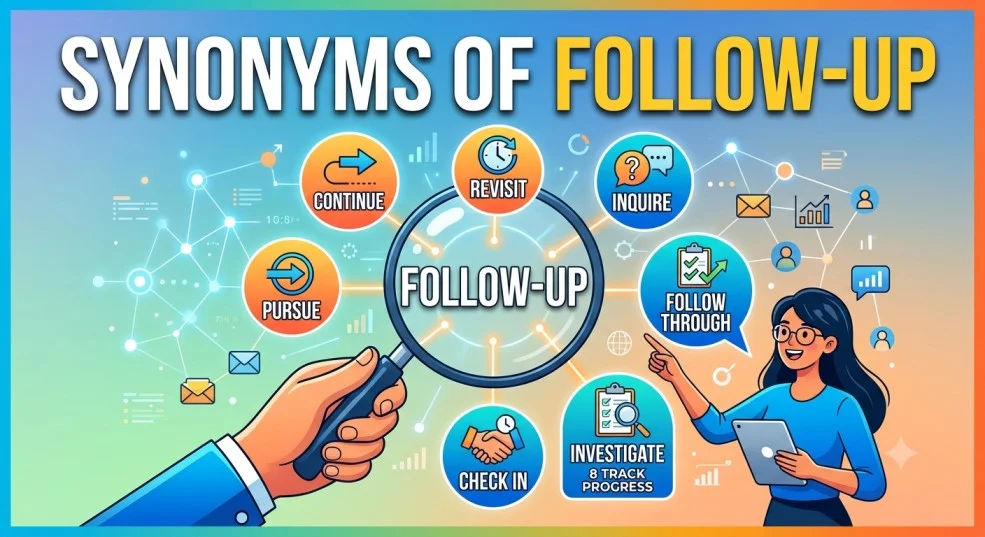
Imagine sending an important email to a client, but getting no response for days. You decide to send a polite reminder to check on their decision. This simple action is a classic follow up, which means taking further action on something started earlier. People use this phrase daily in offices, clinics, and school settings to track progress. However, repeating it over and over can make your writing dull.
Discovering a fresh synonym of follow up helps English learners and content writers build strong vocabulary. Varying your word choices keeps your content engaging and precise. This article explores the core meaning of our key phrase alongside 30 dynamic alternatives.
You will explore definitions, real-life examples, grammar patterns, historical roots, pronunciations, and semantic categories. By studying each synonym of follow up in depth, you will quickly expand your language skills across all writing contexts.
Meaning of Follow Up
Definition
Follow Up (Phrasal Verb / Noun / Adjective): To take extra action on a past matter or to check the status of a previous task.
Examples
- I will follow up with the manager tomorrow about my job application.
- The doctor scheduled a follow up visit to inspect my healing arm.
Connotative Meaning
(Connotation is the emotional tone or mental feeling a word carries beyond its literal dictionary definition.)
- Positive tone: Shows reliability, responsibility, professionalism, and commitment to completing a job.
- Negative tone: Can feel nagging, overly pushy, micromanaging, or annoying if done too often.
- Neutral tone: Standard administrative checking, routine tracking, or basic status updating.
Etymology
- Origin: Created by combining the Old English verb folgian (to go after or accompany) with the adverb up (expressing complete movement).
- Short History of the Keyword:
- Old English (450–1100): Folgian meant to go behind, accompany, or serve another person.
- Middle English (1100–1500): Evolved into folwen, keeping the core meaning of moving after something.
- Modern English (1500–Present): Combined into a single phrasal phrase in the 20th century for business and medical checks.
Pronunciation (US & UK – IPA)
- US: /ˈfɑː.loʊ ʌp/
- UK: /ˈfɒl.əʊ ʌp/
Syllables
- fol-low-up
Affixation Pattern of Follow Up
- Root: Follow
- Prefix: None
- Suffix: None (uses the particle up)
- Word Formation:
- Phrasal Verb: follow up (She needs to follow up with the customer.)
- Noun: follow-up (The doctor requested a quick follow-up.)
- Adjective: follow-up (He sent a follow-up email this morning.)
A List of Wonderful Synonyms of Follow Up
1. Pursue (Verb)
US: /pɚˈsuː/ | UK: /pəˈsjuː/
Meaning: To follow or work on a goal until you reach a clear result.
Examples:
- We must pursue this business opportunity with energy.
- The detective will pursue every lead in the case.
2. Check (Verb)
US: /tʃɛk/ | UK: /tʃɛk/
Meaning: To inspect something carefully to verify its current condition or status.
Examples:
- Please check on the shipping status of our new order.
- I need to check with my team before committing.
3. Trace (Verb)
US: /treɪs/ | UK: /treɪs/
Meaning: To find or track the path, source, or development of something step by step.
Examples:
- Technicians will trace the computer system error to its source.
- The historian tried to trace the old document’s history.
4. Investigate (Verb)
US: /ɪnˈvɛstəˌɡeɪt/ | UK: /ɪnˈvɪstɪɡeɪt/
Meaning: To search for facts to discover the truth about a situation.
Examples:
- Officers will investigate the strange incident immediately.
- Scientists continue to investigate new ways to save energy.
5. Revisit (Verb)
US: /riːˈvɪzɪt/ | UK: /riːˈvɪzɪt/
Meaning: To consider or discuss a topic again after some time has passed.
Examples:
- Let us revisit our project plans during next week’s meeting.
- The committee decided to revisit the budget decision.
6. Review (Verb)
US: /rɪˈvjuː/ | UK: /rɪˈvjuː/
Meaning: To examine something closely to make corrections or reach a judgment.
Examples:
- The editor will review your essay before publication.
- We must review our sales performance every month.
7. Monitor (Verb)
US: /ˈmɑːnɪtər/ | UK: /ˈmɒnɪtə/
Meaning: To observe and record progress or quality over a period of time.
Examples:
- Nurses monitor the patient’s vital signs every hour.
- Teachers monitor classroom progress during independent study.
8. Track (Verb)
US: /træk/ | UK: /træk/
Meaning: To follow the progress, path, or development of a project or item.
Examples:
- Customers can track their packages using an online code.
- Our app helps you track your daily exercise habits.
9. Evaluate (Verb)
US: /ɪˈvæljuˌeɪt/ | UK: /ɪˈvæljueɪt/
Meaning: To judge the quality, value, or success of something after testing.
Examples:
- Experts will evaluate the safety of the new bridge.
- We need to evaluate all job applicants fairly.
10. Continue (Verb)
US: /kənˈtɪnjuː/ | UK: /kənˈtɪnjuː/
Meaning: To keep going with an action without stopping or after a brief pause.
Examples:
- Please continue your hard work on this assignment.
- The rain will continue throughout the entire evening.
11. Recheck (Verb)
US: /riːˈtʃɛk/ | UK: /riːˈtʃɛk/
Meaning: To inspect or test something a second time to ensure accuracy.
Examples:
- Always recheck your answers before turning in your test.
- The mechanic had to recheck the tire pressure.
12. Clarify (Verb)
US: /ˈklærəˌfaɪ/ | UK: /ˈklærɪfaɪ/
Meaning: To make a statement clearer and easier to understand by giving details.
Examples:
- I called the client to clarify our project deadline.
- The teacher used an example to clarify the difficult rule.
13. Audit (Verb)
US: /ˈɔːdɪt/ | UK: /ˈɔːdɪt/
Meaning: To perform an official, systematic review of records or procedures.
Examples:
- An outside firm will audit our company accounts this spring.
- We routinely audit our safety measures to keep workers safe.
14. Probe (Verb)
US: /proʊb/ | UK: /prəʊb/
Meaning: To ask detailed questions or investigate deeply to gather hidden facts.
Examples:
- Journalists began to probe into the political scandal.
- The doctor used a tool to probe the wound carefully.
15. Reexamine (Verb)
US: /ˌriːɪɡˈzæmɪn/ | UK: /ˌriːɪɡˈzæmɪn/
Meaning: To look at or think about a decision again with fresh eyes.
Examples:
- Leaders must reexamine their strategy after losing market share.
- The judge decided to reexamine the original trial evidence.
16. Assess (Verb)
US: /əˈsɛs/ | UK: /əˈsɛs/
Meaning: To judge the condition, quality, or importance of a situation carefully.
Examples:
- The team will assess the storm damage tomorrow morning.
- Teachers assess student learning through weekly quizzes.
17. Inspect (Verb)
US: /ɪnˈspɛkt/ | UK: /ɪnˈspɛkt/
Meaning: To look at something very closely to check for damage or mistakes.
Examples:
- Inspectors will inspect the factory equipment for safety.
- Custom agents inspect all incoming luggage at the airport.
18. Oversee (Verb)
US: /ˌoʊvərˈsiː/ | UK: /ˌəʊvəˈsiː/
Meaning: To manage, watch, and direct a project to ensure it is done correctly.
Examples:
- A senior manager will oversee the construction work.
- She was hired to oversee daily office tasks.
19. Supervise (Verb)
US: /ˈsuːpərˌvaɪz/ | UK: /ˈsuːpəvaɪz/
Meaning: To watch over people or tasks to make sure everything is safe and correct.
Examples:
- Lifeguards supervise children playing in the pool.
- He will supervise the team during the afternoon shift.
20. Confirm (Verb)
US: /kənˈfɚm/ | UK: /kənˈfɜːm/
Meaning: To state or show that a fact or agreement is definitely true or settled.
Examples:
- Please call the clinic to confirm your appointment time.
- The email was sent to confirm our hotel booking.
21. Contact (Verb)
US: /ˈkɑːntækt/ | UK: /ˈkɒntækt/
Meaning: To reach out and communicate with someone by phone, email, or letter.
Examples:
- I will contact customer service to solve my issue.
- You can contact our support team at any time.
22. Interrogate (Verb)
US: /ɪnˈtɛrəˌɡeɪt/ | UK: /ɪnˈtɛrəɡeɪt/
Meaning: To ask someone a series of urgent and intense questions formally.
Examples:
- Detectives brought in the suspect to interrogate him.
- The committee will interrogate the witness tomorrow.
23. Scrutinize (Verb)
US: /ˈskruːtn̩ˌaɪz/ | UK: /ˈskruːtɪnaɪz/
Meaning: To examine every small detail of something with extreme care.
Examples:
- Lawyers will scrutinize every word in the legal contract.
- The editor had to scrutinize the document for typos.
24. Study (Verb)
US: /ˈstʌdi/ | UK: /ˈstʌdi/
Meaning: To devote time and attention to gaining knowledge or analyzing data.
Examples:
- Doctors study patient records to find the best treatment.
- We must study the market trends before launching our product.
25. Note (Verb)
US: /noʊt/ | UK: /nəʊt/
Meaning: To pay attention to something specific and record it for later reference.
Examples:
- Please note any changes in the schedule on your calendar.
- The doctor will note your symptoms in your chart.
26. Verify (Verb)
US: /ˈvɛrəˌfaɪ/ | UK: /ˈvɛrɪfaɪ/
Meaning: To test or confirm that information is accurate and true.
Examples:
- The bank must verify your phone number before sending money.
- Always verify news stories before sharing them online.
27. Search (Verb)
US: /sɝːtʃ/ | UK: /sɜːtʃ/
Meaning: To look through a space or record carefully to find something lost or hidden.
Examples:
- Rescue workers search the area for lost hikers.
- I need to search my computer for the missing file.
28. Tail (Verb)
US: /teɪl/ | UK: /teɪl/
Meaning: To follow someone closely and secretly to track their actions.
Examples:
- Private investigators decided to tail the suspect.
- The police car had to tail the target vehicle quietly.
29. Hound (Verb)
US: /haʊnd/ | UK: /haʊnd/
Meaning: To pursue or ask someone repeatedly without giving them rest.
Examples:
- Photographers started to hound the famous actor outside his home.
- Debt collectors will hound people who miss late payments.
30. Shadow (Verb)
US: /ˈʃædoʊ/ | UK: /ˈʃædəʊ/
Meaning: To accompany and observe someone closely to learn their work routines.
Examples:
- New workers shadow experienced employees during training week.
- An intern will shadow the lead surgeon all afternoon.
Prototype Meaning
The most typical meaning of this term refers to re-contacting someone or re-checking a task to move it to completion. When people hear this phrase, they usually picture a polite professional sending a reminder email, a doctor checking on a recovering patient, or a manager holding a short status meeting.
Prototype Categorization
Grouped categories make it easy to select the right synonym of follow up for any writing context:
- Routine Workplace Tracking: Check, Review, Monitor, Track, Revisit, Confirm.
- Using these terms keeps your daily emails professional and clean.
- Deep Evaluation & Inspection: Investigate, Audit, Assess, Evaluate, Inspect, Scrutinize, Reexamine, Verify.
- These options suit formal reports and analytical research.
- Direct Communication: Contact, Clarify, Probe.
- Choosing a direct communication synonym of follow up helps clarify your intent when writing to clients.
- Persistent Pursuit & Observation: Pursue, Tail, Hound, Shadow, Interrogate.
- These active words work best in storytelling, news reports, or intense contexts.
Finding a precise synonym of follow up ensures your writing matches the exact level of formality required.
Antonyms of Follow Up
Abandon (Verb)
To stop pursuing, caring for, or working on a task completely.
Neglect (Verb)
To fail to check on, care for, or attend to a responsibility.
Ignore (Verb)
To deliberately refuse to pay attention to or answer incoming information.
Drop (Verb)
To stop an action, project, or communication path suddenly without finishing.
Discontinue (Verb)
To bring an ongoing operation, process, or regular check to a complete end.
Short Questions and Answers
What does follow up mean?
- It means taking further action, making a status check, or continuing communication regarding a matter started earlier.
When should follow up be used?
- Use it when checking progress on a project, sending an email reminder, or conducting a routine medical check.
Is follow up positive or negative?
- It is usually positive because it shows reliability and care, but it can feel negative if it turns into constant nagging.
How is it different from similar words?
- While words like investigate mean searching for secret clues, our keyword simply focuses on keeping progress moving smoothly.
CONCLUSION
Learning how to choose a fresh synonym of follow up greatly enriches your vocabulary and strengthens your overall communication skills. By swapping repetitive phrases for targeted words like pursue, monitor, scrutinize, or clarify, your writing becomes dynamic and clear. Using varied terms helps you avoid boring repetition while building strong English confidence across both spoken and written formats. Regular vocabulary practice empowers you to express complex ideas easily in any professional or academic setting. Make it a daily goal to practice these 30 alternatives in your emails, essays, and everyday conversations.

I am a linguist with 15 years of experience in English language teaching, including postgraduate-level instruction. My expertise includes English grammar, and I contribute as a content and blog writer, producing scholarly and educational language resources.