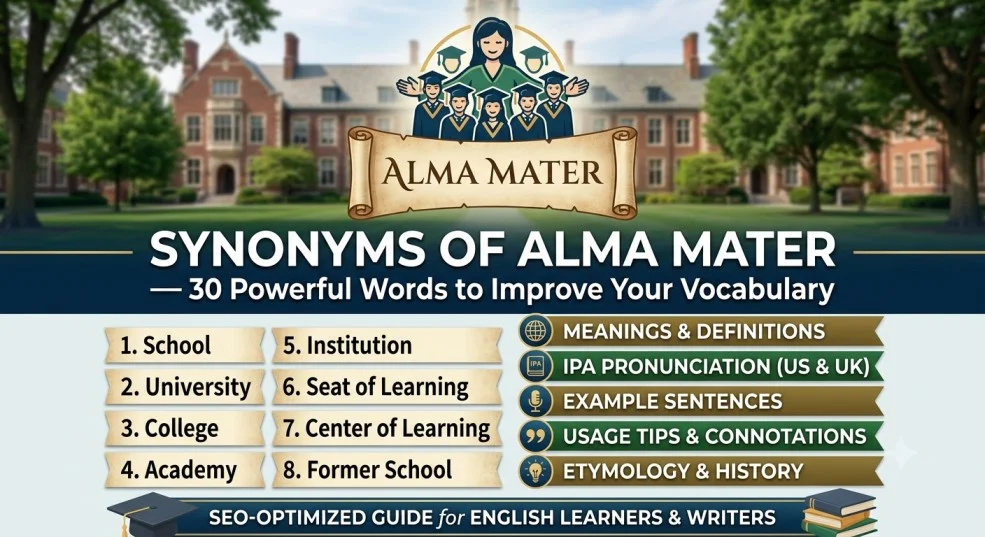
When Sarah returned to her college campus ten years after graduation, she walked through the familiar brick archways with a deep sense of pride and nostalgia. She smiled as she looked at the library where she spent long nights studying, feeling a warm connection to her alma mater. An alma mater is the school, college, or university that a person once attended. People commonly use this term when reflecting on their student days, attending alumni events, or writing professional biographie.
Learning synonyms for alma mater is essential for English language learners and content writers who want to enrich their vocabulary and express educational connections precisely. Repeating the same term over and over can make essays and articles feel monotonous. This comprehensive guide discusses the definition, emotional connotations, origin, pronunciation, and grammar structure of alma mater.
You will also explore 30 related words categorized by context to help you write with greater clarity and confidence.
Meaning of Alma Mater
Definition
Alma Mater (Noun):
The school, college, or university that a person graduated from or attended, or the official song of that school.
Examples
- She donated a large sum of money to her alma mater to fund new science laboratories.
- After thirty years, the former classmates gathered at their alma mater for a joyful reunion.
Connotative Meaning
(Connotation is the emotional feeling, tone, or cultural association that a word carries beyond its literal dictionary definition.)
- Positive tone: Expresses deep respect, fondness, nostalgia, and pride toward one’s former school.
- Negative tone: Rarely used negatively, though it can sound overly formal, elitist, or pretentious if used in very casual everyday conversation.
- Neutral tone: Serves as a standard, objective term in resume writing, academic biographies, and journalism.
Etymology
- Origin: Borrowed directly from Latin, where alma means “nourishing” or “kind” and mater means “mother.”
- Old English (450–1100): The term did not exist in Old English, as Latin terms were primarily restricted to classical church scholars.
- Middle English (1100–1500): Latin scholars used the phrase religiously to refer to nourishing figures or patron saints, but not yet to physical schools.
- Modern English (1500–Present): Adopted into English during the 17th century, specifically starting at the University of Cambridge, to metaphorically describe a university as an “intellectual mother” that nourishes students with knowledge.
Pronunciation (US & UK – IPA)
- US: /ˈɑːl.mə ˈmɑː.t̬ɚ/
- UK: /ˌæl.mə ˈmɑː.tə/
Syllables
al-ma ma-ter
Affixation Pattern of Alma Mater
- Root: Alma (nourishing) + Mater (mother)
- Prefix: None
- Suffix: None
- Alma maters (Noun — plural form)
A List of Wonderful Synonyms of Alma Mater
1. School (Noun)
- US IPA: /skuːl/ | UK IPA: /skuːl/
- Meaning: An institution where people go to learn skills and gain knowledge.
- Examples:
- He returned to his old school to speak to the students.
- She has great memories of her time at primary school.
2. College (Noun)
- US IPA: /ˈkɑː.lɪdʒ/ | UK IPA: /ˈkɒl.ɪdʒ/
- Meaning: An institution of higher education where students study for degrees.
- Examples:
- Her college offered excellent programs in engineering.
- He visited his former college campus over the weekend.
3. University (Noun)
- US IPA: /ˌjuː.nəˈvɝː.sə.t̬i/ | UK IPA: /ˌjuː.nɪˈvɜː.sə.ti/
- Meaning: A high-level educational institution where students study for advanced degrees and conduct research.
- Examples:
- She was proud to graduate from a top university.
- His university invited him back to deliver a lecture.
4. Academy (Noun)
- US IPA: /əˈkæd.ə.mi/ | UK IPA: /əˈkæd.ə.mi/
- Meaning: A school or college that provides specialized training in a specific field.
- Examples:
- The military academy trained many great leaders.
- She completed her studies at a prestigious arts academy.
5. Institution (Noun)
- US IPA: /ˌɪn.stəˈtuː.ʃən/ | UK IPA: /ˌɪn.stɪˈtjuː.ʃən/
- Meaning: A large, established organization created for educational or social purposes.
- Examples:
- The educational institution celebrated its hundredth anniversary.
- He dedicated years of service to his academic institution.
6. Center of Learning (Noun Phrase)
- US IPA: /ˈsen.t̬ɚ ʌv ˈlɝː.nɪŋ/ | UK IPA: /ˈsen.tə ɒv ˈlɜː.nɪŋ/
- Meaning: A place dedicated to education, research, and intellectual development.
- Examples:
- The city established a new center of learning for adult students.
- That ancient library was once the primary center of learning in the region.
7. Seat of Learning (Noun Phrase)
- US IPA: /siːt ʌv ˈlɝː.nɪŋ/ | UK IPA: /siːt ɒv ˈlɜː.nɪŋ/
- Meaning: A university or school renowned for academic tradition and scholarship.
- Examples:
- Oxford is recognized globally as a historic seat of learning.
- Scholars gathered at the famous seat of learning for the conference.
8. Educational Institution (Noun Phrase)
- US IPA: /ˌedʒ.əˈkeɪ.ʃən.əl ˌɪn.stəˈtuː.ʃən/ | UK IPA: /ˌedʒ.ʊˈkeɪ.ʃən.əl ˌɪn.stɪˈtjuː.ʃən/
- Meaning: A formal establishment that provides structured learning and instruction.
- Examples:
- Every educational institution must maintain high safety standards.
- She researched various options before choosing an educational institution.
9. Secondary School (Noun Phrase)
- US IPA: /ˈsek.ən.der.i skuːl/ | UK IPA: /ˈsek.ən.dri skuːl/
- Meaning: A school for young people between the ages of eleven and eighteen.
- Examples:
- He made lifelong friends during his years at secondary school.
- Her former secondary school built a new sports complex.
10. High School (Noun Phrase)
- US IPA: /ˈhaɪ ˌskuːl/ | UK IPA: /ˈhaɪ ˌskuːl/
- Meaning: A school for students in the upper grades, typically ages fourteen to eighteen.
- Examples:
- They organized a reunion for their high school graduating class.
- My old high school coach invited me to watch the game.
11. Graduate School (Noun Phrase)
- US IPA: /ˈɡrædʒ.u.ət ˌskuːl/ | UK IPA: /ˈɡrædʒ.u.ət ˌskuːl/
- Meaning: An advanced university division offering master’s and doctoral degrees.
- Examples:
- She was accepted into her dream graduate school for law.
- He looks back fondly on his rigorous days in graduate school.
12. Seminary (Noun)
- US IPA: /ˈsem.ə.ner.i/ | UK IPA: /ˈsem.ɪ.nər.i/
- Meaning: A college or school that prepares students to become religious leaders.
- Examples:
- The priest spoke highly of his formative years at the seminary.
- She studied theology at a famous local seminary.
13. Institute (Noun)
- US IPA: /ˈɪn.stə.tuːt/ | UK IPA: /ˈɪn.stɪ.tjuːt/
- Meaning: An organization created to promote specific technical, scientific, or artistic work.
- Examples:
- He graduated from a renowned research institute.
- The technology institute funded her innovative project.
14. Faculty (Noun)
- US IPA: /ˈfæk.əl.ti/ | UK IPA: /ˈfæk.əl.ti/
- Meaning: A department or group of departments in a university devoted to a specific field.
- Examples:
- She maintains strong ties with the medical faculty where she trained.
- The law faculty hosted an event for former students.
15. Hall of Learning (Noun Phrase)
- US IPA: /hɑːl ʌv ˈlɝː.nɪŋ/ | UK IPA: /hɔːl ɒv ˈlɜː.nɪŋ/
- Meaning: A poetic phrase describing a place devoted to academic study.
- Examples:
- Students walked quietly through the grand hall of learning.
- He gained invaluable wisdom within that venerable hall of learning.
16. Lyceum (Noun)
- US IPA: /laɪˈsiː.əm/ | UK IPA: /laɪˈsiː.əm/
- Meaning: A school or institution providing formal secondary or preparatory education.
- Examples:
- The town preserved its historic lyceum building for community events.
- She received classical instruction at the local lyceum.
17. Training Ground (Noun Phrase)
- US IPA: /ˈtreɪ.nɪŋ ˌɡraʊnd/ | UK IPA: /ˈtreɪ.nɪŋ ˌɡraʊnd/
- Meaning: A place or situation that prepares individuals for future careers or challenges.
- Examples:
- The student newspaper served as a great training ground for her career.
- That university acted as an ideal training ground for young scientists.
18. Place of Education (Noun Phrase)
- US IPA: /pleɪs ʌv ˌedʒ.əˈkeɪ.ʃən/ | UK IPA: /pleɪs ɒv ˌedʒ.ʊˈkeɪ.ʃən/
- Meaning: Any location or building where teaching and learning occur.
- Examples:
- Every child deserves access to a safe place of education.
- She remembers her first place of education with deep affection.
19. Nursery School (Noun Phrase)
- US IPA: /ˈnɝː.sɚ.i ˌskuːl/ | UK IPA: /ˈnɜː.sər.i ˌskuːl/
- Meaning: A school for very young children, typically aged two to five.
- Examples:
- The teacher visited her old nursery school to donate books.
- His earliest memories began at nursery school.
20. Primary School (Noun Phrase)
- US IPA: /ˈpraɪ.mer.i ˌskuːl/ | UK IPA: /ˈpraɪ.mər.i ˌskuːl/
- Meaning: A school for children in the earliest stages of basic education.
- Examples:
- Her former primary school principal greeted her warmly.
- He wrote a letter of thanks to his old primary school.
21. Alma Mater Song (Noun Phrase)
- US IPA: /ˈɑːl.mə ˈmɑː.t̬ɚ sɑːŋ/ | UK IPA: /ˌæl.mə ˈmɑː.tə sɒŋ/
- Meaning: The official anthem or traditional song of a school or university.
- Examples:
- The crowd stood and sang the alma mater song during graduation.
- Everyone knew the words to their alma mater song.
22. Former School (Noun Phrase)
- US IPA: /ˈfɔːr.mɚ skuːl/ | UK IPA: /ˈfɔː.mə skuːl/
- Meaning: The educational institution that a student attended in the past.
- Examples:
- She maintains strong connections with her former school.
- His former school invited him back as a guest speaker.
23. Old School (Noun Phrase)
- US IPA: /oʊld skuːl/ | UK IPA: /əʊld skuːl/
- Meaning: The school or college that a person attended previously.
- Examples:
- He drove past his old school to show his children where he studied.
- She regularly attends events organized by her old school.
24. Grade School (Noun Phrase)
- US IPA: /ˈɡreɪd ˌskuːl/ | UK IPA: /ˈɡreɪd ˌskuːl/
- Meaning: An elementary school for young children in basic grades.
- Examples:
- They have been close friends since their early days in grade school.
- My grade school building was renovated last summer.
25. Boarding School (Noun Phrase)
- US IPA: /ˈbɔːr.dɪŋ ˌskuːl/ | UK IPA: /ˈbɔː.dɪŋ ˌskuːl/
- Meaning: A school where pupils live and study during the academic term.
- Examples:
- Living at a boarding school taught him independence at an early age.
- She returned to her boarding school for the alumni weekend.
26. Prep School (Noun Phrase)
- US IPA: /ˈprep ˌskuːl/ | UK IPA: /ˈprep ˌskuːl/
- Meaning: An independent private school that prepares students for higher education.
- Examples:
- He credits his academic discipline to his time at prep school.
- Her prep school had a strong reputation for academic excellence.
27. Polytechnic (Noun)
- US IPA: /ˌpɑː.liˈtek.nɪk/ | UK IPA: /ˌpɒl.iˈtek.nɪk/
- Meaning: An institution offering higher education in technical and vocational subjects.
- Examples:
- She earned her engineering diploma from a prestigious polytechnic.
- His former polytechnic expanded its computer science department.
28. Conservatory (Noun)
- US IPA: /kənˈsɝː.və.tɔːr.i/ | UK IPA: /kənˈsɜː.və.tr.i/
- Meaning: A school giving specialized instruction in music or the performing arts.
- Examples:
- The violinist spoke fondly of her time at the music conservatory.
- He returned to his old conservatory to mentor young musicians.
29. School House (Noun)
- US IPA: /ˈskuːl.haʊs/ | UK IPA: /ˈskuːl.haʊs/
- Meaning: A building used as a school, particularly in small or historical communities.
- Examples:
- The historic brick school house was converted into a museum.
- She loved studying in the quiet, cozy school house.
30. Mother School (Noun Phrase)
- US IPA: /ˈmʌð.ɚ ˌskuːl/ | UK IPA: /ˈmʌð.ə ˌskuːl/
- Meaning: A literal translation of “alma mater” describing the school that educated a person.
- Examples:
- The scholar always expressed deep gratitude toward his mother school.
- That university serves as the mother school for thousands of successful professionals.
Prototype Meaning
When people hear the term alma mater, they typically picture an established university or college characterized by historic brick or stone buildings, sprawling green lawns, traditional libraries, and graduation ceremonies. The mental image usually involves warm feelings of nostalgia, academic pride, personal growth, and long-lasting friendships formed during transformative young adult years.
Prototype Categorization
Grouping synonyms into specific semantic categories helps writers choose the most accurate term for any context:
- General Educational Terms: School, College, University, Institution. Use these standard words for straightforward, non-emotional everyday statements.
- Level-Specific Schools: Primary School, Secondary School, High School, Graduate School. Use these terms when you need to specify the exact educational stage.
- Specialized & Vocational Institutions: Academy, Seminary, Institute, Polytechnic, Conservatory. Use these words when referring to specialized training in fields like art, religion, music, or science.
- Poetic & Figurative Descriptions: Seat of Learning, Center of Learning, Hall of Learning, Training Ground, Mother School. Use these elevated phrases to create vivid, formal, or inspiring written descriptions.
Understanding these categories allows content creators to avoid repetitive phrasing while selecting words that perfectly match the desired tone.
Antonyms of Alma Mater
Antonyms
- Workplace (Noun): A building or location where people perform jobs rather than study.
- Self-Education (Noun): Learning acquired on one’s own without attending a formal school or university.
- Prison (Noun): An institution designed for punishment rather than personal development or academic learning.
- Ignorance (Noun): A state of lacking knowledge, learning, or educational development.
Short Questions and Answers
Questions and Answers
- What does alma mater mean?
- An alma mater is the school, college, or university that a person previously attended or graduated from.
- When should alma mater be used?
- Use alma mater in formal, academic, or nostalgic contexts when discussing your past education, attending alumni reunions, or writing professional biographies.
- Is alma mater positive or negative?
- The term is overwhelmingly positive or neutral, expressing feelings of pride, affection, and academic respect toward one’s former institution.
- How is it different from similar words?
- Terms like school or university simply name a physical place, whereas alma mater specifically highlights a personal, historical relationship between a former student and their school.
Conclusion
Mastering alma mater and its broad range of synonyms significantly expands your English vocabulary and enhances your communication skills. Using precise words like seat of learning, academy, or institution helps you avoid repetitive language, keeps your audience engaged, and adds elegance to your writing. Whether you are drafting a professional resume, crafting a compelling essay, or sharing personal stories, choosing the right term allows you to communicate with clarity and sophistication. Make daily vocabulary expansion a habit to build lasting confidence in your spoken and written English.

I am a linguist with 15 years of experience in English language teaching, including postgraduate-level instruction. My expertise includes English grammar, and I contribute as a content and blog writer, producing scholarly and educational language resources.