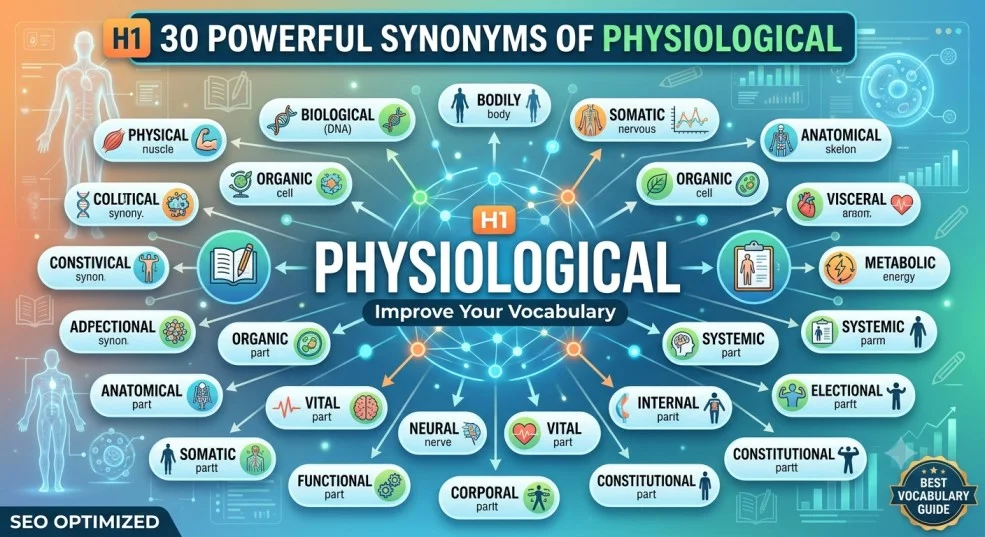
Examples and Explanation
When you run fast up a steep hill, your heart beats rapidly, your lungs expand, and your body sweats to cool down. All of these automatic actions are natural body functions. If you want to describe how living bodies work, you use the word physiological. People use the word physiological often in medicine, health, fitness, and daily life because every living creature experiences physical body processes.
Learning strong synonyms for physiological is essential for English learners and content writers who want to enrich their language skills. Using varied vocabulary prevents boring repetition, improves reader engagement, and makes writing clear.
This article explores the full meaning of physiological and its best synonyms, providing clear examples, grammar rules, word origins, pronunciations, and semantic categories written in simple sentences.
Meaning of Physiological
Definition
Physiological (Adjective): Related to the normal physical and biological functions of living organisms and their body parts.
Examples
- Proper sleep is essential to maintain healthy physiological functions.
- Cold weather causes a physiological response in human skin.
Connotative Meaning
(Connotation is the emotional feeling or idea that a word brings to mind alongside its literal definition.)
- Positive tone: Healthy physical functioning, normal biological balance, natural vitality.
- Negative tone: Bodily strain, physical pain reactions, stress responses under harsh conditions.
- Neutral tone: Scientific body processes, biological functions, anatomical mechanisms.
Etymology
- Source language: Ancient Greek.
- Original meaning: Derived from physis (meaning nature) and logos (meaning study or discourse).
- Old English (450–1100): The word did not exist in Old English, as people used simple Germanic terms for the human body.
- Middle English (1100–1500): Early medical ideas began entering the language through Latin and Old French texts.
- Modern English (1500–Present): The term entered Modern English around 1600 to describe natural science and later narrowed in the 1800s to describe bodily functions.
Pronunciation (US & UK – IPA)
- US: /ˌfɪz.i.əˈlɑː.dʒɪ.kəl/
- UK: /ˌfɪz.i.əˈlɒdʒ.ɪ.kəl/
Syllables
phys-i-o-log-i-cal
Affixation Pattern of Physiological
- Root: Physio (Nature or Body) + Log (Study)
- Prefix: None
- Suffix: -ical (Adjective-forming suffix)
- Physiology (Noun)
- Physiologist (Noun)
- Physiologically (Adverb)
- Physio (Noun – Informal)
A List of Best Synonyms of Physiological
1. Physical (Adjective)
- US: /ˈfɪz.ɪ.kəl/ | UK: /ˈfɪz.ɪ.kəl/
- Meaning: Relating to the tangible body rather than the mind.
- Examples:
- Daily physical exercise improves overall health.
- She felt physical fatigue after the long hike.
2. Biological (Adjective)
- US: /ˌbaɪ.əˈlɑː.dʒɪ.kəl/ | UK: /ˌbaɪ.əˈlɒdʒ.ɪ.kəl/
- Meaning: Relating to living processes and life structures.
- Examples:
- Digestion is a biological process in all animals.
- Sleep follows a natural biological clock.
3. Bodily (Adjective)
- US: /ˈbɑː.də.li/ | UK: /ˈbɒd.əl.i/
- Meaning: Relating to or concerning the physical human body.
- Examples:
- The patient complained of severe bodily pain.
- All animals need regular bodily hydration.
4. Anatomical (Adjective)
- US: /ˌæn.əˈtɑː.mɪ.kəl/ | UK: /ˌæn.əˈtɒm.ɪ.kəl/
- Meaning: Relating to the structural makeup of the body.
- Examples:
- Doctors study anatomical models to learn surgery.
- Bone structure is a primary anatomical feature.
5. Somatic (Adjective)
- US: /soʊˈmæt.ɪk/ | UK: /səˈmæt.ɪk/
- Meaning: Relating to the body as distinct from the mind.
- Examples:
- Stress can cause real somatic symptoms like headaches.
- The doctor examined her somatic nervous system.
6. Corporal (Adjective)
- US: /ˈkɔːr.pɚ.əl/ | UK: /ˈkɔː.pər.əl/
- Meaning: Relating to the human physical body.
- Examples:
- The law protects citizens from severe corporal harm.
- Human beings experience corporal needs like food and shelter.
7. Corporeal (Adjective)
- US: /kɔːrˈpɔːr.i.əl/ | UK: /kɔːˈpɔː.ri.əl/
- Meaning: Having a physical body or material form.
- Examples:
- Earthly creatures live in a corporeal world.
- Spirits do not possess a corporeal structure.
8. Organic (Adjective)
- US: /ɔːrˈɡæn.ɪk/ | UK: /ɔːˈɡæn.ɪk/
- Meaning: Relating to living matter or bodily organs.
- Examples:
- The clinic checks for organic brain conditions.
- Living cells form the basic unit of organic life.
9. Functional (Adjective)
- US: /ˈfʌŋk.ʃən.əl/ | UK: /ˈfʌŋk.ʃən.əl/
- Meaning: Relating to the natural operation of body organs.
- Examples:
- The heart test showed complete functional recovery.
- Digestion is a vital functional organ system.
10. Visceral (Adjective)
- US: /ˈvɪs.ər.əl/ | UK: /ˈvɪs.ər.əl/
- Meaning: Relating to the deep internal organs of the body.
- Examples:
- Fear often triggers a visceral reaction in the stomach.
- The doctor examined his visceral organs carefully.
11. Systemic (Adjective)
- US: /sɪˈstem.ɪk/ | UK: /sɪˈstem.ɪk/
- Meaning: Affecting the entire body as a whole system.
- Examples:
- A high fever is a systemic response to infection.
- The medication treats systemic body inflammation.
12. Fleshly (Adjective)
- US: /ˈfleʃ.li/ | UK: /ˈfleʃ.li/
- Meaning: Relating to the physical body and flesh.
- Examples:
- Humans have basic fleshly desires for food and rest.
- The sculpture captured realistic fleshly forms.
13. Metabolic (Adjective)
- US: /ˌmet.əˈbɑː.lɪk/ | UK: /ˌmet.əˈbɒl.ɪk/
- Meaning: Relating to body processes that convert food to energy.
- Examples:
- Running fast increases your metabolic rate.
- Proper hydration supports good metabolic health.
14. Neural (Adjective)
- US: /ˈnʊr.əl/ | UK: /ˈnjʊə.rəl/
- Meaning: Relating to the nervous system and nerves.
- Examples:
- Brain activity sends neural signals to the muscles.
- Pain travels through complex neural pathways.
15. Cellular (Adjective)
- US: /ˈsel.jə.lɚ/ | UK: /ˈsel.jə.lər/
- Meaning: Relating to or consisting of living cells.
- Examples:
- Oxygen is essential for cellular respiration.
- The skin undergoes constant cellular repair.
16. Glandular (Adjective)
- US: /ˈɡlæn.dʒə.lɚ/ | UK: /ˈɡlæn.djə.lər/
- Meaning: Relating to glands and bodily secretions.
- Examples:
- Hormones are managed by the glandular system.
- Sweating is a natural glandular function.
17. Structural (Adjective)
- US: /ˈstrʌk.tʃɚ.əl/ | UK: /ˈstrʌk.tʃər.əl/
- Meaning: Relating to the physical structure of an organism.
- Examples:
- Bones provide structural support to the body.
- Muscle tissue has a complex structural layout.
18. Material (Adjective)
- US: /məˈtɪr.i.əl/ | UK: /məˈtɪə.ri.əl/
- Meaning: Possessing a physical or tangible nature.
- Examples:
- The human body is part of the material world.
- Science studies the material makeup of organs.
19. Natural (Adjective)
- US: /ˈnætʃ.ɚ.əl/ | UK: /ˈnætʃ.ər.əl/
- Meaning: Existing in or caused by nature, not artificial.
- Examples:
- Sweating is a natural reaction to hot weather.
- The body has natural defense mechanisms.
20. Vital (Adjective)
- US: /ˈvaɪ.t̬əl/ | UK: /ˈvaɪ.təl/
- Meaning: Necessary or essential to life and body functioning.
- Examples:
- Blood circulation is a vital body process.
- The nurse recorded the patient’s vital signs.
21. Non-mental (Adjective)
- US: /nɑːnˈmen.t̬əl/ | UK: /nɒnˈmen.təl/
- Meaning: Related to body operations rather than thoughts.
- Examples:
- Reflexes are non-mental physical reactions.
- The test measures non-mental body responses.
22. Internal (Adjective)
- US: /ɪnˈtɝː.nəl/ | UK: /ɪnˈtɜː.nəl/
- Meaning: Located on or affecting the inside of the body.
- Examples:
- Proper diet maintains clean internal organs.
- The doctor checked for internal bleeding.
23. Animal (Adjective)
- US: /ˈæn.ə.məl/ | UK: /ˈæn.ɪ.məl/
- Meaning: Relating to the physical traits of living bodies.
- Examples:
- Shivering is a basic animal instinct against cold.
- Humans share many basic animal functions with mammals.
24. Endocrine (Adjective)
- US: /ˈen.də.krɪn/ | UK: /ˈen.də.krɪn/
- Meaning: Relating to glands that release hormones into the body.
- Examples:
- Growth is controlled by the endocrine system.
- Diabetes affects normal endocrine regulation.
25. Constitutional (Adjective)
- US: /ˌkɑːn.stəˈtuː.ʃən.əl/ | UK: /ˌkɒn.stɪˈtjuː.ʃən.əl/
- Meaning: Relating to a person’s overall physical health.
- Examples:
- He has a strong constitutional resistance to illness.
- Walking improves overall constitutional health.
26. Genomic (Adjective)
- US: /dʒəˈnoʊ.mɪk/ | UK: /dʒəˈnəʊ.mɪk/
- Meaning: Relating to the complete genetic makeup of a body.
- Examples:
- DNA shapes your genomic physical traits.
- Scientists study genomic variations in health.
27. Vascular (Adjective)
- US: /ˈvæs.kjə.lɚ/ | UK: /ˈvæs.kjə.lər/
- Meaning: Relating to blood vessels and fluid circulation.
- Examples:
- Exercise supports healthy vascular flow.
- The heart is the center of the vascular system.
28. Muscular (Adjective)
- US: /ˈmʌs.kjə.lɚ/ | UK: /ˈmʌs.kjə.lər/
- Meaning: Relating to or affecting the body muscles.
- Examples:
- Lifting weights builds strong muscular power.
- Cramps cause sudden muscular tightness.
29. Sub-pathological (Adjective)
- US: /sʌbˌpæθ.əˈlɑː.dʒɪ.kəl/ | UK: /sʌbˌpæθ.əˈlɒdʒ.ɪ.kəl/
- Meaning: Relating to bodily states that are normal and healthy.
- Examples:
- Normal tiredness is a sub-pathological bodily state.
- The lab confirmed normal sub-pathological blood levels.
30. Organic-functional (Adjective)
- US: /ɔːrˈɡæn.ɪk ˈfʌŋk.ʃən.əl/ | UK: /ɔːˈɡæn.ɪk ˈfʌŋk.ʃən.əl/
- Meaning: Relating to how natural living organs perform work.
- Examples:
- Breathing is an essential organic-functional duty.
- Healthy diets improve organic-functional longevity.
Prototype Meaning
The prototype meaning of physiological refers to the natural, automatic work your body does to stay alive. When people hear this word, they picture internal body systems operating smoothly, such as a beating heart, expanding lungs, digesting food, or circulating blood. It represents normal biological processes that happen inside living things without conscious effort.
Prototype Categorization
Grouping these synonyms helps writers select the best word for any context:
- General Body Terms: Physical, Bodily, Corporal, Corporeal, Fleshly, Material.
- Scientific & Structural Terms: Anatomical, Biological, Organic, Cellular, Structural, Genomic.
- Internal Function Terms: Functional, Metabolic, Visceral, Systemic, Glandular, Endocrine, Vascular.
- Neurological & Natural Terms: Somatic, Neural, Natural, Vital, Internal, Constitutional.
Categorizing words helps writers choose precise scientific terms for technical essays or simple terms for everyday conversations.
Antonyms of Physiological
- Psychological (Adjective): Relating to the mental mind and human emotions rather than the physical body.
- Mental (Adjective): Related to or occurring in the human mind.
- Spiritual (Adjective): Related to the human spirit or soul rather than physical matter.
- Pathological (Adjective): Caused by or relating to physical disease rather than normal body functions.
- Abstract (Adjective): Existing in thought or idea without a concrete physical existence.
Short Questions and Answers
What does physiological mean?
- It describes anything related to the normal physical and biological functions of a living body.
When should physiological be used?
- Use it when discussing how living bodies work, including health, fitness, biology, medicine, or natural reactions like sweating and digestion.
Is physiological positive or negative?
- It is mostly neutral because it describes natural body functions, but it can turn positive when referring to good health or negative when referring to physical stress.
How is it different from similar words?
- Physical refers to the whole tangible body, anatomical focuses on physical body structure, and physiological focuses on how bodily parts actually function.
Conclusion
Learning the word physiological and its 30 synonyms will boost your English vocabulary significantly. Using these rich words helps you avoid repeating terms, express ideas clearly, and create dynamic content. Whether you write scientific papers, craft blog posts, or speak in daily conversations, using exact synonyms strengthens your communication skills and builds true writing confidence. Make it a daily habit to practice and use these words in your writing.

I am a linguist with 15 years of experience in English language teaching, including postgraduate-level instruction. My expertise includes English grammar, and I contribute as a content and blog writer, producing scholarly and educational language resources.