Sam wanted to go to the park, but it started to rain. This everyday word helps us link two contrasting ideas. It is one of the most common conjunctions in the English language. We use it every day in speech and writing to show exceptions or unexpected changes. However, repeating the same word over and over can make your writing feel flat and repetitive.
Learning synonyms of but is essential for English learners and SEO content writers who want to expand their vocabulary. By exploring synonyms of but, you can add variety, clear emotion, and strong flow to your work.
This article explains the core meaning of this key word, its history, pronunciation, grammar patterns, and 30 useful synonyms of but organized into semantic categories.
Meaning of But
Definition
But (Conjunction): Used to introduce a phrase or clause that contrasts with what has already been mentioned.
Examples
- I wanted to call you, but my phone battery died.
- She studied hard, but the test was very difficult.
Connotative Meaning
(Connotation is the emotional feeling or idea that a word evokes in addition to its literal meaning.)
- Positive tone: Used to introduce a surprisingly good outcome (e.g., “It was hard, but we won!”).
- Negative tone: Used to introduce bad news, limitations, or disappointments (e.g., “I love the car, but it is too expensive.”).
- Neutral tone: Used simply to state a logical contrast without strong emotion (e.g., “The shirt is blue, but the pants are black.”).
Etymology
- Origin: Derived from Old English būtan, meaning “outside,” “without,” or “except.”
History of But
- Old English (450–1100): Spelled būtan (from be- “by” + ūtan “outside”), used primarily as a preposition or adverbal prefix meaning “outside of.”
- Middle English (1100–1500): Developed into boten or buten, gradually taking on its conjunction role to mean “except that” or “however.”
- Modern English (1500–Present): Simplified to “but,” serving as the standard coordinating conjunction for contrast.
Pronunciation (US & UK)
- US: /bʌt/
- UK: /bʌt/
Syllables
- but
Affixation Pattern of But
- Root: but
- Prefix: None
- Suffix: None
Word Formation
- But (Conjunction): Used to join contrasting clauses.
- But (Preposition): Meaning “except” (e.g., “everyone but him”).
- But (Adverb): Meaning “only” or “no more than” (e.g., “he is but a child”).
- Buts (Noun): Used in the plural phrase “no ifs, ands, or buts.”
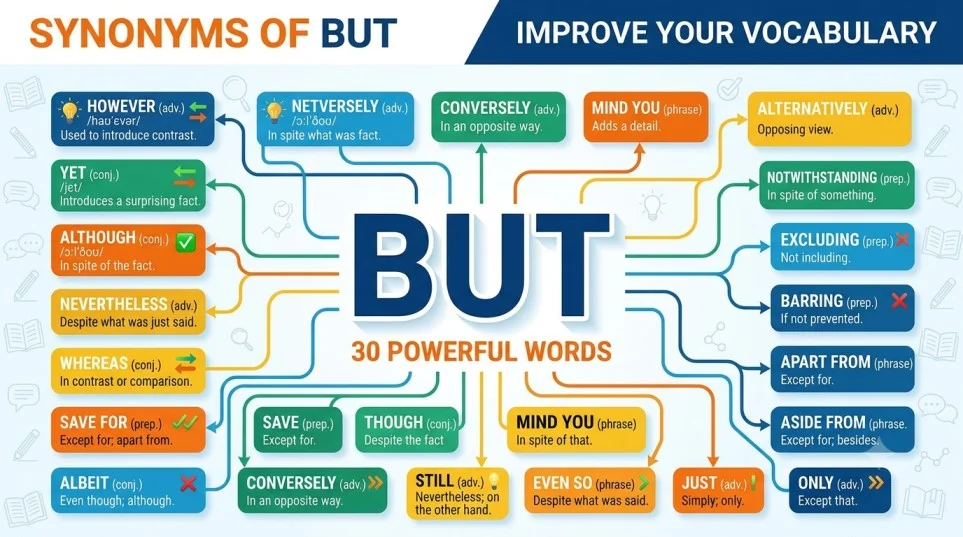
A List of Powerful Synonyms of But
1. However (Adverb)
- US IPA: /haʊˈɛvər/ | UK IPA: /haʊˈɛvə/
- Meaning: Used to introduce a statement that contrasts with something just said.
- Examples:
- The weather was cold; however, we enjoyed our walk.
- She wanted to go; however, she was too tired.
2. Yet (Conjunction)
- US IPA: /jɛst/ | UK IPA: /jɛt/
- Meaning: Used to introduce a fact that seems surprising after what was mentioned before.
- Examples:
- He is very young, yet he is remarkably wise.
- It was raining, yet they played the match.
3. Although (Conjunction)
- US IPA: /ɔːlˈðoʊ/ | UK IPA: /ɔːlˈðəʊ/
- Meaning: In spite of the fact that.
- Examples:
- Although it was late, he kept working.
- She smiled although she was feeling sad.
4. Though (Conjunction)
- US IPA: /ðoʊ/ | UK IPA: /ðəʊ/
- Meaning: Despite the fact that; a shorter form of although.
- Examples:
- Though he tried hard, he did not win.
- The food was cheap, though it tasted great.
5. Except (Preposition)
- US IPA: /ɪkˈsɛpt/ | UK IPA: /ɪkˈsɛpt/
- Meaning: Not including; other than.
- Examples:
- Everyone arrived on time except John.
- I like all vegetables except spinach.
6. Save (Preposition)
- US IPA: /seɪv/ | UK IPA: /seɪv/
- Meaning: Except for or other than.
- Examples:
- The street was empty save for a single dog.
- All hopes were lost save one last chance.
7. Still (Adverb)
- US IPA: /stɪl/ | UK IPA: /stɪl/
- Meaning: Nevertheless; on the other hand.
- Examples:
- The task was hard; still, we finished it.
- He made a mistake; still, he learned from it.
8. Nevertheless (Adverb)
- US IPA: /ˌnɛvərðəˈlɛs/ | UK IPA: /ˌnɛvəðəˈlɛs/
- Meaning: In spite of that; notwithstanding.
- Examples:
- The journey was dangerous; nevertheless, they set off.
- There was little chance of success; nevertheless, she tried.
9. Nonetheless (Adverb)
- US IPA: /ˌnʌnðəˈlɛs/ | UK IPA: /ˌnʌnðəˈlɛs/
- Meaning: In spite of that; nevertheless.
- Examples:
- The price was high; nonetheless, he bought the book.
- It was a simple gift, but nonetheless meaningful.
10. Mind you (Phrase)
- US IPA: /maɪnd juː/ | UK IPA: /maɪnd juː/
- Meaning: Used to add a detail that modifies a previous statement.
- Examples:
- He is a great cook; mind you, he takes a long time.
- I love living here; mind you, the winters are harsh.
11. On the other hand (Phrase)
- US IPA: /ɑːn ðə ˈʌðər hænd/ | UK IPA: /ɒn ðə ˈʌðə hænd/
- Meaning: Used to present an opposing point of view.
- Examples:
- The house is small; on the other hand, it is cozy.
- City life is exciting; on the other hand, it is noisy.
12. Conversely (Adverb)
- US IPA: /kənˈvɜːrsli/ | UK IPA: /kənˈvɜːsli/
- Meaning: In an opposite way; on the contrary.
- Examples:
- High prices reduce sales; conversely, low prices boost them.
- You can walk; conversely, you can take the bus.
13. Alternatively (Adverb)
- US IPA: /ɔːlˈtɜːrnətɪvli/ | UK IPA: /ɔːlˈtɜːnətɪvli/
- Meaning: As another option or possibility.
- Examples:
- We can cook dinner; alternatively, we can order food.
- You may pay cash; alternatively, use a card.
14. Whereas (Conjunction)
- US IPA: /wɛrˈæz/ | UK IPA: /weərˈæz/
- Meaning: In contrast or comparison with the fact that.
- Examples:
- She loves tea, whereas her brother prefers coffee.
- Some like heat, whereas others prefer cold weather.
15. While (Conjunction)
- US IPA: /waɪl/ | UK IPA: /waɪl/
- Meaning: While at the same time introducing a contrast.
- Examples:
- While I understand your point, I disagree with it.
- While the plan is risky, it might work.
16. Even so (Phrase)
- US IPA: /ˈiːvən soʊ/ | UK IPA: /ˈiːvn̅ səʊ/
- Meaning: Despite what was just said.
- Examples:
- The test was unfair; even so, she passed.
- It was raining heavily; even so, they played outside.
17. Be that as it may (Phrase)
- US IPA: /biː ðæt æz ɪt meɪ/ | UK IPA: /biː ðæt æz ɪt meɪ/
- Meaning: Acceptable as a fact, but not changing the main point.
- Examples:
- You were tired; be that as it may, you should have called.
- It was costly; be that as it may, we needed it.
18. Notwithstanding (Preposition)
- US IPA: /ˌnɑːtwɪθˈstændɪŋ/ | UK IPA: /ˌnɒtwɪðˈstændɪŋ/
- Meaning: In spite of something.
- Examples:
- Notwithstanding the rain, the event was a success.
- He continued his work, notwithstanding his illness.
19. Albeit (Conjunction)
- US IPA: /ɔːlˈbiːɪt/ | UK IPA: /ɔːlˈbiːɪt/
- Meaning: Even though; although.
- Examples:
- He accepted the job, albeit with some hesitation.
- It was a small victory, albeit an important one.
20. Barring (Preposition)
- US IPA: /ˈbɑːrɪŋ/ | UK IPA: /ˈbɑːrɪŋ/
- Meaning: Except for; if not prevented by.
- Examples:
- Barring rain, we will have a picnic tomorrow.
- He should graduate soon, barring any delays.
21. Excluding (Preposition)
- US IPA: /ɪkˈskluːdɪŋ/ | UK IPA: /ɪkˈskluːdɪŋ/
- Meaning: Not including; leaving out.
- Examples:
- The price is twenty dollars, excluding tax.
- Everyone joined, excluding the new team member.
22. Aside from (Prepositional Phrase)
- US IPA: /əˈsaɪd frʌm/ | UK IPA: /əˈsaɪd frɒm/
- Meaning: Except for; besides.
- Examples:
- Aside from one mistake, your essay was perfect.
- Aside from tennis, she loves swimming.
23. Apart from (Prepositional Phrase)
- US IPA: /əˈpɑːrt frʌm/ | UK IPA: /əˈpɑːt frɒm/
- Meaning: Except for; in addition to.
- Examples:
- Apart from a few bruises, he was unhurt.
- Apart from math, he enjoys history class.
24. Other than (Phrase)
- US IPA: /ˈʌðər ðæn/ | UK IPA: /ˈʌðə ðæn/
- Meaning: Except for; besides.
- Examples:
- I have no plans other than studying today.
- She eats nothing other than fresh fruit.
25. Only (Adverb)
- US IPA: /ˈoʊnli/ | UK IPA: /ˈəʊnli/
- Meaning: Except that; with the drawback that.
- Examples:
- I would buy it, only I do not have enough money.
- We would go, only it is too late now.
26. Just (Adverb)
- US IPA: /dʒʌst/ | UK IPA: /dʒʌst/
- Meaning: Simply; only (used informally to show exception or contrast).
- Examples:
- I like the car; it is just a bit too small.
- Everything is fine; just watch your step.
27. On the flip side (Phrase)
- US IPA: /ɑːn ðə flɪp saɪd/ | UK IPA: /ɒn ðə flɪp saɪd/
- Meaning: Looking at the opposite side or alternative aspect.
- Examples:
- The job is tough; on the flip side, the pay is great.
- It takes time; on the flip side, you learn a lot.
28. Then again (Phrase)
- US IPA: /ðɛn əˈɡɛn/ | UK IPA: /ðɛn əˈɡɛn/
- Meaning: Used to introduce a contrasting thought or consideration.
- Examples:
- He might come; then again, he might stay home.
- It seems expensive; then again, it lasts forever.
29. Though it may be (Phrase)
- US IPA: /ðoʊ ɪt meɪ biː/ | UK IPA: /ðəʊ ɪt meɪ biː/
- Meaning: Acknowledging a fact while introducing a counterpoint.
- Examples:
- Hard though it may be, we must try.
- Simple though it may be, it works well.
30. Save for (Prepositional Phrase)
- US IPA: /seɪv fɔːr/ | UK IPA: /seɪv fɔː/
- Meaning: Except for.
- Examples:
- The room was quiet save for the ticking clock.
- All seats were filled save for one in the back.
Prototype Meaning
The most typical meaning of but is to signal a turn or contrast between two thoughts. When people hear this word, they immediately expect a shift, a surprise, or a limitation. For instance, in the sentence “The sun was shining, but it was cold,” the word alerts the listener that the second part will balance or challenge the first.
Prototype Categorization
We can organize these synonyms of but into distinct semantic groups:
- Formal Transitions: However, nevertheless, nonetheless, notwithstanding. (Best for academic, formal, or professional writing).
- Direct Clause Connectors: Yet, although, though, whereas, while. (Great for smooth transitions within complex sentences).
- Exception Indicators: Except, save, barring, excluding, aside from, apart from, save for, other than. (Best when highlighting an exclusion or single difference).
- Informal & Conversational Transitions: Mind you, on the flip side, then again, only, just. (Perfect for dialogue, informal blogs, and casual speech).
- Alternative Ideas: On the other hand, conversely, alternatively. (Ideal when comparing two distinct choices or paths).
Categorizing these synonyms of but helps writers select the right word for their context, tone, and audience.
Antonyms of But
- And (Conjunction): Used to connect words or clauses that agree or add information (e.g., “bread and butter”).
- Also (Adverb): In addition; too; further (e.g., “She speaks French and also German.”).
- Furthermore (Adverb): In addition to what has already been said (e.g., “The house is cheap; furthermore, it is in a great area.”).
- Moreover (Adverb): As a further matter; besides (e.g., “It is fast; moreover, it uses very little fuel.”).
Short Questions and Answers
- What does but mean?
- It is a coordinating conjunction used to join two contrasting ideas or clauses together.
- When should but be used?
- Use it when you want to show a clear limit, exception, or surprising contrast between two statements.
- Is but positive or negative?
- It is neutral on its own, but it can take on a positive or negative tone depending on the surrounding sentence context.
- How is it different from similar words?
- Words like “however” are more formal and often start new sentences, whereas “and” adds similar ideas rather than contrasting them.
Conclusion
Mastering the key word but and its many alternatives is a simple way to elevate your English skills. Exploring synonyms of but helps you expand your vocabulary, build sentence variety, and write more engaging articles. By choosing the best fit for your context, you avoid repetitive phrasing, improve content flow, and speak with natural confidence. Make it a habit to practice new words every day to sharpen your communication skills!

I am a linguist with 15 years of experience in English language teaching, including postgraduate-level instruction. My expertise includes English grammar, and I contribute as a content and blog writer, producing scholarly and educational language resources.