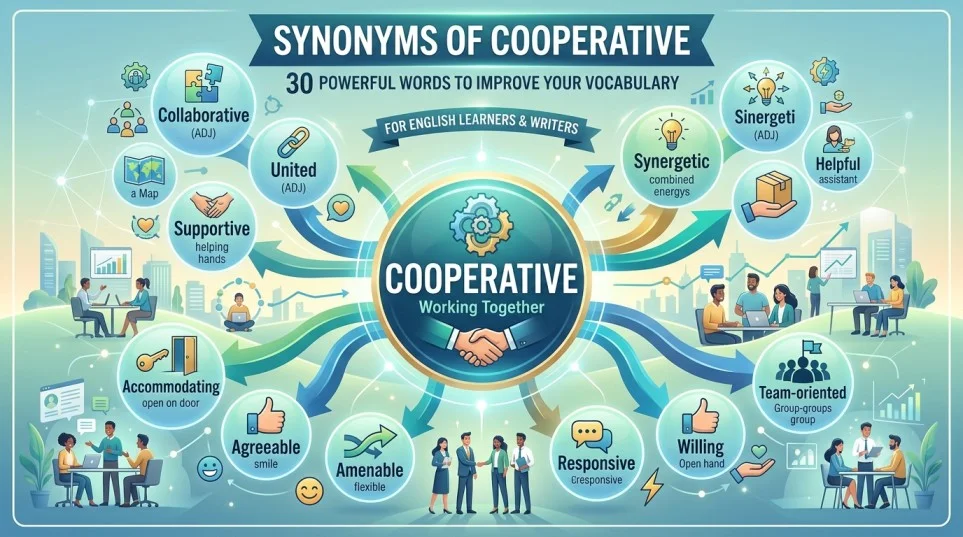
Imagine you are working on a group project at school or work. Everyone shares ideas, listens carefully, and finishes their tasks on time. You would call this team cooperative. People use this word often because teamwork happens every day. However, using the same word repeatedly makes your writing boring.
Learning synonyms for key terms helps English learners and content writers express precise thoughts, avoid repetition, and build confidence.
This detailed guide explains the meaning, history, grammar, and pronunciation of our main word. You will also explore thirty powerful synonyms organized by meaning, complete with real-world example sentences and usage tips.
Meaning of Cooperative
Definition
Cooperative (Adjective): Willing to work together, help others, or follow rules to reach a shared goal.
Examples
- The students were very cooperative during the fire drill.
- Our team reached the deadline because everyone stayed cooperative.
Connotation
(Connotation means the emotional feeling or idea a word creates beyond its literal meaning.)
- Positive tone: Shows helpfulness, unity, and a friendly team spirit.
- Negative tone: Can sometimes suggest blindly following orders without asking questions.
- Neutral tone: Simply describes people working together on a task.
Etymology
- Source Language: Latin (cooperativus)
- Original Meaning: Working together (co- meaning “together” and operari meaning “to work”).
Short History of Cooperative
- Old English (450–1100): The exact word did not exist. People used native Germanic terms like efen-wyrhtan (co-worker).
- Middle English (1100–1500): Borrowed from Old French and Latin, laying the root for words linked to labor and operation.
- Modern English (1500–Present): Formed in the 1600s to describe mutual assistance, eventually growing into a common adjective and noun by the 1800s.
Pronunciation
- US: /koʊˈɑː.pɚ.ə.t̬ɪv/
- UK: /kəʊˈɒp.ər.ə.tɪv/
Syllables
co-op-er-a-tive
Affixation Pattern
- Root: Oper (work)
- Prefix: Co- (together)
- Suffix: -ative (inclined to or performing an action)
Word Formation
- Cooperate (Verb)
- Cooperation (Noun)
- Cooperatively (Adverb)
- Cooperativeness (Noun)
- Uncooperative (Adjective)
A List of Great Synonyms of Cooperative
1. Collaborative (Adjective)
US: /kəˈlæb.ə.reɪ.t̬ɪv/ | UK: /kəˈlæb.ər.ə.tɪv/
Meaning: Working jointly with others on a creative or intellectual task.
Examples:
- The group produced brilliant collaborative artwork.
- We formed a collaborative effort to clean up the park.
2. Helpful (Adjective)
US: /ˈhelp.fəl/ | UK: /ˈhelp.fəl/
Meaning: Giving or ready to give help.
Examples:
- The store clerk was very helpful when I lost my wallet.
- She offered several helpful tips for my job interview.
3. Accommodating (Adjective)
US: /əˈkɑː.mə.deɪ.t̬ɪŋ/ | UK: /əˈkɒm.ə.deɪ.tɪŋ/
Meaning: Fit or eager to adapt and help others.
Examples:
- The hotel staff was warm and accommodating.
- He showed an accommodating nature during the meeting.
4. Supportive (Adjective)
US: /səˈpɔːr.t̬ɪv/ | UK: /səˈpɔː.tɪv/
Meaning: Providing encouragement or emotional help.
Examples:
- My parents were always supportive of my choices.
- A supportive audience makes public speaking easier.
5. Compliant (Adjective)
US: /kəmˈplaɪ.ənt/ | UK: /kəmˈplaɪ.ənt/
Meaning: Willing to obey rules or agree with others.
Examples:
- The factory remains compliant with all safety laws.
- A compliant puppy is easy to train.
6. Obliging (Adjective)
US: /əˈblaɪ.dʒɪŋ/ | UK: /əˈblaɪ.dʒɪŋ/
Meaning: Eager to do favors or help out.
Examples:
- The obliging neighbor agreed to feed our cat.
- He gave an obliging smile and opened the door.
7. Unified (Adjective)
US: /ˈjuː.nə.faɪd/ | UK: /ˈjuː.nɪ.faɪd/
Meaning: Joined together as one whole group.
Examples:
- The players showed a unified front during the match.
- Our team reached a unified decision.
8. Pliable (Adjective)
US: /ˈplaɪ.ə.bəl/ | UK: /ˈplaɪ.ə.bəl/
Meaning: Easily shaped or influenced by others.
Examples:
- Young children often have pliable minds.
- The negotiator found the client pliable today.
9. Amenable (Adjective)
US: /əˈmiː.nə.bəl/ | UK: /əˈmiː.nə.bəl/
Meaning: Open and responsive to suggestions or advice.
Examples:
- She was amenable to changing the project timeline.
- The boss seemed amenable to our new idea.
10. Agreeable (Adjective)
US: /əˈɡriː.ə.bəl/ | UK: /əˈɡriː.ə.bəl/
Meaning: Pleasant and easy to get along with.
Examples:
- He is an agreeable man who rarely gets angry.
- We spent an agreeable afternoon in the garden.
11. Synergistic (Adjective)
US: /ˌsɪn.ɚˈdʒɪs.tɪk/ | UK: /ˌsɪn.əˈdʒɪs.tɪk/
Meaning: Working together to produce a result greater than the sum of parts.
Examples:
- The two companies gained a synergistic advantage.
- Their combined talents created a synergistic effect.
12. Friendly (Adjective)
US: /ˈfrend.li/ | UK: /ˈfrend.li/
Meaning: Kind, pleasant, and easy to talk to.
Examples:
- The local residents are very friendly to tourists.
- She offered a friendly greeting at the door.
13. United (Adjective)
US: /juːˈnaɪ.t̬ɪd/ | UK: /juːˈnaɪ.tɪd/
Meaning: Joined together for a common purpose.
Examples:
- The citizens stood united against the problem.
- A united team works faster than a divided one.
14. Responsive (Adjective)
US: /rɪˈspɑːn.sɪv/ | UK: /rɪˈspɒn.sɪv/
Meaning: Reacting quickly and positively to feedback or requests.
Examples:
- Customer support was fast and responsive.
- The horse was responsive to the rider’s commands.
15. Team-minded (Adjective)
US: /ˈtiːm.maɪn.dɪd/ | UK: /ˈtiːm.maɪn.dɪd/
Meaning: Focused on the success of the whole group.
Examples:
- We need team-minded workers for this new project.
- Her team-minded approach helped resolve the fight.
16. Coordinated (Adjective)
US: /koʊˈɔːr.də.neɪ.t̬ɪd/ | UK: /kəʊˈɔː.dɪ.neɪ.tɪd/
Meaning: Organized smoothly to work well together.
Examples:
- The rescue team launched a coordinated plan.
- Their movements were precise and coordinated.
17. Willing (Adjective)
US: /ˈwɪl.ɪŋ/ | UK: /ˈwɪl.ɪŋ/
Meaning: Ready and happy to do something.
Examples:
- He was a willing volunteer at the shelter.
- Are you willing to help us move this table?
18. Docile (Adjective)
US: /ˈdɑː.səl/ | UK: /ˈdoʊ.saɪl/
Meaning: Quiet, calm, and easily led or managed.
Examples:
- The sheep were calm and docile in the pen.
- He has a docile personality that avoids conflict.
19. Subservient (Adjective)
US: /səbˈsɝː.vi.ənt/ | UK: /səbˈsɜː.vi.ənt/
Meaning: Prepared to obey others without question.
Examples:
- She refused to take a subservient role at work.
- The assistant acted in a subservient manner.
20. Biddable (Adjective)
US: /ˈbɪd.ə.bəl/ | UK: /ˈbɪd.ə.bəl/
Meaning: Meek and ready to obey order or requests.
Examples:
- The trainer prefers biddable dogs for service work.
- She was a quiet, biddable child.
21. Manageable (Adjective)
US: /ˈmæn.ə.dʒə.bəl/ | UK: /ˈmæn.ɪ.dʒə.bəl/
Meaning: Easy to control, guide, or care for.
Examples:
- The small class size made the students manageable.
- Breaking big tasks down keeps them manageable.
22. Tractable (Adjective)
US: /ˈtræk.tə.bəl/ | UK: /ˈtræk.tə.bəl/
Meaning: Easy to deal with or influence.
Examples:
- The new policy turned a hard task into a tractable issue.
- He proved to be a tractable business partner.
23. Yielding (Adjective)
US: /ˈjiːl.dɪŋ/ | UK: /ˈjiːl.dɪŋ/
Meaning: Giving way under pressure or agreeing easily.
Examples:
- Her yielding nature made bargaining very easy.
- The pillow was soft and yielding.
24. Passive (Adjective)
US: /ˈpæs.ɪv/ | UK: /ˈpæs.ɪv/
Meaning: Accepting actions without active resistance.
Examples:
- He took a passive role during the debate.
- Passive agreement is not as strong as real passion.
25. Conformable (Adjective)
US: /kənˈfɔːr.mə.bəl/ | UK: /kənˈfɔː.mə.bəl/
Meaning: Adaptable and ready to follow accepted standards.
Examples:
- The rules made the members conformable to policy.
- He showed a conformable attitude toward work.
26. Harmonious (Adjective)
US: /hɑːrˈmoʊ.ni.əs/ | UK: /hɑːˈməʊ.ni.əs/
Meaning: Free from conflict or disagreement; working smoothly.
Examples:
- They maintained a harmonious working relationship.
- The choir sang in a soft, harmonious blend.
27. Interdependent (Adjective)
US: /ˌɪn.t̬ɚ.dɪˈpen.dənt/ | UK: /ˌɪn.tə.dɪˈpen.dənt/
Meaning: Depending on each other for success or survival.
Examples:
- Bees and flowers share an interdependent bond.
- Modern global markets are deeply interdependent.
28. Solicitous (Adjective)
US: /səˈlɪs.ə.t̬əs/ | UK: /səˈlɪs.ɪ.təs/
Meaning: Showing care, attention, or concern for others.
Examples:
- The doctor was solicitous about the patient’s health.
- She gave a solicitous inquiry about my day.
29. Hand-in-glove (Adjective)
US: /ˌhænd.ɪnˈɡlʌv/ | UK: /ˌhænd.ɪnˈɡlʌv/
Meaning: Working in close union or partnership.
Examples:
- The two directors worked hand-in-glove on the film.
- Police worked hand-in-glove with the local community.
30. Mutual (Adjective)
US: /ˈmjuː.tʃu.əl/ | UK: /ˈmjuː.tʃu.əl/
Meaning: Held in common or experienced equally by two sides.
Examples:
- Respect must be mutual for a friendship to last.
- They reached a mutual understanding on price.
Prototype Meaning
The prototype meaning of cooperative centers on active teamwork. When people hear this word, they picture individuals sitting around a table, sharing ideas, and helping each other solve a problem. It suggests willingness, active effort, and positivity aimed at a shared goal.
Prototype Categorization
- Active Teamwork: Collaborative, Synergistic, Interdependent, United, Unified, Team-minded, Coordinated, Hand-in-glove, Mutual
- Kind & Support: Helpful, Accommodating, Supportive, Obliging, Agreeable, Friendly, Harmonious, Solicitous, Responsive
- Willing & Obedient: Compliant, Pliable, Amenable, Willing, Docile, Subservient, Biddable, Manageable, Tractable, Yielding, Passive, Conformable
Grouping words by context helps writers pick the right tone. For example, use collaborative for creative work, helpful for everyday kindness, and compliant for following legal rules.
Antonyms of Cooperative
- Uncooperative (Adjective): Not willing to work together or help others.
- Stubborn (Adjective): Unwilling to change an opinion or position.
- Hostile (Adjective): Unfriendly, aggressive, or opposing an action.
- Defiant (Adjective): Openly resisting authority or orders.
- Obstinate (Adjective): Refusing to change behavior despite advice.
Short Questions and Answers
- What does cooperative mean?
- It means working well with others, offering help, and following shared rules to finish a task.
- When should cooperative be used?
- Use it when describing group work, obedient behavior, or people helping each other in schools, offices, and sports.
- Is cooperative positive or negative?
- It is mostly positive because it implies harmony and helpful teamwork. However, it can sound neutral or slightly negative if it implies blindly obeying orders.
- How is it different from similar words?
- Cooperative means willing to work with others. Collaborative focuses specifically on creating or building something together. Compliant focuses on obeying rules rather than active teamwork.
Conclusion
Mastering the word cooperative and its many synonyms builds a stronger English vocabulary. Switching between words like collaborative, helpful, and harmonious adds clarity to your writing and speaking. It helps you avoid repeating the same terms and makes your sentences more engaging. Practicing these words daily builds confidence and helps you express thoughts with precision.

I am a linguist with 15 years of experience in English language teaching, including postgraduate-level instruction. My expertise includes English grammar, and I contribute as a content and blog writer, producing scholarly and educational language resources.