Imagine you are standing in front of a crowded room. You look around and notice that every single person is smiling at you. The word “every” fits naturally here because it includes all people in the room without leaving anyone out. People use “every” daily because it is simple, direct, and clear. However, repeating it constantly makes your speech and writing sound dull.
Learning synonyms for “every” helps English learners and content writers build a rich vocabulary. Stronger word choices add precision, elegance, and variety to your sentences.
This article explores the meaning of “every” along with its best synonyms.
You will discover clear definitions, real-world example sentences, correct grammar usage, word history, exact pronunciations, and semantic categories to master this fundamental term.
Meaning of Every
Definition
Every (Determiner / Adjective): Including each individual person, item, or thing in a complete group, without exception.
Examples
- She read every book on the top shelf.
- The local bakery makes fresh bread every morning.
Connotative Meaning
(Connotation is the emotional feeling or idea that a word invokes in addition to its literal meaning.)
- Positive tone: Expresses complete inclusion, unity, thoroughness, or warmth (e.g., “every detail was perfect”).
- Negative tone: Highlights overwhelming scale, relentless repetition, or inescapable burdens (e.g., “every single mistake was punished”).
- Neutral tone: Acts as a plain factual descriptor for a complete group or recurring schedule (e.g., “every train arrives on time”).
Etymology
- Origin: Derived from Old English æfre ælc, which combines æfre (ever) and ælc (each).
- Old English (450–1100): Written as æfre ælc, meaning “ever each” or “each one continuously.”
- Middle English (1100–1500): Evolved into evrich or everich, merging the two separate words into one standard term.
- Modern English (1500–Present): Shortened to every, taking on its current spelling and universal daily usage.
Pronunciation
- US: /ˈɛv.ɹi/
- UK: /ˈev.ri/
Syllables
ev-ry
Affixation Pattern of Every
- Root: Ever (from Old English æfre)
- Prefix: None
- Suffix: -y (phonetic contraction of each)
Word Formation:
- Everybody (Pronoun): All people.
- Everyone (Pronoun): Each person in a group.
- Everything (Pronoun): All existing things.
- Everywhere (Adverb): In or to all places.
- Everyday (Adjective): Ordinary, routine, or daily.
A List of Leading Synonyms of Every
1. Each (Determiner)
US IPA: /iːtʃ/ | UK IPA: /iːtʃ/
Meaning: Every individual item or person considered separately within a group.
- Examples:
- Each student received a new notebook.
- The teacher spoke to each parent personally.
2. All (Determiner)
US IPA: /ɔːl/ | UK IPA: /ɔːl/
Meaning: The whole quantity, extent, or total number of something.
- Examples:
- All children deserve a good education.
- She kept all her old letters in a box.
3. Whole (Adjective)
US IPA: /hoʊl/ | UK IPA: /həʊl/
Meaning: Entire or complete, without missing any single part.
- Examples:
- The whole class passed the difficult exam.
- He spent the whole afternoon reading in the park.
4. Entire (Adjective)
US IPA: /ɪnˈtaɪ.ɚ/ | UK IPA: /ɪnˈtaɪə/
Meaning: Complete in all its parts, with nothing left out.
- Examples:
- The entire town celebrated the victory.
- She ate the entire bowl of soup.
5. Individual (Adjective)
US IPA: /ˌɪn.dəˈvɪdʒ.u.əl/ | UK IPA: /ˌɪn.dɪˈvɪdʒ.u.əl/
Meaning: Single or separate when viewed alongside a larger group.
- Examples:
- Pay attention to the individual needs of each child.
- The chef places individual strawberries on every cake.
6. Specific (Adjective)
US IPA: /spəˈsɪf.ɪk/ | UK IPA: /spəˈsɪf.ɪk/
Meaning: Explicitly named, distinct, or precise within a category.
- Examples:
- She checked specific details before signing the contract.
- He requested specific instructions for the task.
7. Particular (Adjective)
US IPA: /pɚˈtɪk.jə.lɚ/ | UK IPA: /pəˈtɪk.jə.lə/
Meaning: Relating to a single, distinct item or person rather than a group.
- Examples:
- Every particular rule must be followed carefully.
- She likes that particular shade of blue.
8. Sole (Adjective)
US IPA: /soʊl/ | UK IPA: /səʊl/
Meaning: One and only, operating as a single unit without others.
- Examples:
- He was the sole survivor of the accident.
- She bears the sole responsibility for the project.
9. Single (Adjective)
US IPA: /ˈsɪŋ.ɡəl/ | UK IPA: /ˈsɪŋ.ɡəl/
Meaning: Only one, distinct from all others in a group.
- Examples:
- Not a single cloud appeared in the clear sky.
- Every single member voted in favor of the plan.
10. Complete (Adjective)
US IPA: /kəmˈpliːt/ | UK IPA: /kəmˈpliːt/
Meaning: Having all necessary parts, elements, or steps included.
- Examples:
- We need a complete list of all participants.
- The set is complete with all twelve pieces.
11. Total (Adjective)
US IPA: /ˈtoʊ.təl/ | UK IPA: /ˈtəʊ.təl/
Meaning: Comprising the whole sum or aggregate quantity.
- Examples:
- The total cost includes tax and shipping.
- They showed total dedication to their work.
12. Universal (Adjective)
US IPA: /ˌjuː.nəˈvɝː.səl/ | UK IPA: /ˌjuː.nɪˈvɜː.səl/
Meaning: Existing, done, or experienced everywhere by all people.
- Examples:
- Music is a universal language.
- The novel addresses universal themes of love and loss.
13. Omnipresent (Adjective)
US IPA: /ˌɑːm.nɪˈprɛz.ənt/ | UK IPA: /ˌɒm.nɪˈprez.ənt/
Meaning: Present everywhere simultaneously in all situations.
- Examples:
- Smartphones seem omnipresent in modern society.
- The omnipresent noise of the city filled the room.
14. Ubiquitous (Adjective)
US IPA: /juːˈbɪk.wə.t̬əs/ | UK IPA: /juːˈbɪk.wɪ.təs/
Meaning: Found or appearing everywhere at the same time.
- Examples:
- Coffee shops are ubiquitous in major cities.
- Wi-Fi access has become ubiquitous in hotel rooms.
15. Comprehensive (Adjective)
US IPA: /ˌkɑːm.prəˈhɛn.sɪv/ | UK IPA: /ˌkɒm.prɪˈhen.sɪv/
Meaning: Including all or nearly all elements or aspects of something.
- Examples:
- The guide provides a comprehensive overview of the topic.
- They performed a comprehensive search of the building.
16. Exhaustive (Adjective)
US IPA: /ɪɡˈzɑː.stɪv/ | UK IPA: /ɪɡˈzɔː.stɪv/
Meaning: Fully thorough and leaving no element unexamined.
- Examples:
- Researchers conducted an exhaustive study on the disease.
- The report presents an exhaustive analysis of the data.
17. Overall (Adjective)
US IPA: /ˌoʊ.vɚˈɑːl/ | UK IPA: /ˌəʊ.vərˈɔːl/
Meaning: Taking everything into account across the entire whole.
- Examples:
- The overall score was higher than expected.
- Her overall health improved after changing her diet.
18. Thorough (Adjective)
US IPA: /ˈθɝː.oʊ/ | UK IPA: /ˈθʌr.ə/
Meaning: Complete with regard to every detail and executed with care.
- Examples:
- He gave the apartment a thorough cleaning.
- The doctor conducted a thorough examination.
19. All-inclusive (Adjective)
US IPA: /ˌɑːl.ɪnˈkluː.sɪv/ | UK IPA: /ˌɔːl.ɪnˈkluː.sɪv/
Meaning: Including everything or every person within its scope.
- Examples:
- They booked an all-inclusive resort package for their vacation.
- The membership offers an all-inclusive price.
20. Infinite (Adjective)
US IPA: /ˈɪn.fə.nət/ | UK IPA: /ˈɪn.fɪ.nət/
Meaning: Endless or limitless in quantity, extent, or space.
- Examples:
- The night sky reveals an infinite number of stars.
- She showed infinite patience while teaching the young children.
21. Limitless (Adjective)
US IPA: /ˈlɪm.ɪt.ləs/ | UK IPA: /ˈlɪm.ɪt.ləs/
Meaning: Without any restriction, boundaries, or end.
- Examples:
- The internet offers limitless sources of information.
- Young children have limitless energy during play.
22. Unbounded (Adjective)
US IPA: /ʌnˈbaʊn.dɪd/ | UK IPA: /ʌnˈbaʊn.dɪd/
Meaning: Having no boundaries, restrictions, or limits placed on it.
- Examples:
- Her unbounded enthusiasm inspired the rest of the team.
- The artist possessed unbounded creative freedom.
23. Endless (Adjective)
US IPA: /ˈɛnd.ləs/ | UK IPA: /ˈend.ləs/
Meaning: Having no end or seeming to go on forever.
- Examples:
- We walked along the endless sandy beach.
- The project required an endless amount of patience.
24. Unceasing (Adjective)
US IPA: /ʌnˈsiː.sɪŋ/ | UK IPA: /ʌnˈsiː.sɪŋ/
Meaning: Continuing forever without stopping or pausing.
- Examples:
- The unceasing rain caused flooding across the lower town.
- Her unceasing efforts earned her a well-deserved promotion.
25. Continuous (Adjective)
US IPA: /kənˈtɪn.ju.əs/ | UK IPA: /kənˈtɪn.ju.əs/
Meaning: Forming a uninterrupted series, line, or flow.
- Examples:
- The machine operates on a continuous cycle.
- There was a continuous stream of cars on the highway.
26. Constant (Adjective)
US IPA: /ˈkɑːn.stənt/ | UK IPA: /ˈkɒn.stənt/
Meaning: Occurring continuously or repeatedly over a period of time.
- Examples:
- The engine made a constant humming sound.
- She remains in constant contact with her family.
27. Systematic (Adjective)
US IPA: /ˌsɪs.təˈmæt.ɪk/ | UK IPA: /ˌsɪs.təˈmæt.ɪk/
Meaning: Done according to a fixed plan, system, or method.
- Examples:
- They carried out a systematic check of all files.
- Her systematic approach to studying guaranteed success.
28. Methodical (Adjective)
US IPA: /məˈθɑː.dɪ.kəl/ | UK IPA: /məˈθɒd.ɪ.kəl/
Meaning: Done in an orderly, logical, and step-by-step way.
- Examples:
- He is a methodical worker who double-checks every item.
- She took a methodical approach to solving the puzzle.
29. Regular (Adjective)
US IPA: /ˈrɛɡ.jə.lɚ/ | UK IPA: /ˈreɡ.jə.lə/
Meaning: Occurring at uniform intervals of time or space.
- Examples:
- Make regular checks on your equipment.
- She maintains regular study hours every day.
30. Periodic (Adjective)
US IPA: /ˌpɪr.iˈɑː.dɪk/ | UK IPA: /ˌpɪə.riˈɒd.ɪk/
Meaning: Happening or repeating at fixed intervals over time.
- Examples:
- The team conducts periodic reviews of the project budget.
- Car engines require periodic maintenance to run smoothly.
Prototype Meaning
The word “every” typically signifies absolute completeness across a defined collection. When people hear “every,” they imagine a group where not a single member or detail is left out. It emphasizes total coverage while maintaining focus on the individual elements that make up the whole.
Prototype Categorization
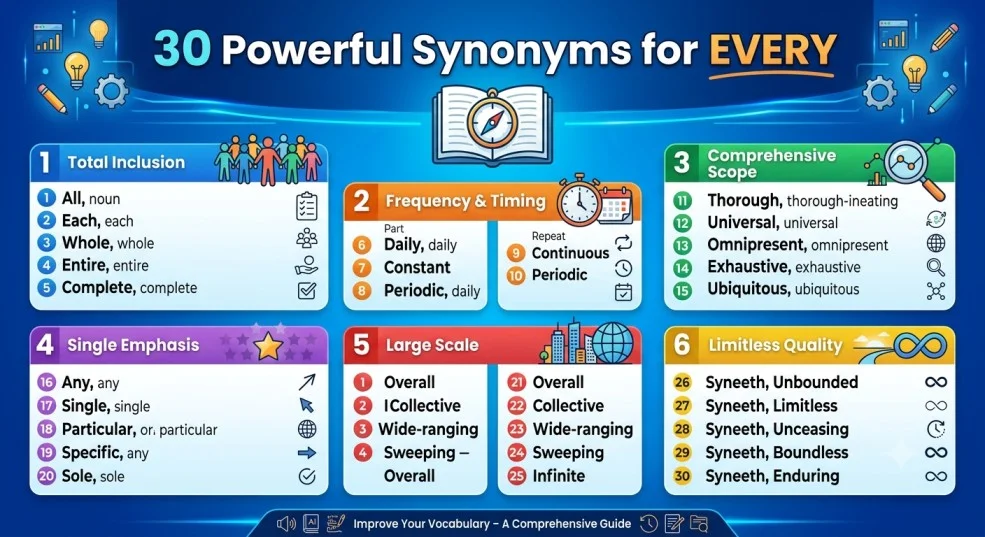
- Distributive Synonyms: Each, individual, specific, particular, single, sole.
- Totalizing Synonyms: All, whole, entire, complete, total, overall, all-inclusive.
- Widespread / Spatial Synonyms: Universal, omnipresent, ubiquitous.
- Thoroughness Synonyms: Comprehensive, exhaustive, thorough, systematic, methodical.
- Temporal / Frequency Synonyms: Endless, unceasing, continuous, constant, regular, periodic.
- Unbounded Synonyms: Infinite, limitless, unbounded.
Grouping synonyms into categories allows writers to match their exact intent. For instance, using “ubiquitous” highlights spatial presence, whereas “systematic” emphasizes methodical care. Categorization prevents awkward word choices and sharpens overall writing clarity.
Antonyms of Every
- None (Pronoun): Not any; no single one out of a group.
- No (Determiner): Not any or not at all.
- Neither (Determiner / Pronoun): Not one nor the other of two options.
- Few (Determiner / Adjective): A small number of; hardly any.
- Some (Determiner / Pronoun): An unspecified number or portion, but not all.
Short Questions and Answers
- What does “every” mean?
- “Every” means each individual item, person, or element within an entire group, without excluding any.
- When should “every” be used?
- Use “every” when you want to refer to all members of a group individually or when describing regular, repeated schedules.
- Is “every” positive or negative?
- “Every” is naturally neutral, but it takes on positive or negative feelings depending on the surrounding sentence context.
- How is “every” different from “each”?
- “Every” considers all items combined together as a complete group, whereas “each” focuses on every item viewed strictly one by one.
CONCLUSION
Mastering the word “every” and its many synonyms expands your vocabulary and upgrades your overall communication skills. Swapping basic words for precise alternatives makes your writing and speaking far more captivating. It stops repetitive language patterns and brings fresh clarity to your sentences. Building a strong vocabulary strengthens your confidence in daily conversations, professional emails, and creative writing. Practice using a new synonym from this guide every day to elevate your English fluency.

I am a linguist with 15 years of experience in English language teaching, including postgraduate-level instruction. My expertise includes English grammar, and I contribute as a content and blog writer, producing scholarly and educational language resources.