Imagine you are giving a big speech at school or work. You want to tell everyone that your new idea is a big deal. You use the word “important” over and over again. Soon, your listeners look bored.
“Important” is a word we use every single day to show that something matters. But using the same word makes your writing dry. Learning new synonyms helps English learners and writers sound smart and keep readers happy.
This guide explains the word “important” and thirty of its best synonyms. We will look at meanings, clear examples, sentence patterns, word history, and easy pronunciation guides. These tools are written in simple sentences to help you build your vocabulary fast.
Meaning of Important
Definition
important (adjective): Having great value, influence, or meaning.
Examples
- It is important to brush your teeth every night.
- She has an important meeting with her boss today.
Connotative Meaning
What is the connotation? (Connotation is the emotional feeling or idea that a word brings to your mind beyond its literal dictionary definition.)
- Positive tone: It can make a task or person feel valuable, noble, and worthy of respect.
- Negative tone: It can sometimes sound demanding, bossy, or stressful when used to force action.
- Neutral tone: It can simply state facts about a rank, rule, or job without adding extra emotion.
Etymology
- Origin:
- Latin importans, which comes from importare. This originally meant “to bring in” or “to be of consequence.”
- Short History:
- Old English (450–1100): This word did not exist yet. People used older Germanic words like micel (meaning great or much) or weorþ (meaning worthy).
- Middle English (1100–1500): The word entered the English language from Old French in the late 1400s to describe things that carried heavy weight.
- Modern English (1500–Present): It became a standard, everyday word used to describe anything that has power, value, or high status.
Pronunciation and Word Structure
Pronunciation (US & UK – IPA)
- US: /ɪmˈpɔːr.tənt/
- UK: /ɪmˈpɔː.tənt/
Syllables
im-por-tant
Affixation Pattern of Important
Root
port (from Latin portare, which means “to carry”)
Prefix
im- (meaning “into” or “upon”)
Suffix
-ant (used to turn a root into an adjective)
Word Formation
- Importance (noun)
- Importantly (adverb)
- Unimportant (adjective)
- Import (verb or noun)
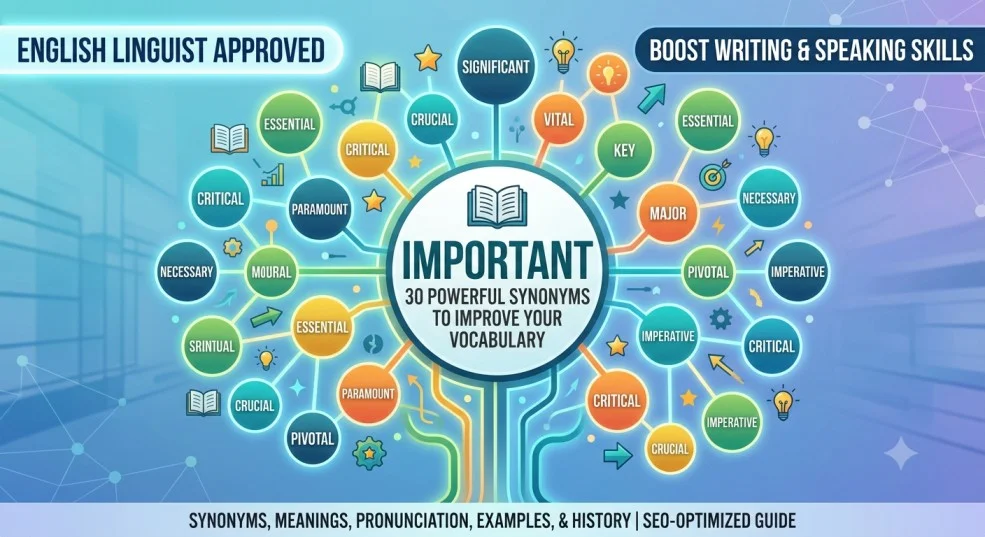
A List of Best 30 Synonyms of Important
1. Significant (Adjective)
US: /sɪɡˈnɪf.ɪ.kənt/ | UK: /sɪɡˈnɪf.ɪ.kənt/
Meaning: Having a great or noticeable effect.
- There is a significant rise in sales this month.
- This is a significant day for our family.
2. Crucial (Adjective)
US: /ˈkruː.ʃəl/ | UK: /ˈkruː.ʃəl/
Meaning: Extremely important because many other things depend on it.
- Water is crucial for human life.
- The last goal was crucial for winning the game.
3. Essential (Adjective)
US: /ɪˈsen.ʃəl/ | UK: /ɪˈsen.ʃəl/
Meaning: Absolutely necessary for something to work.
- Food is essential for our bodies.
- It is essential to pack a map for the trip.
4. Vital (Adjective)
US: /ˈvaɪ.t̬əl/ | UK: /ˈvaɪ.təl/
Meaning: Necessary for success, life, or health.
- The heart is a vital organ.
- She played a vital role in our team.
5. Key (Adjective)
US: /kiː/ | UK: /kiː/
Meaning: Most important or primary.
- He is a key player on the team.
- Hard work is the key ingredient to success.
6. Critical (Adjective)
US: /ˈkrɪt̬.ɪ.kəl/ | UK: /ˈkrɪt.ɪ.kəl/
Meaning: Extremely important, often because something bad might happen if it fails.
- The patient is in critical condition.
- This is a critical time for the company.
7. Major (Adjective)
US: /ˈmeɪ.dʒər/ | UK: /ˈmeɪ.dʒər/
Meaning: Very large, serious, or important.
- Traffic is a major problem in this city.
- She made a major discovery in science.
8. Principal (Adjective)
US: /ˈprɪn.sə.pəl/ | UK: /ˈprɪn.sə.pəl/
Meaning: First in order of importance.
- Bananas are the country’s principal export.
- My principal concern is your safety.
9. Paramount (Adjective)
US: /ˈper.ə.maʊnt/ | UK: /ˈpær.ə.maʊnt/
Meaning: More important than anything else.
- Safety is of paramount importance on this ride.
- Keeping secrets is paramount in this job.
10. Main (Adjective)
US: /meɪn/ | UK: /meɪn/
Meaning: Larger, more important, or having more influence than others.
- The main road is closed today.
- What is the main idea of this book?
11. Necessary (Adjective)
US: /ˈnes.ə.ser.i/ | UK: /ˈnes.ə.ser.i/
Meaning: Needed to get a result or finish a task.
- Sleep is necessary for good health.
- Take all the necessary tools with you.
12. Urgent (Adjective)
US: /ˈɝː.dʒənt/ | UK: /ˈɜː.dʒənt/
Meaning: Needing quick attention or action right now.
- I have an urgent message for the doctor.
- This is an urgent matter that cannot wait.
13. Weighty (Adjective)
US: /ˈweɪ.t̬i/ | UK: /ˈweɪ.ti/
Meaning: Having serious or heavy importance.
- The judge has to make a weighty decision.
- They discussed some weighty topics at dinner.
14. Prime (Adjective)
US: /praɪm/ | UK: /praɪm/
Meaning: Of the best quality or highest value.
- This is a prime example of good art.
- The store sits in a prime location.
15. Chief (Adjective)
US: /tʃiːf/ | UK: /tʃiːf/
Meaning: Most important or main in rank.
- He is the chief of police in our town.
- Our chief goal is to help poor children.
16. Indispensable (Adjective)
US: /ˌɪn·dɪˈspen·sə·bəl/ | UK: /ˌɪn.dɪˈspen.sə.bəl/
Meaning: Too useful or too important to do without.
- A good dictionary is indispensable for language students.
- Computers are indispensable in modern offices.
17. Momentous (Adjective)
US: /moʊˈmen.t̬əs/ | UK: /məˈmen.təs/
Meaning: Very important because of its future effects.
- The moon landing was a momentous event.
- She made a momentous choice to change careers.
18. Fundamental (Adjective)
US: /ˌfʌn.dəˈmen.t̬əl/ | UK: /ˌfʌn.dəˈmen.təl/
Meaning: Forming a necessary base or core.
- Reading is a fundamental skill for learning.
- We have a fundamental right to be safe.
19. Meaningful (Adjective)
US: /ˈmiː.nɪŋ.fəl/ | UK: /ˈmiː.nɪŋ.fəl/
Meaning: Useful, serious, or important.
- They had a meaningful talk about their plans.
- I want to do meaningful work that helps people.
20. Prominent (Adjective)
US: /ˈprɑː.mə.nənt/ | UK: /ˈprɒm.ɪ.nənt/
Meaning: Important, famous, or easily seen.
- He is a prominent lawyer in the city.
- The tower is a prominent landmark.
21. Consequential (Adjective)
US: /ˌkɑːn.səˈkwen.ʃəl/ | UK: /ˌkɒn.sɪˈkwen.ʃəl/
Meaning: Having significant results or effects.
- His vote was consequential to the final law.
- That was a consequential moment in our history.
22. Pivotal (Adjective)
US: /ˈpɪv.ə.t̬əl/ | UK: /ˈpɪv.ə.təl/
Meaning: Crucial because everything else turns or depends on it.
- She played a pivotal role in starting the club.
- That game was a pivotal point in the season.
23. Serious (Adjective)
US: /ˈsɪr.i.əs/ | UK: /ˈsɪə.ri.əs/
Meaning: Bad or dangerous enough to cause worry.
- Pollution is a serious problem for our planet.
- He made a serious mistake on his test.
24. Notable (Adjective)
US: /ˈnoʊ.t̬ə.bəl/ | UK: /ˈnəʊ.tə.bəl/
Meaning: Worthy of attention or notice.
- There is a notable difference between the two dogs.
- The city has many notable parks to visit.
25. Foremost (Adjective)
US: /ˈfɔːr.moʊst/ | UK: /ˈfɔː.məʊst/
Meaning: Most prominent, respected, or leading.
- She is the foremost expert on wild birds.
- Safety is our foremost concern on this trip.
26. Salient (Adjective)
US: /ˈseɪ.li.ənt/ | UK: /ˈseɪ.li.ənt/
Meaning: Most noticeable or key to a point.
- Let me summarize the salient points of the speech.
- The salient feature of this phone is its camera.
27. Material (Adjective)
US: /məˈtɪr.i.əl/ | UK: /əˈtɪə.ri.əl/
Meaning: Important enough to influence a decision.
- His lies had a material effect on the trial.
- There are no material changes to our plans.
28. Substantial (Adjective)
US: /səbˈstæn.ʃəl/ | UK: /səbˈstæn.ʃəl/
Meaning: Large in size, value, or importance.
- We saved a substantial amount of money this year.
- He made a substantial contribution to the charity.
29. Leading (Adjective)
US: /ˈliː.dɪŋ/ | UK: /ˈliː.dɪŋ/
Meaning: Most important, successful, or ahead of others.
- She is a leading scientist in her field.
- This company is the leading maker of clean cars.
30. Imperative (Adjective)
US: /ɪmˈper.ə.t̬ɪv/ | UK: /ɪmˈper.ə.tɪv/
Meaning: Extremely urgent or necessary.
- It is imperative that you leave now.
- Good communication is imperative for a happy home.
Prototype Meaning
When people hear the word “important,” they usually think of a key that opens a big door. They imagine a main task on a to-do list, a life-saving medical choice, or a highly respected leader. This prototype meaning centers on things that hold power, carry deep weight, or decide success and failure.
Prototype Categorization
We can group these thirty synonyms into distinct folders to make choosing the right word easy:
- Life and Survival: Vital, essential, necessary. These words show that something must exist for life to go on.
- Urgency and Speed: Urgent, critical, imperative. Use these words when action must happen right now to avoid trouble.
- Order and Rank: Principal, chief, main, foremost, leading. These words point out who or what sits at the top of a group.
- Heavy Impact: Significant, pivotal, momentous, consequential. Use these to describe choices that change the future.
Categorizing words helps writers match their exact feelings. It stops you from using a “survival” word when you really need an “urgency” word.
Antonyms of Important
- Unimportant (adjective): Not having value, interest, or meaning.
- Trivial (adjective): Having little value, depth, or worth.
- Insignificant (adjective): Small, cheap, or not worth noticing.
- Minor (adjective): Low in rank, size, or impact.
- Negligible (adjective): Too small to be worth worrying about.
Short Questions and Answers
- What does important mean?
- It means having great value, power, or influence over people and events.
- When should important be used?
- Use it when you want to highlight a key task, a serious matter, or an item of high quality.
- Is important positive or negative?
- It is usually positive because it highlights value, but it can sound stressful when describing urgent work.
- How is it different from similar words?
- “Important” is a general word. Similar words like “vital” focus on survival, while “urgent” focuses on speed.
Conclusion
Learning the word “important” and its thirty synonyms is a great way to grow. It improves your vocabulary so you can share ideas clearly. It strengthens your writing and speaking, making your sentences far more interesting. It helps you avoid repetition so your readers do not get bored. Best of all, it builds your English confidence in school, business, and daily life. Try using one new synonym every single day to see your skills grow.

I am a linguist with 15 years of experience in English language teaching, including postgraduate-level instruction. My expertise includes English grammar, and I contribute as a content and blog writer, producing scholarly and educational language resources.