Imagine you are at a quiet party. You see a friend across the room. You do not want to disturb the host, so you walk over sideways and quietly. This quiet, sideways walk is what we call “sidle.” It is a highly useful word because it helps us describe subtle human body language and secretive movements.
For English learners and content writers, learning synonyms for “sidle” is very important because it makes your vocabulary rich and helps you avoid using the same words over and over. When you write with precise words, your stories and articles become much more exciting and professional to read.
In this easy guide, we will explore the deep meaning of the word “sidle” along with its unique history, correct pronunciation, and basic grammar. We will also study thirty excellent synonyms divided into clear semantic categories with simple example sentences.
Meaning of sidle
Definition
sidle (verb):
To walk in a quiet, slow, or sneaky way, often sideways, so that people do not notice you.
Examples
- She decided to sidle up to her boss to ask for a small favor.
- The shy cat would sidle along the wall when guests entered the room.
Connotative Meaning
(Connotation is the feeling or emotion that a word makes you think of, rather than its literal dictionary definition.)
- Positive tone: In rare cases, it can sound cute, shy, or playfully gentle, like a small child or a pet asking for attention.
- Negative tone: It often carries a suspicious, sneaky, or dishonest feeling, suggesting someone is trying to hide their movement or spy on others.
- Neutral tone: It can simply describe a physical movement in a tight space where walking sideways is the only option.
Etymology
- Origin: It comes from the Middle English word “sidelying,” which means “sideways.”
- Old English (450–1100): The word did not exist in this form, but the root word “side” (Sīde) was used to describe the lateral part of a body or object.
- Middle English (1100–1500): The adverb “sideling” emerged, meaning “on one side” or “directionally sideways.”
- Modern English (1500–Present): In the late 1600s, people turned the adverb “sideling” into a verb by dropping the ending, creating the modern verb “sidle.”
Pronunciation (US & UK – IPA)
- US: /ˈsaɪdəl/
- UK: /ˈsaɪd.əl/
Syllables
- si-dle
Affixation Pattern of sidle
- Root: side
- Prefix: None
- Suffix: -le (a suffix used to form verbs that show repeated or small actions)
- Word formation from the keyword:
- Sidled (verb – past tense)
- Sidling (verb – present participle / gerund)
- Sidler (noun – a person who sidles)
A List of 30 Amazing Synonyms of sidle
1. Creep (verb)
- US: /kriːp/ | UK: /kriːp/
- Meaning: To move slowly and quietly close to the ground to avoid being seen or heard.
- Examples:
- The kids try to creep downstairs on Christmas morning.
- I saw a shadow creep across the dark backyard.
2. Edge (verb)
- US: /edʒ/ | UK: /edʒ/
- Meaning: To move slowly and carefully in one direction, little by little.
- Examples:
- You should edge toward the exit if you want to leave early.
- The car had to edge forward through the thick crowd.
3. Inch (verb)
- US: /ɪntʃ/ | UK: /ɪntʃ/
- Meaning: To move extremely slowly and by very small degrees.
- Examples:
- The climbers had to inch up the steep icy cliff.
- We had to inch our way through the heavy traffic.
4. Slide (verb)
- US: /slaɪd/ | UK: /slaɪd/
- Meaning: To move smoothly and easily over a surface without lifting your feet.
- Examples:
- He tried to slide into the back row without the teacher seeing him.
- She would slide her hand across the wooden table.
5. Slink (verb)
- US: /slɪŋk/ | UK: /slɪŋk/
- Meaning: To move quietly and sneakily, especially because you feel guilty, scared, or ashamed.
- Examples:
- The guilty dog will slink away after chewing the shoe.
- I saw him slink out of the meeting early.
6. Slip (verb)
- US: /slɪp/ | UK: /slɪp/
- Meaning: To go or move quickly, quietly, and smoothly so you are not noticed.
- Examples:
- Please slip into the kitchen and grab a glass of water.
- She managed to slip past the security guard.
7. Sneak (verb)
- US: /sniːk/ | UK: /sniːk/
- Meaning: To go quietly and stealthily, especially to avoid being caught.
- Examples:
- We tried to sneak some cookies from the cookie jar.
- They had to sneak into the movie theater after it started.
8. Steal (verb)
- US: /stiːl/ | UK: /stiːl/
- Meaning: To move quietly and slowly so that nobody hears or sees you.
- Examples:
- A quiet tear began to steal down her soft cheek.
- I watched him steal out of the room during the break.
9. Tiploe (verb)
- US: /ˈtɪpˌtoʊ/ | UK: /ˈtɪp.təʊ/
- Meaning: To walk on the tips of your toes very quietly.
- Examples:
- You must tiptoe past the sleeping baby’s room.
- I had to tiptoe across the cold kitchen floor.
10. Drift (verb)
- US: /drɪft/ | UK: /drɪft/
- Meaning: To move slowly along without any clear direction or effort.
- Examples:
- The guests would drift from one conversation to another.
- Clouds drift slowly across the blue afternoon sky.
11. Glide (verb)
- US: /ɡlaɪd/ | UK: /ɡlaɪd/
- Meaning: To move smoothly and continuously with little effort.
- Examples:
- Swans glide gracefully across the calm lake water.
- She seemed to glide across the dance floor.
12. Prowl (verb)
- US: /praʊl/ | UK: /praʊl/
- Meaning: To move quietly and carefully around an area, like an animal hunting.
- Examples:
- Cats like to prowl around the neighborhood at night.
- Security guards prowl the dark streets to keep us safe.
13. Shuffle (verb)
- US: /ˈʃʌf.əl/ | UK: /ˈʃʌf.əl/
- Meaning: To walk slowly while dragging your feet along the ground.
- Examples:
- The tired old man had to shuffle down the hallway.
- Please do not shuffle your feet when you walk.
14. Skulk (verb)
- US: /skʌlk/ | UK: /skʌlk/
- Meaning: To hide or move around secretly, especially when planning something bad.
- Examples:
- I saw a strange man skulk behind the garden wall.
- Wolves skulk in the dark shadows of the forest.
15. Sidestep (verb)
- US: /ˈsaɪd.step/ | UK: /ˈsaɪd.step/
- Meaning: To step to one side in order to avoid something.
- Examples:
- He had to sidestep quickly to avoid the puddle.
- She knew how to sidestep difficult questions during interviews.
16. Ease (verb)
- US: /iːz/ | UK: /iːz/
- Meaning: To move gently, slowly, and carefully into a position.
- Examples:
- You should ease yourself slowly into the hot bath.
- He tried to ease the car into the tight parking space.
17. Worm (verb)
- US: /wɜːrm/ | UK: /wɜːm/
- Meaning: To move with difficulty by crawling or twisting your body.
- Examples:
- The boy tried to worm his way through the small gap in the fence.
- She managed to worm her way into the busy crowd.
18. Snake (verb)
- US: /sneɪk/ | UK: /sneɪk/
- Meaning: To move along a twisting or winding path like a serpent.
- Examples:
- The long line of people began to snake down the street.
- The quiet river would snake through the green valley.
19. Gumshoe (verb)
- US: /ˈɡʌm.ʃuː/ | UK: /ˈɡʌm.ʃuː/
- Meaning: To walk very quietly or act like a detective searching for clues.
- Examples:
- The detective had to gumshoe around the old warehouse.
- He tried to gumshoe past the office windows unnoticed.
20. Pad (verb)
- US: /pæd/ | UK: /pæd/
- Meaning: To walk with soft, quiet, and steady steps, like an animal with padded paws.
- Examples:
- The cat would pad softly across the living room rug.
- He liked to pad around the house in his bare feet.
21. Lurk (verb)
- US: /lɜːrk/ | UK: /lɜːk/
- Meaning: To wait or move around secretly, especially near a place.
- Examples:
- Please do not lurk in the dark hallway; it scares people.
- Many dangers can lurk in the deep ocean waters.
22. Saunter (verb)
- US: /ˈsɔːn.tər/ | UK: /ˈsɔːn.tər/
- Meaning: To walk in a slow, relaxed, and casual way without rushing.
- Examples:
- We decided to saunter through the park on Sunday afternoon.
- He would saunter into class like he was not late at all.
23. Amble (verb)
- US: /ˈæm.bəl/ | UK: /ˈæm.bəl/
- Meaning: To walk at a slow, easy, and gentle pace.
- Examples:
- The tourists amble along the sunny beach.
- Horses love to amble through the green meadows.
24. Meander (verb)
- US: /miˈæn.dər/ | UK: /miˈæn.dər/
- Meaning: To walk around slowly without any clear direction or purpose.
- Examples:
- We had time to meander through the local shops.
- Streams meander gently down the side of the mountain.
25. Slither (verb)
- US: /ˈslɪð.ər/ | UK: /ˈslɪð.ər/
- Meaning: To slide smoothly, quietly, and sideways over a surface.
- Examples:
- Snakes slither through the dry grass very quickly.
- The cold water would slither down the window glass.
26. Coast (verb)
- US: /koʊst/ | UK: /kəʊst/
- Meaning: To move along smoothly and without using much energy or force.
- Examples:
- You can coast down the hill on your bicycle.
- The boat would coast slowly into the wooden dock.
27. Filter (verb)
- US: /ˈfɪl.tər/ | UK: /ˈfɪl.tər/
- Meaning: To move slowly or in small numbers through a space.
- Examples:
- Light started to filter through the thick forest trees.
- The crowd began to filter out of the theater doors.
28. Flit (verb)
- US: /flɪt/ | UK: /flɪt/
- Meaning: To move very quickly and lightly from one place to another.
- Examples:
- Butterflies flit from flower to flower in summer.
- Birds flit through the branches of the tall trees.
29. Shadow (verb)
- US: /ˈʃæd.oʊ/ | UK: /ˈʃæd.əʊ/
- Meaning: To follow someone closely and secretly to see what they do.
- Examples:
- The private investigator was hired to shadow the suspect.
- Puppies will shadow their owners around the house all day.
30. Wind (verb)
- US: /waɪnd/ | UK: /waɪnd/
- Meaning: To follow a curving, twisting, and indirect path.
- Examples:
- The narrow road started to wind up the steep mountain.
- Path options wind through the beautiful public gardens.
Prototype Meaning
The absolute most typical meaning of “sidle” is to walk sideways in a cautious, slow, and quiet manner. When people hear this word, they almost always imagine a shy, suspicious, or sneaky person trying to get closer to someone or something without making a scene or drawing any attention.
Prototype Categorization
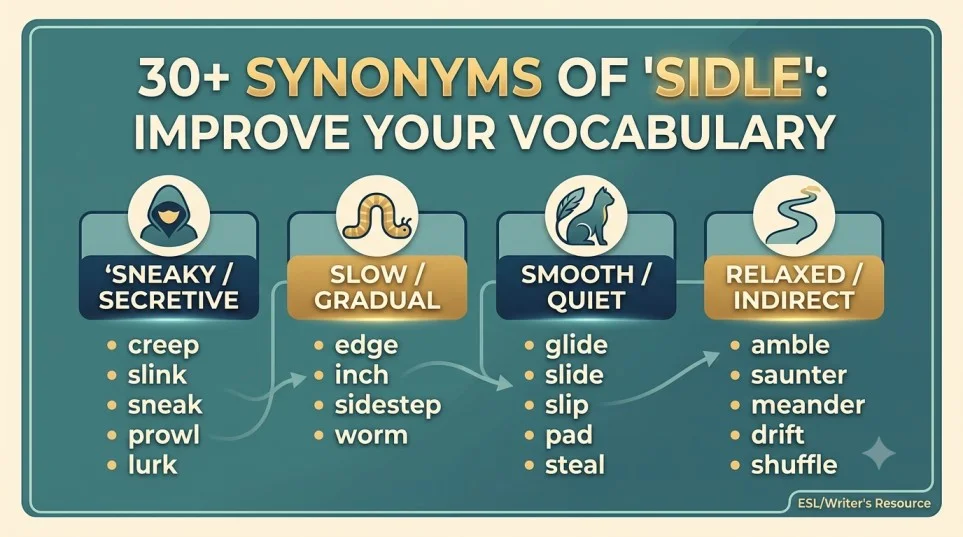
We can organize these thirty synonyms into helpful categories based on their exact shades of meaning:
- The Sneaky or Suspicious Group: Slink, skulk, sneak, prowl, lurk, shadow, gumshoe. (Best for writing mystery stories, spy thrillers, or describing bad behavior).
- The Slow and Tiny Movement Group: Edge, inch, creep, worm, sidestep. (Perfect for describing careful progress through tight spaces or difficult situations).
- The Smooth and Light Movement Group: Glide, slide, slip, steal, pad, tiptoe, slither, flit. (Great for elegant, quiet, or ghost-like movements).
- The Casual and Relaxed Group: Saunter, amble, meander, drift, coast, wind, snake, filter, shuffle. (Ideal for peaceful walks, nature scenes, or lazy days).
Categorizing these words helps writers pick the absolute best word for their specific scene. For example, a spy does not “amble” into an enemy base; they “sneak” or “skulk.”
Antonyms of [sidle]
- Confront (verb): To stand directly in front of someone or meet them face-to-face in an aggressive or bold way.
- Charge (verb): To run or rush forward rapidly and loudly toward someone or something.
- March (verb): To walk with firm, steady, and loud steps, often in a highly noticeable, public, or military style.
- Stomp (verb): To walk with extremely heavy, loud, and angry footsteps that everyone can easily hear.
Short Questions and Answers
- What does “sidle” mean?
- It means to walk slowly, quietly, and sideways, usually so that you do not draw attention.
- When should “sidle” be used?
- Use it when someone is shyly approaching a crush, sneakily trying to overhear a secret conversation, or carefully moving through a crowded room.
- Is “sidle” positive or negative?
- It depends on your story. It can be negative if a thief is doing it, but positive or cute if a shy child is doing it to hug their parent.
- How is it different from similar words?
- Unlike “march” or “run,” “sidle” is quiet and specifically sideways. Unlike “creep,” which is just quiet, “sidle” always has an indirect or angled approach.
Conclusion
Learning the word “sidle” and its thirty powerful synonyms is a fantastic way to improve your everyday vocabulary. Having these descriptive words in your writing toolkit helps you avoid boring repetition, strengthens both your writing and speaking skills, and builds your overall confidence in English. Try to practice using at least one new synonym from this guide in your daily conversations or creative writing exercises!

I am a linguist with 15 years of experience in English language teaching, including postgraduate-level instruction. My expertise includes English grammar, and I contribute as a content and blog writer, producing scholarly and educational language resources.