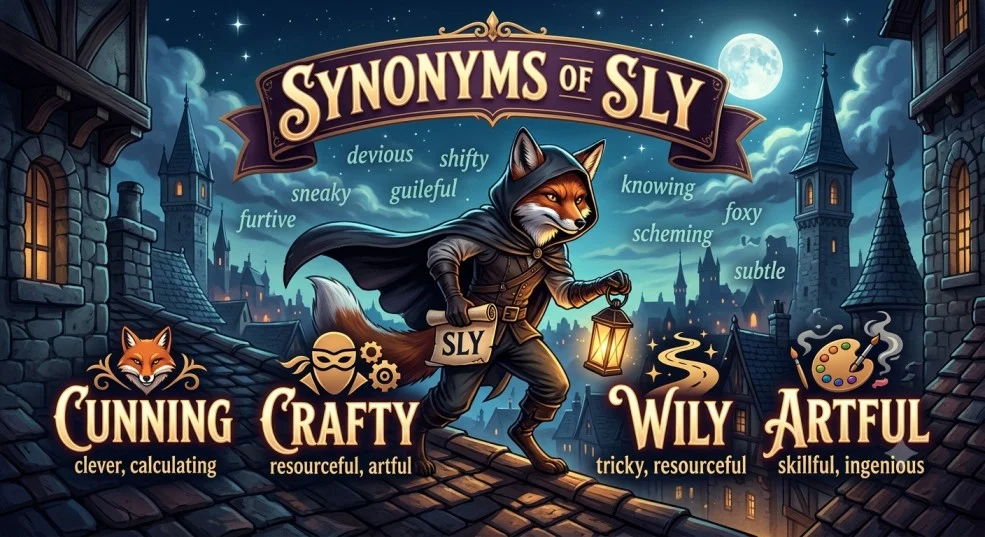
Imagine a clever fox quietly creeping into a barn to grab a quick snack without getting caught. Or think of a friend who sneaks the last cookie while no one is looking. That sneaky and clever behavior is what we call sly. People use this word every day to describe secretive or sneaky actions.
Learning synonyms for sly is important for English learners and SEO writers. Expanding your vocabulary stops boring repetition and makes your writing clear. This article explores the meaning of sly along with thirty powerful synonyms.
You will learn definitions, simple examples, correct grammar, history, pronunciations, and semantic categories written in easy sentences.
Meaning of sly
Definition
sly (Adjective): Clever in a sneaky, secret, or deceitful way.
Examples
- The sly cat crept toward the sleeping bird.
- She gave a sly smile before sharing her secret.
Connotative Meaning
(Connotation is the emotional tone or feeling a word carries beyond its basic definition.)
- Positive tone: Playfully clever, sharp, or witty.
- Negative tone: Dishonest, manipulative, or untrustworthy.
- Neutral tone: Quiet or secretive without bad intent.
Etymology
The word comes from the Old Norse word slægr, which means “cunning” or “crafty.”
- Old English (450–1100): Borrowed near the end of this era from Viking settlers.
- Middle English (1100–1500): Became slei or sly, meaning skillful or crafty.
- Modern English (1500–Present): Shifted to mean sneaky, secretive, or playfully deceitful.
Pronunciation
- US: /slaɪ/
- UK: /slaɪ/
Syllables
sly (1 syllable)
Affixation Pattern of sly
- Root: sly
- Prefix: None
- Suffix: -ly (slyly), -ness (slyness), -er (slyer), -est (slyest)
- Word Formation:
- Slyly (Adverb): Done in a sly way.
- Slyness (Noun): The quality of being sly.
- Slyer (Adjective): Comparative form of sly.
- Slyest (Adjective): Superlative form of sly.
A List of Best Synonyms of sly
1. Cunning (Adjective)
US: /ˈkʌn.ɪŋ/ | UK: /ˈkʌn.ɪŋ/
Meaning: Clever at planning tricks to get what you want.
Examples:
- The cunning fox escaped from the hunter.
- He used cunning ideas to win the game.
2. Crafty (Adjective)
US: /ˈkræf.ti/ | UK: /ˈkrɑːf.ti/
Meaning: Clever at getting an advantage, often by tricking people.
Examples:
- The crafty salesman convinced me to buy the car.
- She has a crafty way of solving hard problems.
3. Sneaky (Adjective)
US: /ˈsniː.ki/ | UK: /ˈsniː.ki/
Meaning: Doing things secretly and dishonestly.
Examples:
- He took a sneaky glance at her test paper.
- The sneaky dog ate the meat off the table.
4. Deceitful (Adjective)
US: /dɪˈsiːt.fəl/ | UK: /dɪˈsiːt.fəl/
Meaning: Making people believe things that are not true.
Examples:
- Nobody trusted the deceitful politician.
- Her deceitful words hurt her friends.
5. Wily (Adjective)
US: /ˈwaɪ.li/ | UK: /ˈwaɪ.li/
Meaning: Full of clever tricks and bad intent.
Examples:
- The wily leader always stayed ahead of his rivals.
- A wily rabbit hid under the bush.
6. Tricky (Adjective)
US: /ˈtrɪk.i/ | UK: /ˈtrɪk.i/
Meaning: Likely to deceive or deceive easily.
Examples:
- Be careful around that tricky question.
- He is a tricky player on the court.
7. Artful (Adjective)
US: /ˈɑːrt.fəl/ | UK: /ˈɑːt.fəl/
Meaning: Clever in a deceptive or skillful way.
Examples:
- The artful thief avoided every camera.
- She gave an artful answer to the news reporter.
8. Shrewd (Adjective)
US: /ʃruːd/ | UK: /ʃruːd/
Meaning: Having good judgment and quick smarts.
Examples:
- The shrewd investor saved his money.
- She made a shrewd decision today.
9. Astute (Adjective)
US: /əˈstuːt/ | UK: /əˈstʃuːt/
Meaning: Very clever at understanding situations accurately.
Examples:
- He made an astute observation about the market.
- The astute child noticed the trick quickly.
10. Furtive (Adjective)
US: /ˈfɝː.t̬ɪv/ | UK: /ˈfɜː.tɪv/
Meaning: Done quietly to avoid being seen or heard.
Examples:
- They exchanged a furtive look across the room.
- The cat made a furtive move toward the mouse.
11. Stealthy (Adjective)
US: /ˈstel.θi/ | UK: /ˈstel.θi/
Meaning: Quiet, slow, and careful so no one notices.
Examples:
- The ninja took stealthy steps in the dark.
- The owl is a stealthy hunter.
12. Underhanded (Adjective)
US: /ˌʌn.dɚˈhæn.dɪd/ | UK: /ˌʌn.dəˈhæn.dɪd/
Meaning: Done in a secret or dishonest way.
Examples:
- He used underhanded tricks to win the race.
- That was an underhanded move.
13. Devious (Adjective)
US: /ˈdiː.vi.əs/ | UK: /ˈdiː.vi.əs/
Meaning: Willing to lie and trick people to get results.
Examples:
- The villain had a devious plan.
- She took a devious route through the woods.
14. Scheming (Adjective)
US: /ˈskiː.mɪŋ/ | UK: /ˈskiː.mɪŋ/
Meaning: Making secret plans to trick others.
Examples:
- The scheming worker wanted a promotion.
- Keep away from scheming people.
15. Calculating (Adjective)
US: /ˈkæl.kjə.leɪ.t̬ɪŋ/ | UK: /ˈkæl.kjə.leɪ.tɪŋ/
Meaning: Planning carefully for personal advantage without caring for others.
Examples:
- He gave a cold and calculating look.
- She is a calculating business agent.
16. Slick (Adjective)
US: /slɪk/ | UK: /slɪk/
Meaning: Clever and convincing, but perhaps dishonest.
Examples:
- The slick speaker made many promises.
- He gave a slick presentation.
17. Guileful (Adjective)
US: /ˈɡaɪl.fəl/ | UK: /ˈɡaɪl.fəl/
Meaning: Full of trickery and deceit.
Examples:
- The guileful fox tricked the crow.
- His guileful smile gave him away.
18. Slinking (Adjective)
US: /ˈslɪŋ.kɪŋ/ | UK: /ˈslɪŋ.kɪŋ/
Meaning: Moving quietly and stealthily out of fear or guilt.
Examples:
- A slinking shadow moved near the wall.
- The slinking dog knew it did wrong.
19. Subversive (Adjective)
US: /səbˈvɝː.sɪv/ | UK: /səbˈvɜː.sɪv/
Meaning: Secretly trying to destroy or weaken an established system.
Examples:
- They printed a subversive pamphlet.
- The group held subversive meetings.
20. Treacherous (Adjective)
US: /ˈtretʃ.ɚ.əs/ | UK: /ˈtretʃ.ər.əs/
Meaning: Guilty of betrayal or deception.
Examples:
- The treacherous guard opened the gate to enemies.
- Be careful on that treacherous road.
21. Smooth (Adjective)
US: /smuːð/ | UK: /smuːð/
Meaning: Charming in a way that seems fake or tricky.
Examples:
- The smooth talker gained her trust.
- He has a smooth way of dodging hard questions.
22. Cagey (Adjective)
US: /ˈkeɪ.dʒi/ | UK: /ˈkeɪ.dʒi/
Meaning: Secretive and reluctant to give information.
Examples:
- The manager was cagey about the budget.
- He gave a cagey response to the police.
23. Designing (Adjective)
US: /dɪˈzaɪ.nɪŋ/ | UK: /dɪˈzaɪ.nɪŋ/
Meaning: Plotting and scheming for personal gain.
Examples:
- The designing stepmother wanted all the money.
- Beware of designing rivals at work.
24. Arch (Adjective)
US: /ɑːrtʃ/ | UK: /ɑːtʃ/
Meaning: Playfully sly or mischievous.
Examples:
- She gave an arch eyebrow raise.
- He made an arch comment about the food.
25. Secretive (Adjective)
US: /ˈsiː.krə.t̬ɪv/ | UK: /ˈsiː.krə.tɪv/
Meaning: Inclined to conceal thoughts, feelings, or plans.
Examples:
- My brother is very secretive about his new job.
- She kept a secretive diary.
26. Covert (Adjective)
US: /ˈkoʊ.vɝːt/ | UK: /ˈkʌv.ət/
Meaning: Secret or hidden on purpose.
Examples:
- They ran a covert mission in the desert.
- The camera recorded his covert action.
27. Elusive (Adjective)
US: /iˈluː.sɪv/ | UK: /iˈluː.sɪv/
Meaning: Difficult to catch, find, or remember.
Examples:
- The elusive criminal escaped again.
- Truth can be elusive at times.
28. Roguish (Adjective)
US: /ˈroʊ.ɡɪish/ | UK: /ˈrəʊ.ɡɪʃ/
Meaning: Playfully mischievous or slightly dishonest.
Examples:
- He had a roguish grin on his face.
- The roguish hero saved the day.
29. Machiavellian (Adjective)
US: /ˌmæk.i.əˈvel.i.ən/ | UK: /ˌmæk.i.əˈvel.i.ən/
Meaning: Using clever deceit to gain political power.
Examples:
- The king used Machiavellian tactics.
- It was a Machiavellian plot to take control.
30. Evasive (Adjective)
US: /ɪˈveɪ.sɪv/ | UK: /ɪˈveɪ.sɪv/
Meaning: Trying to avoid giving a direct answer.
Examples:
- He gave an evasive answer to the news reporter.
- Her evasive behavior made people suspicious.
Prototype Meaning
When people hear the word sly, they picture a sneaky fox or a person winking with a secret plan. The core idea is acting smartly and quietly to get what you want without getting caught.
Prototype Categorization
We can group the synonyms of sly into four helpful categories:
- Playfully Clever: Words like arch, roguish, and slick show lighthearted or playful sneakiness.
- Smart & Sharp: Words like shrewd, astute, and cunning focus on mental sharpness.
- Quiet & Hidden: Words like stealthy, furtive, covert, and secretive emphasize hiding from view.
- Dishonest & Harmful: Words like devious, treacherous, underhanded, and guileful imply bad intentions.
Categorizing these words helps writers pick the exact word for any situation.
Antonyms of sly
- Honest (Adjective): Free of deceit and always truthful.
- Frank (Adjective): Open, sincere, and direct.
- Candid (Adjective): Truthful and straightforward without hiding anything.
- Direct (Adjective): Clear and honest without tricks.
- Trustworthy (Adjective): Reliable, honest, and safe to trust.
- Naïve (Adjective): Innocent and lacking tricky judgment.
Short Questions and Answers
What does sly mean?
- Sly means being clever, sneaky, or secretive to get an outcome without being noticed.
When should sly be used?
- Use sly when describing a person, action, or look that involves clever deceit, hidden plans, or playful sneakiness.
Is sly positive or negative?
- Sly is usually negative because it implies trickery, but it can be neutral or playfully positive depending on context.
How is it different from similar words?
- Sly focuses on hidden or sneaky cleverness, whereas shrewd means smart, stealthy means quiet, and honest means truthful.
Conclusion
Learning the word sly and its synonyms grows your vocabulary quickly. Using diverse words improves your writing and speaking skills. It prevents boring repetition and helps you say exactly what you mean. Daily vocabulary practice will build your English confidence and help you write better every day.

I am a linguist with 15 years of experience in English language teaching, including postgraduate-level instruction. My expertise includes English grammar, and I contribute as a content and blog writer, producing scholarly and educational language resources.