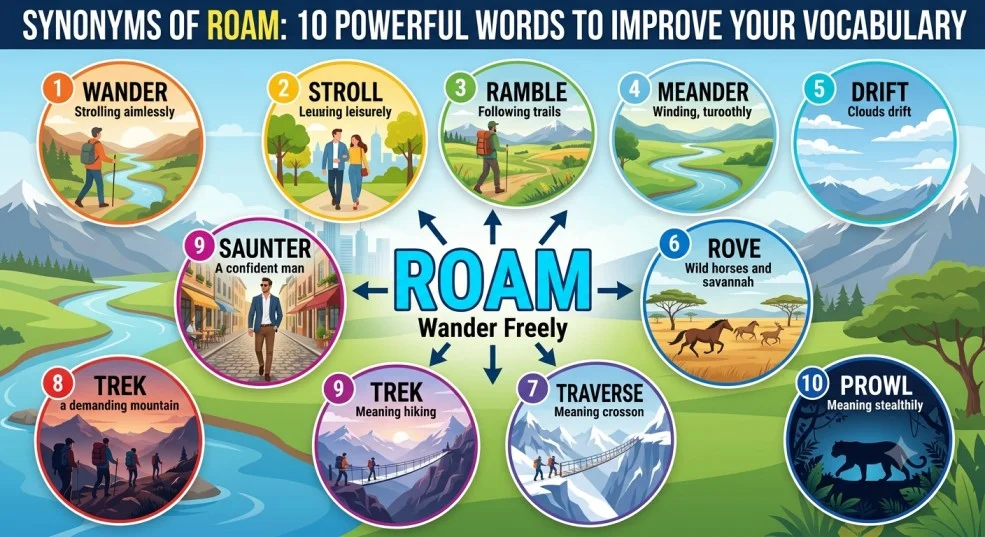
Imagine you are walking through a park on a sunny day. You have no map and no hurry. You just walk where your feet take you. This is what it means to roam. The word roam describes open, free movement without a fixed plan. People use it often because it feels peaceful, natural, and free.
Learning synonyms for roam is very helpful for English learners and SEO content writers. Repeating the same word makes writing boring. New words make your speech vivid and your writing clear. This article explores the meaning of roam alongside thirty rich synonyms.
You will learn their definitions, real-life examples, grammar rules, history, pronunciations, and semantic categories to boost your English vocabulary effortlessly.
Meaning of Roam
Definition
roam (verb): To move or travel around a large area without a fixed plan or goal.
Examples
- The cattle roam freely across the green open fields.
- We loved to roam around the old city streets during our vacation.
Connotative Meaning
(Connotation is the emotional feeling or idea that a word creates beyond its literal meaning.)
- Positive tone: Expresses freedom, peaceful exploration, relaxation, and adventure.
- Negative tone: Can suggest being lost, aimless, homeless, or uncontrolled.
- Neutral tone: Simply describes moving around an area without a set destination.
Etymology
- Origin: Middle English romen, related to Old English ramian (to strive or walk) and West Germanic roots meaning to move about.
- Old English (450–1100): Ramian meant to make a effort or move about.
- Middle English (1100–1500): Became romen, meaning to walk or wander aimlessly.
- Modern English (1500–Present): Settled into roam, used for wide physical or mental wandering.
Pronunciation
- US: /roʊm/
- UK: /rəʊm/
Syllables
roam (1 syllable)
Affixation Pattern of Roam
- Root: roam
- Prefix: None
- Suffix: None (base form)
- Word Formation:
- Roams (verb – third-person singular present)
- Roamed (verb – past tense / past participle)
- Roaming (verb / noun / adjective – present participle / gerund)
- Roamer (noun – a person or thing that roams)
A List of Wonderful Synonyms of Roam
1. Wander (Verb)
US: /ˈwɑːn.dɚ/ | UK: /ˈwɒn.də/
Meaning: To walk or move around aimlessly without a set direction.
Examples:
- She likes to wander through the forest on Sunday mornings.
- The tourists wandered around the market for hours.
2. Stroll (Verb)
US: /stroʊl/ | UK: /strəʊl/
Meaning: To walk in a slow, relaxed, and enjoyable way.
Examples:
- Couples stroll along the beach at sunset.
- Let us take a short stroll through the park.
3. Ramble (Verb)
US: /ˈræm.bəl/ | UK: /ˈræm.bəl/
Meaning: To walk for pleasure, especially in the countryside without a fixed route.
Examples:
- We rambled across the rolling hills all afternoon.
- He loves to ramble through nature paths on weekends.
4. Meander (Verb)
US: /miˈæn.dɚ/ | UK: /miˈæn.də/
Meaning: To follow a winding and turning path without rushing.
Examples:
- The river meanders gently through the valley.
- We meandered through the narrow city alleys.
5. Drift (Verb)
US: /drɪft/ | UK: /drɪft/
Meaning: To be carried along slowly by currents of water, air, or life.
Examples:
- Clouds drift slowly across the blue sky.
- He drifted from one small town to another.
6. Rove (Verb)
US: /roʊv/ | UK: /rəʊv/
Meaning: To travel constantly over a wide area without a permanent home.
Examples:
- Wild animals rove across the vast desert lands.
- Her eyes roved over the crowded room looking for a friend.
7. Stray (Verb)
US: /streɪ/ | UK: /streɪ/
Meaning: To move away from a correct path or group by accident.
Examples:
- A young lamb strayed away from the flock.
- Do not stray off the main trail in the dark.
8. Prowl (Verb)
US: /praʊl/ | UK: /praʊl/
Meaning: To move about quietly and carefully in search of prey or opportunity.
Examples:
- The tiger prowls through the thick jungle grass.
- Security guards prowl the building during the night.
9. Range (Verb)
US: /reɪndʒ/ | UK: /reɪndʒ/
Meaning: To travel or spread over a broad geographical region.
Examples:
- Buffalo range freely across the northern plains.
- Her interests range from art history to modern physics.
10. Trek (Verb)
US: /trɛk/ | UK: /trɛk/
Meaning: To make a long, slow, and often difficult journey on foot.
Examples:
- Hikers trek across the high mountain passes each summer.
- They trekked through the dense jungle for three days.
11. Saunter (Verb)
US: /ˈsɑːn.tɚ/ | UK: /ˈsɔːn.tə/
Meaning: To walk in a slow, confident, and relaxed manner.
Examples:
- He sauntered into the room as if he owned the place.
- They sauntered along the boulevard enjoying the evening air.
12. Tramp (Verb)
US: /træmp/ | UK: /træmp/
Meaning: To walk heavily and firmly over long distances.
Examples:
- Soldiers tramped through the deep muddy roads.
- We tramped all day through the snow to reach the cabin.
13. Gad (Verb)
US: /ɡæd/ | UK: /ɡæd/
Meaning: To move around continuously from place to place seeking pleasure.
Examples:
- She is always gadding about town with her friends.
- He spent the weekend gadding from one party to another.
14. Cruise (Verb)
US: /kruːz/ | UK: /kruːz/
Meaning: To travel smoothly at a steady speed without urgent effort.
Examples:
- We cruised down the coastal highway with the windows open.
- Ships cruise across the ocean during vacation trips.
15. Traverse (Verb)
US: /trəˈvɝːs/ | UK: /trəˈvɜːs/
Meaning: To pass or travel across a wide land or water region.
Examples:
- Explorers traversed the frozen desert in extreme cold.
- The railway bridge traverses the broad river.
16. Hike (Verb)
US: /haɪk/ | UK: /haɪk/
Meaning: To walk long distances in nature for health and exercise.
Examples:
- Families hike up the scenic mountain path every autumn.
- We plan to hike ten miles tomorrow morning.
17. Peregrinate (Verb)
US: /ˈpɛr.ə.ɡrɪ.neɪt/ | UK: /ˈpɛr.ɪ.ɡrɪ.neɪt/
Meaning: To travel widely on foot from country to country.
Examples:
- Scholars used to peregrinate across Europe to study.
- He peregrinated through distant lands for years.
18. Gallivant (Verb)
US: /ˈɡæl.ə.vænt/ | UK: /ˈɡæl.ɪ.vænt/
Meaning: To go around from place to place looking for fun and amusement.
Examples:
- Instead of working, he spent the day gallivanting in the city.
- Stop gallivanting around and focus on your homework.
19. Amble (Verb)
US: /ˈæm.bəl/ | UK: /ˈæm.bəl/
Meaning: To walk at an easy, slow, and unhurried pace.
Examples:
- The old man ambled down the village street.
- Donkeys amble along the dusty country lanes.
20. Trudge (Verb)
US: /trʌdʒ/ | UK: /trʌdʒ/
Meaning: To walk slowly with heavy steps due to weariness or difficult ground.
Examples:
- The tired workers trudged home through the heavy snow.
- We trudged up the muddy mountain trail.
21. Promenade (Verb)
US: /ˌprɑː.məˈneɪd/ | UK: /ˌprɒm.əˈnɑːd/
Meaning: To take a leisurely walk in public to socialise or display fashion.
Examples:
- Visitors promenade along the seaside pier in summer.
- Families promenaded through the central city park.
22. Perambulate (Verb)
US: /pəˈræm.bjə.leɪt/ | UK: /pəˈræm.bjʊ.leɪt/
Meaning: To walk over or through an area to inspect or enjoy it.
Examples:
- The guard perambulated the grounds every two hours.
- We perambulated the historic estate gardens.
23. Baffle (Verb)
US: /ˈbæf.əl/ | UK: /ˈbæf.əl/
Note: In regional dialect usage, ‘baffle’ can mean to struggle forward or wander through obstacles.
Meaning: To move with difficulty through rough or uncertain ground.
Examples:
- Travelers baffled through the deep swamp water.
- He baffled across the storm-damaged field.
24. Jog (Verb)
US: /dʒɑːɡ/ | UK: /dʒɒɡ/
Meaning: To move at a steady, gentle trotting pace over distance.
Examples:
- She jogs through the neighbourhood park every morning.
- The horse jogged down the dirt track.
25. Loiter (Verb)
US: /ˈlɔɪ.tɚ/ | UK: /ˈlɔɪ.tə/
Meaning: To stand or linger around a public place without an obvious purpose.
Examples:
- Teenagers loitered outside the shopping mall entrance.
- Signs warn visitors not to loiter near the entrance gate.
26. Patter (Verb)
US: /ˈpæt.ɚ/ | UK: /ˈpæt.ə/
Meaning: To walk or move quickly with light, quick-sounding footsteps.
Examples:
- Children patter across the hardwood floors upstairs.
- Raindrops patter gently against the window glass.
27. Float (Verb)
US: /floʊt/ | UK: /fləʊt/
Meaning: To move effortlessly and gracefully without clear destination.
Examples:
- Dancers float across the ballroom stage smoothly.
- She floated through the party greeting every guest.
28. Trekker (Noun / Verb context)
US: /ˈtrɛk.ɚ/ | UK: /ˈtrɛk.ə/
Meaning: To travel as a wanderer over rough terrain.
Examples:
- Adventurers trekker through the deep valley pathways.
- They trekked across remote wilderness zones.
29. Voyage (Verb)
US: /ˈvɔɪ.ɪdʒ/ | UK: /ˈvɔɪ.ɪdʒ/
Meaning: To make a long journey across water or space.
Examples:
- Sailors voyaged across uncharted seas in search of land.
- Spacecraft voyage into distant parts of the galaxy.
30. Navigate (Verb)
US: /ˈnæv.ə.ɡeɪt/ | UK: /ˈnæv.ɪ.ɡeɪt/
Meaning: To plan and direct a route through a wide area.
Examples:
- Ships navigate safely through narrow sea channels.
- We navigated our way through the crowded subway station.
Prototype Meaning
The prototype meaning of roam describes open, unhurried, and boundless movement across a large physical space. When people hear roam, they usually imagine wild animals moving freely across grassy plains, or a traveler walking through countryside trails without looking at a map or watching the clock.
Prototype Categorization
Categorizing synonyms helps writers pick the right word for every scenario:
- Relaxed and Slow Walking: stroll, amble, saunter, meander, promenade
- Purposeful or Heavy Journeying: trek, tramp, trudge, traverse, hike, navigate
- Social or Fun-Seeking Movement: gallivant, gad, loiter, cruise
- Stealthy or Wandering Animal Movement: prowl, range, rove, stray
- Gentle or Uncontrolled Flow: drift, float, wander, peregrinate
Grouped vocabulary lets content writers match tone accurately. For example, use saunter for a confident stroll, but choose trudge for a tired walk.
Antonyms of Roam
- Stay (verb): To remain in one specific place rather than moving away.
- Settle (verb): To establish a permanent home or fixed position.
- Remain (verb): To continue staying in the same location.
- Stop (verb): To cease movement or come to a complete halt.
- Dwell (verb): To live in a fixed building or specified area.
Short Questions and Answers
What does roam mean?
- Roam means moving around a large area freely without a fixed plan, goal, or set destination.
When should roam be used?
- Use roam when describing animals in nature, travelers exploring open spaces, or minds wandering freely without restrictions.
Is roam positive or negative?
- Roam is mostly positive or neutral because it suggests freedom, exploration, and peace. It can turn negative if it implies being lost or aimless.
How is it different from similar words?
- Roam covers broad areas without a set plan. Stroll means walking slowly for pleasure. Trudge means walking with heavy, tired steps. Prowl means moving quietly to hunt or search.
Conclusion
Mastering roam and its thirty powerful synonyms builds a richer, more expressive vocabulary. Using varied words keeps your writing fresh, avoids dull repetition, and sharpens your communication skills. Readers and listeners stay engaged when your vocabulary is dynamic and precise. Start practicing these words daily in conversation, journaling, and content creation to elevate your English fluency and confidence naturally.

I am a linguist with 15 years of experience in English language teaching, including postgraduate-level instruction. My expertise includes English grammar, and I contribute as a content and blog writer, producing scholarly and educational language resources.