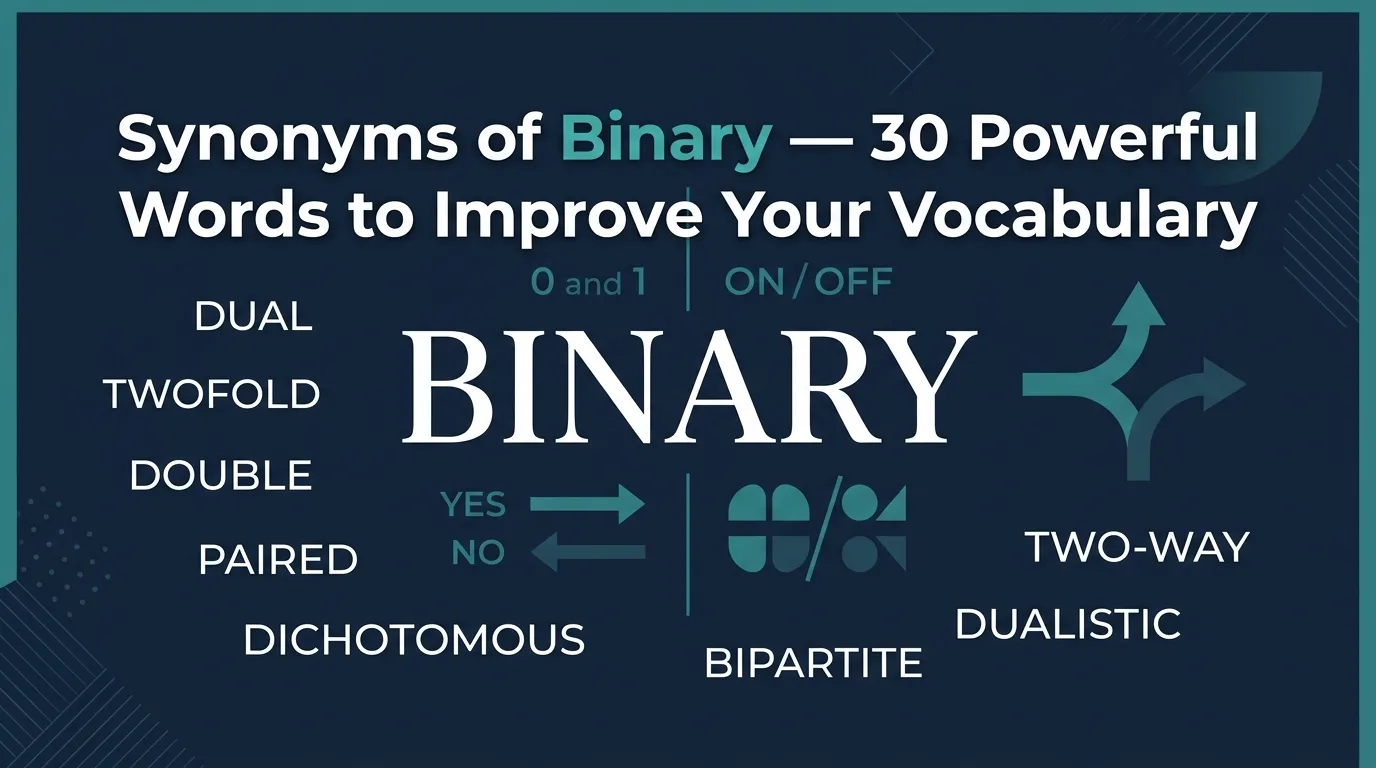
Binary means something that has two parts, choices, states, or values. Depending on the context, useful synonyms of binary include dual, twofold, double, paired, dichotomous, divided, either-or, two-way, bipartite, and dualistic.
| Synonym | Simple Meaning | Best Context |
| Dual | Having two parts | General |
| Twofold | Having two aspects | Formal |
| Double | Twice as much or two | General |
| Paired | Existing in a pair | General |
| Dichotomous | Divided into two distinct groups | Academic |
| Two-way | Involving two directions or sides | Communication |
| Bipartite | Made of two parts | Formal/technical |
| Dualistic | Based on two opposing ideas | Philosophy |
| Divided | Split into parts or groups | General |
| Either-or | Offering two choices | Informal |
This article explains binary and its synonyms through meaning, grammar, examples, connotation, history, pronunciation, word formation, and semantic categories. It also shows how to choose the right synonym for technical, academic, everyday, and figurative writing.
Meaning of Binary
Definition
Binary (adjective/noun): describes something that has two parts, two choices, or two possible states.
As an adjective, binary often describes a system based on two options, such as yes/no or on/off. As a noun, it can refer to a system or arrangement based on two parts.
Examples
- A computer uses a binary system based on 0 and 1.
- The question presents a binary choice: accept or reject.
Connotative Meaning
(Connotation means the feeling, idea, or association that a word suggests beyond its basic meaning.)
- Positive tone: Binary can suggest clarity, order, simplicity, and clear choices.
- Negative tone: It can suggest oversimplification when a complex issue is reduced to only two choices.
- Neutral tone: In mathematics and computing, binary is usually a precise technical term without a strong emotional tone.
Etymology
- Source: Binary comes from Late Latin binarius, meaning “consisting of two.”
- It is related to Latin bini, meaning “two each” or “two together.”
- English adopted the word through French and Latin-based scientific vocabulary.
Short History of the Keyword
- Old English (450–1100): Binary was not a normal Old English word. English speakers used native words related to two, twain, and pairs.
- Middle English (1100–1500): Latin and French vocabulary increasingly entered English, creating the foundation for later technical terms such as binary.
- Modern English (1500–Present): Binary became common in mathematics, logic, computing, linguistics, biology, and everyday descriptions of two-way choices.
Pronunciation (US & UK – IPA)
US: /ˈbaɪ.nə.ri/
UK: /ˈbaɪ.nə.ri/
Syllables
bi-na-ry
Affixation Pattern of Binary
- Root: bin- — connected with the idea of two.
- Prefix: None in modern English.
- Suffix: -ary — forms adjectives relating to a particular condition or category.
Word Formation of Binary
- binary — adjective/noun
- binarily — adverb, meaning “in a binary manner”
- binarity — noun, meaning the state or quality of being binary
- binarize — verb, meaning to convert something into a binary form
- binarization — noun, meaning the process of making something binary
- binarism — noun, referring to a binary system or way of thinking
Synonyms of Binary
1. Dual (Adjective)
US: /ˈduː.əl/ | UK: /ˈdjuː.əl/
Meaning: Having two parts, elements, or aspects.
Examples:
- The machine has a dual control system.
- She has a dual role as a teacher and researcher.
2. Twofold (Adjective)
US: /ˈtuː.foʊld/ | UK: /ˈtuː.fəʊld/
Meaning: Having two parts, purposes, or aspects.
Examples:
- The project has a twofold purpose.
- The benefits are twofold.
3. Double (Adjective)
US: /ˈdʌb.əl/ | UK: /ˈdʌb.əl/
Meaning: Consisting of two or twice as much.
Examples:
- The room has a double door.
- He ordered a double portion.
4. Paired (Adjective)
US: /perd/ | UK: /peəd/
Meaning: Arranged or existing in groups of two.
Examples:
- The students worked in paired groups.
- The experiment used paired samples.
5. Dichotomous (Adjective)
US: /daɪˈkɑː.tə.məs/ | UK: /daɪˈkɒt.ə.məs/
Meaning: Divided into two clearly different groups or categories.
Examples:
- The study uses a dichotomous classification.
- The issue is not as dichotomous as it first appears.
6. Two-way (Adjective)
US: /ˌtuːˈweɪ/ | UK: /ˌtuːˈweɪ/
Meaning: Involving two directions, sides, or choices.
Examples:
- The road supports two-way traffic.
- We need better two-way communication.
7. Bipartite (Adjective)
US: /baɪˈpɑːr.taɪt/ | UK: /baɪˈpɑː.taɪt/
Meaning: Divided into or consisting of two parts.
Examples:
- The agreement created a bipartite committee.
- The graph has a bipartite structure.
8. Dualistic (Adjective)
US: /ˌduː.əˈlɪs.tɪk/ | UK: /ˌdjuː.əˈlɪs.tɪk/
Meaning: Based on two contrasting or opposing ideas.
Examples:
- The theory has a dualistic structure.
- His argument presents a dualistic view of human nature.
9. Divided (Adjective)
US: /dɪˈvaɪ.dɪd/ | UK: /dɪˈvaɪ.dɪd/
Meaning: Separated into two or more parts or groups.
Examples:
- The class was divided into two teams.
- The country remains politically divided.
10. Either-or (Adjective)
US: /ˈiː.ðɚ ˌɔːr/ | UK: /ˈaɪ.ðə ˌɔː/
Meaning: Offering two alternatives with one choice between them.
Examples:
- The decision should not be an either-or choice.
- This is an either-or situation.
11. Two-part (Adjective)
US: /ˌtuːˈpɑːrt/ | UK: /ˌtuːˈpɑːt/
Meaning: Consisting of two separate parts.
Examples:
- The lesson has a two-part structure.
- We watched a two-part documentary.
12. Binary-choice (Adjective)
US: /ˈbaɪ.nə.ri tʃɔɪs/ | UK: /ˈbaɪ.nə.ri tʃɔɪs/
Meaning: Involving only two possible choices.
Examples:
- The survey asks a binary-choice question.
- The form uses a binary-choice format.
13. Bipolar (Adjective)
US: /baɪˈpoʊ.lɚ/ | UK: /baɪˈpəʊ.lə/
Meaning: Having two opposite poles, ends, or sides.
Examples:
- The debate became bipolar, with two strongly opposed sides.
- The system has a bipolar structure.
14. Dichotomic (Adjective)
US: /ˌdaɪ.kəˈtɑː.mɪk/ | UK: /ˌdaɪ.kəˈtɒm.ɪk/
Meaning: Dividing something into two contrasting groups.
Examples:
- The researcher rejected a dichotomic model.
- The theory uses a dichotomic classification.
15. Two-sided (Adjective)
US: /ˌtuːˈsaɪ.dɪd/ | UK: /ˌtuːˈsaɪ.dɪd/
Meaning: Having or involving two sides.
Examples:
- The argument is two-sided.
- We need a two-sided discussion.
16. Paired-up (Adjective)
US: /ˌperd ˈʌp/ | UK: /ˌpeəd ˈʌp/
Meaning: Put together in groups of two.
Examples:
- The children were paired-up for the activity.
- The teacher gave each paired-up team a task.
17. Complementary (Adjective)
US: /ˌkɑːm.pləˈmen.t̬ɚ.i/ | UK: /ˌkɒm.plɪˈmen.tər.i/
Meaning: Consisting of two parts that work well together.
Examples:
- The two methods are complementary.
- They offer complementary approaches to the problem.
18. Contrasting (Adjective)
US: /kənˈtræs.tɪŋ/ | UK: /kənˈtrɑː.stɪŋ/
Meaning: Showing two clearly different qualities or ideas.
Examples:
- The essay presents two contrasting views.
- The artist used contrasting colors.
19. Opposing (Adjective)
US: /əˈpoʊ.zɪŋ/ | UK: /əˈpəʊ.zɪŋ/
Meaning: Being against each other or moving in different directions.
Examples:
- The debate included two opposing opinions.
- The groups have opposing goals.
20. Alternative (Adjective/Noun)
US: /ɔːlˈtɝː.nə.t̬ɪv/ | UK: /ɔːlˈtɜː.nə.tɪv/
Meaning: One of two or more possible choices.
Examples:
- We need an alternative plan.
- You have two alternatives.
21. Binary-like (Adjective)
US: /ˈbaɪ.nə.ri laɪk/ | UK: /ˈbaɪ.nə.ri laɪk/
Meaning: Similar to a system based on two distinct options or states.
Examples:
- The system has a binary-like structure.
- Her answer created a binary-like division.
22. Bipartitional (Adjective)
US: /ˌbaɪ.pɑːrˈtɪʃ.ən.əl/ | UK: /ˌbaɪ.pɑːˈtɪʃ.ən.əl/
Meaning: Relating to a division into two parts.
Examples:
- The researchers used a bipartitional model.
- The diagram shows a bipartitional structure.
23. Dual-part (Adjective)
US: /ˌduː.əl ˈpɑːrt/ | UK: /ˌdjuː.əl ˈpɑːt/
Meaning: Made up of two connected parts.
Examples:
- The course follows a dual-part design.
- The system uses a dual-part process.
24. Binary-minded (Adjective)
US: /ˈbaɪ.nə.ri ˈmaɪn.dɪd/ | UK: /ˈbaɪ.nə.ri ˈmaɪn.dɪd/
Meaning: Tending to view issues as having only two possible sides.
Examples:
- A binary-minded approach may miss important details.
- Avoid a binary-minded view of complex issues.
25. Two-pronged (Adjective)
US: /ˌtuːˈprɑːŋd/ | UK: /ˌtuːˈprɒŋd/
Meaning: Having two main parts or approaches.
Examples:
- The company adopted a two-pronged strategy.
- The campaign has a two-pronged approach.
26. Dual-natured (Adjective)
US: /ˌduː.əl ˈneɪ.tʃɚd/ | UK: /ˌdjuː.əl ˈneɪ.tʃəd/
Meaning: Having two distinct sides or qualities.
Examples:
- The character has a dual-natured personality.
- The material has a dual-natured behavior.
27. Paired-off (Adjective)
US: /ˌperd ˈɔːf/ | UK: /ˌpeəd ˈɒf/
Meaning: Arranged into separate pairs.
Examples:
- The players were paired-off for the exercise.
- The students were paired-off before the activity began.
28. Two-valued (Adjective)
US: /ˌtuːˈvæljuːd/ | UK: /ˌtuːˈvæljuːd/
Meaning: Having only two possible values.
Examples:
- The system uses a two-valued logic.
- The variable is two-valued in this model.
29. Binary-based (Adjective)
US: /ˈbaɪ.nə.ri beɪst/ | UK: /ˈbaɪ.nə.ri beɪst/
Meaning: Built around two possible states, values, or categories.
Examples:
- The software uses a binary-based system.
- The model is binary-based rather than continuous.
30. Dual-choice (Adjective)
US: /ˌduː.əl ˈtʃɔɪs/ | UK: /ˌdjuː.əl ˈtʃɔɪs/
Meaning: Offering or involving two choices.
Examples:
- The test contains several dual-choice questions.
- The form uses a dual-choice system.
Prototype Meaning
The most typical meaning of binary is something based on two distinct options or states. People often imagine a clear division such as 0 or 1, yes or no, on or off, or one side versus another. In computing, binary has an especially precise meaning because digital systems commonly represent information with two states.
Prototype Categorization
- Two-part meanings: dual, twofold, double, two-part, and dual-part work well when something has two components.
- Clear division: dichotomous, dichotomic, bipartite, and bipartitional suit academic and technical writing.
- Two choices: either-or, alternative, dual-choice, and binary-choice are useful when discussing decisions.
- Opposition: bipolar, opposing, and contrasting emphasize differences between two sides.
- Paired concepts: paired, paired-up, and paired-off focus on things arranged in groups of two.
- Technical meanings: two-valued, binary-based, and bipartite can work in specialized contexts.
Categorization helps writers choose the best synonym because binary does not always mean exactly the same thing as “two.” Sometimes it means two parts, sometimes two choices, and sometimes two opposing states.
Antonyms of Binary
- Multiple (adjective): involving many parts, choices, or values.
- Multifaceted (adjective): having many different aspects.
- Complex (adjective): made of many connected or difficult parts.
- Continuous (adjective): changing smoothly rather than having separate states.
- Multidimensional (adjective): involving several different dimensions or aspects.
- Plural (adjective): involving more than one, often many, elements or views.
Short Questions and Answers
- What does binary mean?
Binary means involving or consisting of two parts, choices, values, or states. - When should binary be used?
Use binary when you want to describe a clear two-part system, especially in computing, mathematics, logic, science, or discussions of two choices. - Is binary positive or negative?
It is usually neutral. However, it can have a negative sense when it suggests that a complex issue has been reduced to only two choices. - How is binary different from similar words?
Dual is a broad synonym for “having two,” while dichotomous stresses a clear division between two groups. Twofold often means having two aspects, and either-or focuses on a choice between two alternatives.
Conclusion
Learning the synonyms of binary gives you more ways to describe two-part systems, choices, divisions, and opposing ideas. Words such as dual, twofold, paired, dichotomous, bipartite, two-way, and dualistic can make your writing more precise. Each synonym has its own best context. For example, dichotomous works well in academic writing, while dual is common in everyday and professional English. Understanding pronunciation, connotation, history, grammar, and word formation also helps you use these words correctly. Regular synonym practice can improve vocabulary, strengthen writing and speaking, reduce repetition, and build confidence. Try learning a few new words each day and use them in your own sentences.

I am a linguist with 15 years of experience in English language teaching, including postgraduate-level instruction. My expertise includes English grammar, and I contribute as a content and blog writer, producing scholarly and educational language resources.