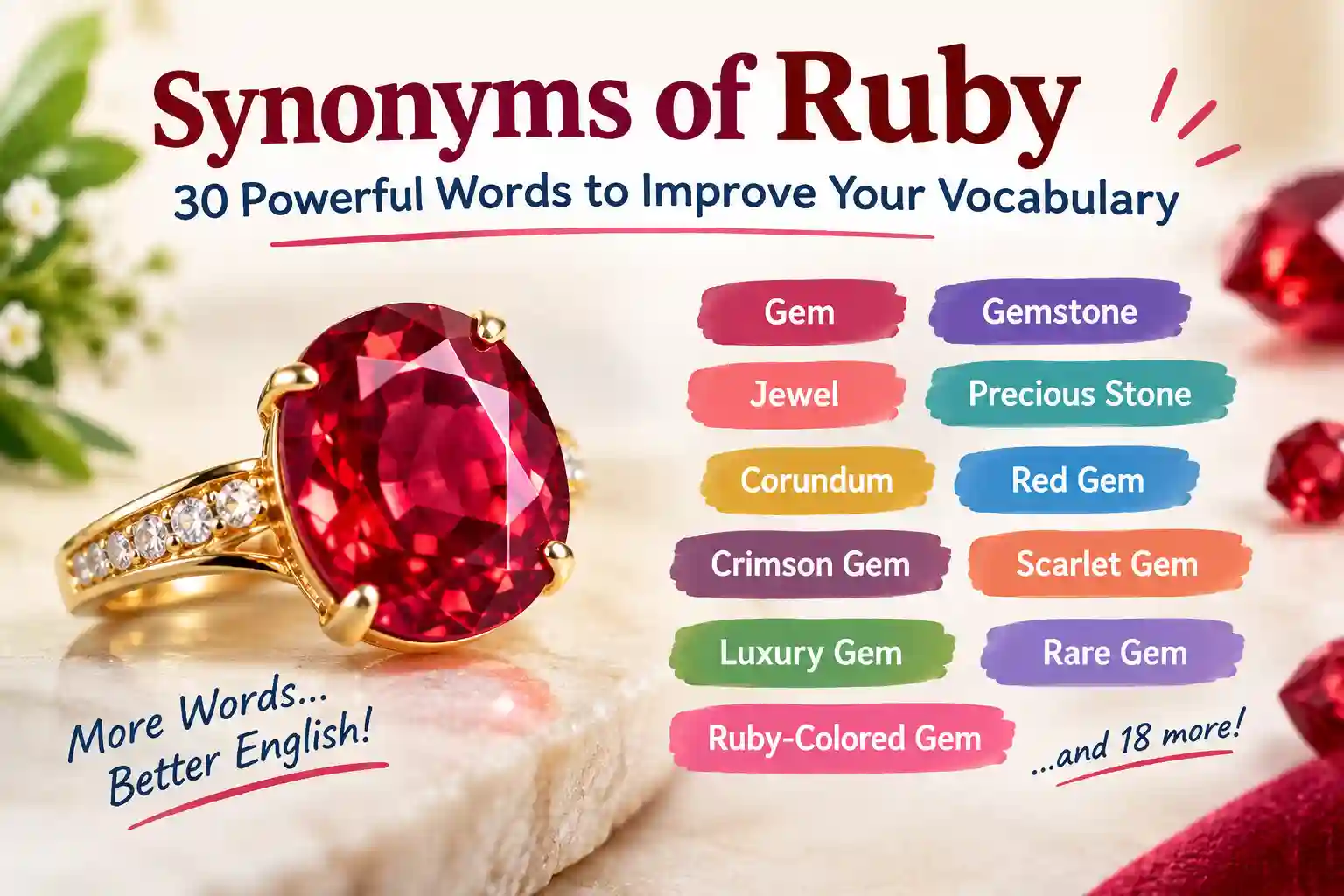
The word ruby usually means a valuable red gemstone, a red variety of corundum. Common synonyms of ruby and its closely related alternatives include gemstone, gem, jewel, precious stone, corundum, red gem, red stone, jewel stone, precious gem, and red corundum. The best word depends on whether you are talking about the stone itself, its red color, its beauty, or its value.
| Synonym / Alternative | Part of Speech | Simple Meaning |
| Gemstone | Noun | A stone valued for beauty or rarity |
| Gem | Noun | A precious or attractive stone |
| Jewel | Noun | A valuable stone used in jewelry |
| Precious stone | Noun | A valuable natural stone |
| Corundum | Noun | A mineral of which ruby is a red variety |
| Red gem | Noun | A gemstone that is red |
| Red stone | Noun | A stone with a red color |
| Precious gem | Noun | A valuable and beautiful gemstone |
| Red corundum | Noun | The mineral variety known as ruby |
| Jewel stone | Noun | A stone valued for jewelry |
This article explains the meaning of ruby, its related words, grammar, pronunciation, history, word formation, connotations, semantic categories, and practical examples. It also shows how writers and English learners can choose the most suitable alternative in different situations.
Meaning of Ruby
Definition
Ruby (noun): A ruby is a valuable, usually red gemstone that is a variety of the mineral corundum.
A ruby is known for its rich red color and beauty. It is commonly used in rings, necklaces, earrings, and other jewelry.
Examples
- She wore a beautiful ruby necklace to the wedding.
- The jeweler placed the large ruby in a gold ring.
The word can also describe a deep red color. For example, someone may describe a fabric as having a ruby color.
Connotative Meaning
Connotation means the feelings, ideas, or associations that a word suggests beyond its basic dictionary meaning.
- Positive tone: Ruby often suggests beauty, luxury, love, wealth, passion, rarity, and elegance.
- Negative tone: The word itself is not normally negative, although it may suggest excessive wealth or extravagance in some contexts.
- Neutral tone: In geology, gemology, or science, ruby can simply identify a type of mineral or gemstone without emotional meaning.
Etymology
- Ruby entered English through Old French rubi.
- Old French rubi came from Medieval Latin rubinus lapis, meaning “red stone.”
- The Latin element is connected with rubeus and ruber, meaning “red.”
- These forms are ultimately associated with the Proto-Indo-European root reudh-, meaning “red” or “ruddy.”
Short History of Ruby
- Old English (450–1100): The modern English word ruby was not yet established in Old English. English speakers used native words related to red colors, while the later gemstone term developed through French and Latin.
- Middle English (1100–1500): Forms such as rubi and rubie appeared in English around the late 12th and early 13th centuries. The word referred to the valuable red gemstone.
- Modern English (1500–Present): Ruby developed additional uses. By around 1500 it could describe something having the color of a ruby, and from the 1570s it was also used as a name for a particular red color.
Pronunciation (US & UK – IPA)
US: /ˈruːbi/
UK: /ˈruːbi/
Syllables
ru-by
Affixation Pattern of Ruby
Root: ruby
Prefix: None
Suffix: None in the basic word ruby
The word ruby is a simple noun rather than a word created by adding a productive English prefix or suffix.
Word Formation of Ruby
- Ruby — noun: a red gemstone.
- Ruby — adjective: relating to, made with, or resembling a ruby.
- Rubies — plural noun: more than one ruby.
- Ruby-red — compound adjective: strongly red like a ruby.
- Rubied — adjective/participial form: decorated or colored with ruby-like qualities.
- Rubying — rare verbal form associated with making or treating something in a ruby-like manner.
Synonyms of Ruby
1. Gem (Noun)
US IPA: /dʒɛm/ | UK IPA: /dʒɛm/
Meaning: A valuable or attractive stone, especially one used in jewelry.
Examples:
- The necklace contained a bright red gem.
- She admired the beautiful gem in the display case.
2. Gemstone (Noun)
US IPA: /ˈdʒɛmˌstoʊn/ | UK IPA: /ˈdʒɛmstəʊn/
Meaning: A natural stone valued for its beauty, rarity, or use in jewelry.
Examples:
- Ruby is a famous red gemstone.
- The jeweler carefully examined the gemstone.
3. Jewel (Noun)
US IPA: /ˈdʒuːəl/ | UK IPA: /ˈdʒuːəl/
Meaning: A valuable stone used as an ornament or in jewelry.
Examples:
- The ring held a bright red jewel.
- The museum displayed a rare jewel.
4. Precious Stone (Noun)
US IPA: /ˈprɛʃəs stoʊn/ | UK IPA: /ˈpreʃəs stəʊn/
Meaning: A valuable natural stone prized for beauty and rarity.
Examples:
- The ruby is often described as a precious stone.
- She collected information about rare precious stones.
5. Precious Gem (Noun)
US IPA: /ˈprɛʃəs dʒɛm/ | UK IPA: /ˈpreʃəs dʒɛm/
Meaning: A valuable gemstone that is admired for its beauty or rarity.
Examples:
- The necklace contained a large precious gem.
- The ruby was treated as a precious gem.
6. Corundum (Noun)
US IPA: /kəˈrʌndəm/ | UK IPA: /kəˈrʌndəm/
Meaning: A hard mineral of which ruby is the red variety.
Examples:
- Ruby is a red variety of corundum.
- The geologist studied the corundum sample.
7. Red Corundum (Noun)
US IPA: /rɛd kəˈrʌndəm/ | UK IPA: /red kəˈrʌndəm/
Meaning: Corundum that has the red color associated with ruby.
Examples:
- The specimen was identified as red corundum.
- The jeweler explained that ruby is red corundum.
8. Red Gem (Noun)
US IPA: /rɛd dʒɛm/ | UK IPA: /red dʒɛm/
Meaning: A gemstone that has a red color.
Examples:
- The ring featured a brilliant red gem.
- She chose a red gem for her necklace.
9. Red Stone (Noun)
US IPA: /rɛd stoʊn/ | UK IPA: /red stəʊn/
Meaning: A stone characterized by a red color.
Examples:
- The crown was decorated with a red stone.
- A polished red stone caught her attention.
10. Jewel Stone (Noun)
US IPA: /ˈdʒuːəl stoʊn/ | UK IPA: /ˈdʒuːəl stəʊn/
Meaning: A stone valued for decorative or jewelry use.
Examples:
- The artist used a bright jewel stone in the design.
- The box contained several colorful jewel stones.
11. Red Jewel (Noun)
US IPA: /rɛd ˈdʒuːəl/ | UK IPA: /red ˈdʒuːəl/
Meaning: A jewel characterized by a rich red color.
Examples:
- The queen wore a striking red jewel.
- The necklace had a large red jewel at its center.
12. Precious Jewel (Noun)
US IPA: /ˈprɛʃəs ˈdʒuːəl/ | UK IPA: /ˈpreʃəs ˈdʒuːəl/
Meaning: A valuable jewel that is prized for beauty or rarity.
Examples:
- The ruby was treated as a precious jewel.
- The collection included several precious jewels.
13. Ornamental Stone (Noun)
US IPA: /ˌɔːrnəˈmɛntl stoʊn/ | UK IPA: /ˌɔːnəˈmentl stəʊn/
Meaning: A stone used mainly to make something beautiful or decorative.
Examples:
- The ruby served as an ornamental stone.
- The crown was decorated with several ornamental stones.
14. Jewelry Stone (Noun)
US IPA: /ˈdʒuːəlri stoʊn/ | UK IPA: /ˈdʒuːəlri stəʊn/
Meaning: A stone used in making jewelry.
Examples:
- Ruby is a popular jewelry stone.
- The designer selected a red jewelry stone.
15. Gemstone Mineral (Noun)
US IPA: /ˈdʒɛmstoʊn ˈmɪnərəl/ | UK IPA: /ˈdʒɛmstəʊn ˈmɪnərəl/
Meaning: A mineral that has value because it can be used as a gemstone.
Examples:
- Ruby is an important gemstone mineral.
- The museum displayed the gemstone mineral with other specimens.
16. Red Precious Stone (Noun)
US IPA: /rɛd ˈprɛʃəs stoʊn/ | UK IPA: /red ˈpreʃəs stəʊn/
Meaning: A valuable stone distinguished by its red color.
Examples:
- The necklace contained a red precious stone.
- The jeweler carefully inspected the red precious stone.
17. Red Gemstone (Noun)
US IPA: /rɛd ˈdʒɛmˌstoʊn/ | UK IPA: /red ˈdʒɛmstəʊn/
Meaning: A gemstone with a red appearance.
Examples:
- The ring featured a large red gemstone.
- She wanted a deep-colored red gemstone.
18. Mineral Gem (Noun)
US IPA: /ˈmɪnərəl dʒɛm/ | UK IPA: /ˈmɪnərəl dʒɛm/
Meaning: A naturally occurring mineral valued as a gem.
Examples:
- Ruby is a well-known mineral gem.
- The expert identified the stone as a mineral gem.
19. Fine Gem (Noun)
US IPA: /faɪn dʒɛm/ | UK IPA: /faɪn dʒɛm/
Meaning: A high-quality or beautiful gemstone.
Examples:
- The ruby was considered a fine gem.
- The collector searched for a fine gem.
20. Rare Gem (Noun)
US IPA: /rɛr dʒɛm/ | UK IPA: /reə dʒɛm/
Meaning: A gemstone that is uncommon or difficult to find.
Examples:
- The collector discovered a rare gem.
- The museum displayed a particularly rare gem.
21. Precious Mineral (Noun)
US IPA: /ˈprɛʃəs ˈmɪnərəl/ | UK IPA: /ˈpreʃəs ˈmɪnərəl/
Meaning: A valuable mineral that is prized for its qualities or beauty.
Examples:
- The ruby is a highly valued precious mineral in jewelry contexts.
- The researcher examined the precious mineral closely.
22. Red Crystal (Noun)
US IPA: /rɛd ˈkrɪstəl/ | UK IPA: /red ˈkrɪstəl/
Meaning: A crystal with a red appearance.
Examples:
- The display contained a beautiful red crystal.
- Light passed through the polished red crystal.
23. Crimson Gem (Noun)
US IPA: /ˈkrɪmzən dʒɛm/ | UK IPA: /ˈkrɪmzən dʒɛm/
Meaning: A gem with a deep, rich red color.
Examples:
- The necklace featured a crimson gem.
- She admired the deep color of the crimson gem.
24. Scarlet Gem (Noun)
US IPA: /ˈskɑːrlət dʒɛm/ | UK IPA: /ˈskɑːlət dʒɛm/
Meaning: A gem with a vivid scarlet-red appearance.
Examples:
- The crown held a bright scarlet gem.
- The artist painted a scarlet gem at the center of the design.
25. Blood-Red Gem (Noun)
US IPA: /ˌblʌd ˈrɛd dʒɛm/ | UK IPA: /ˌblʌd ˈred dʒɛm/
Meaning: A gem with an especially deep and intense red color.
Examples:
- The ring contained a blood-red gem.
- The story described a mysterious blood-red gem.
26. Red Jewel Stone (Noun)
US IPA: /rɛd ˈdʒuːəl stoʊn/ | UK IPA: /red ˈdʒuːəl stəʊn/
Meaning: A decorative stone that has a rich red appearance.
Examples:
- The necklace used a polished red jewel stone.
- The artist placed a red jewel stone in the center.
27. Ornamental Gem (Noun)
US IPA: /ˌɔːrnəˈmɛntl dʒɛm/ | UK IPA: /ˌɔːnəˈmentl dʒɛm/
Meaning: A gem used mainly for decoration or jewelry.
Examples:
- The ruby became the main ornamental gem in the crown.
- The designer selected an ornamental gem for the bracelet.
28. Luxury Gem (Noun)
US IPA: /ˈlʌkʃəri dʒɛm/ | UK IPA: /ˈlʌkʃəri dʒɛm/
Meaning: A valuable gem associated with luxury and high value.
Examples:
- The ruby is often viewed as a luxury gem.
- The necklace was decorated with a rare luxury gem.
29. Red Jewel Gem (Noun)
US IPA: /rɛd ˈdʒuːəl dʒɛm/ | UK IPA: /red ˈdʒuːəl dʒɛm/
Meaning: A decorative gem recognized for its red color.
Examples:
- The artist added a red jewel gem to the design.
- The display highlighted the brilliant red jewel gem.
30. Ruby-Colored Gem (Noun)
US IPA: /ˈruːbi ˌkʌlərd dʒɛm/ | UK IPA: /ˈruːbi ˌkʌləd dʒɛm/
Meaning: A gem that has a color similar to the rich red associated with ruby.
Examples:
- The necklace contained a ruby-colored gem.
- She chose a ruby-colored gem for the centerpiece.
Note: Terms such as gemstone, gem, jewel, and corundum are useful lexical alternatives, while expressions such as crimson gem, red gemstone, and ruby-colored gem are descriptive alternatives rather than strict dictionary synonyms. This distinction is important for accurate vocabulary learning.
Prototype Meaning
The most typical meaning of ruby is a valuable, transparent or translucent red gemstone. When people hear ruby, they usually imagine a deep red jewel set in a ring, necklace, crown, or other piece of fine jewelry. The word also suggests qualities such as beauty, rarity, luxury, passion, and elegance.
Prototype Categorization
- Gemstone category: gem, gemstone, jewel, precious gem, and precious stone are broad terms for valuable stones.
- Mineral category: corundum, red corundum, and mineral gem are more technical terms.
- Color category: red gem, crimson gem, scarlet gem, and blood-red gem focus on appearance.
- Jewelry category: jewelry stone, ornamental stone, and ornamental gem focus on decorative use.
- Value category: rare gem, fine gem, and luxury gem emphasize quality, rarity, or status.
- Descriptive category: ruby-colored gem describes something that looks like ruby without necessarily being an actual ruby.
Categorization helps writers choose the right word. A science article may prefer corundum, a jewelry article may use gemstone or jewel, and creative writing may use crimson gem or blood-red gem to create a vivid image.
Antonyms of Ruby
There is no perfect antonym for ruby because a gemstone does not have a direct opposite in the same way that hot has cold. However, depending on the intended meaning, several contrasting words can be useful.
- Ordinary stone (noun): A common stone without the rarity or value of a ruby.
- Common mineral (noun): A mineral that is widespread and not normally valued as a precious gem.
- Imitation gem (noun): A manufactured or artificial object made to look like a real gemstone.
- Fake jewel (noun): An imitation object presented as a valuable jewel.
- Colorless stone (noun): A stone lacking the rich red color associated with ruby.
- Dull stone (noun): A stone without strong color, shine, or decorative appeal.
- Base material (noun): A material lacking the special value normally associated with a precious gemstone.
Short Questions and Answers
- What does ruby mean?
A ruby is a valuable red gemstone and a red variety of corundum. - When should ruby be used?
Use ruby when you are talking specifically about the gemstone or the characteristic ruby-red color. - Is ruby positive or negative?
Ruby is usually neutral as a dictionary word, but it often has positive associations such as beauty, luxury, love, and rarity. - How is ruby different from similar words?
Gemstone is a broad term, jewel emphasizes decorative or valuable use, and corundum is the technical mineral term. Ruby specifically identifies the red gemstone variety.
Conclusion
Learning the synonyms of ruby and its related vocabulary can make your English more precise and expressive. The word usually refers to a valuable red gemstone, but its related terms highlight different ideas. Gem and gemstoneare broad choices, while corundum is more technical. Words such as crimson gem, scarlet gem, and blood-red gem can create stronger visual images in creative writing.
Knowing these alternatives helps you avoid repetition and select the right word for different situations. It can also strengthen both speaking and writing skills. For English learners, studying a word through its meaning, pronunciation, history, connotation, grammar, and related vocabulary gives deeper understanding. Try using one new ruby-related word each day in a sentence. Daily practice can steadily improve vocabulary, writing ability, and confidence.

I am a linguist with 15 years of experience in English language teaching, including postgraduate-level instruction. My expertise includes English grammar, and I contribute as a content and blog writer, producing scholarly and educational language resources.