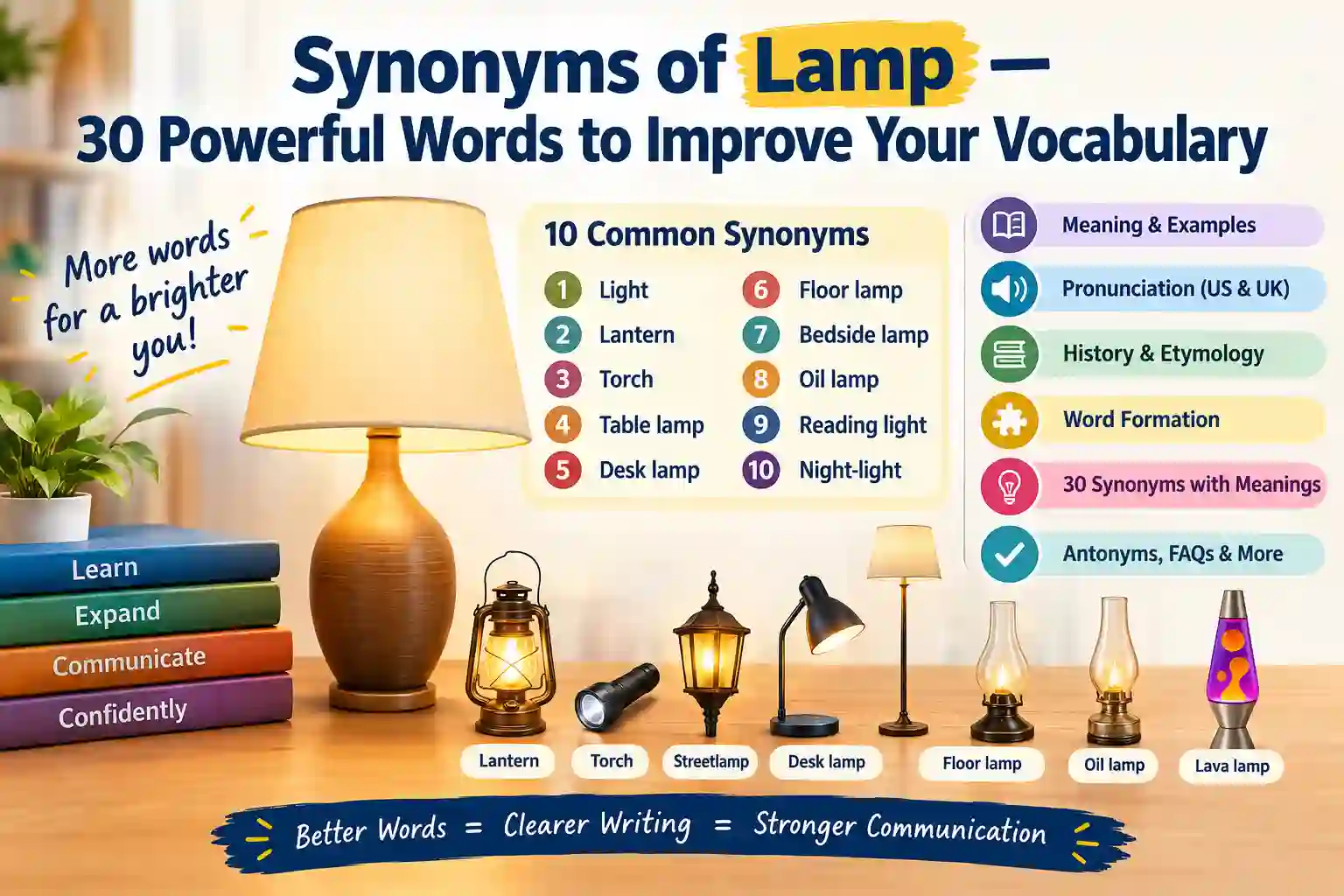
A lamp is a device that gives light. Common synonyms and related words include light, lantern, torch, bedside light, table lamp, desk lamp, floor lamp, oil lamp, and reading light. Some words name a type of lamp, while others describe a different device that gives light. The best word depends on the lamp’s design, power source, and use.
10 Common Synonyms of Lamp
| No. | Synonym | Simple meaning |
| 1 | Light | A device that gives light |
| 2 | Lantern | A portable light, often with a protective cover |
| 3 | Torch | A portable light; in British English, usually a flashlight |
| 4 | Table lamp | A lamp placed on a table |
| 5 | Desk lamp | A lamp used for reading or working |
| 6 | Floor lamp | A tall lamp that stands on the floor |
| 7 | Bedside lamp | A lamp placed near a bed |
| 8 | Oil lamp | A lamp that burns oil for light |
| 9 | Reading light | A light used to read |
| 10 | Night-light | A small light used at night |
Note: These words are not exact substitutes in every sentence. Some name specific types of lamps, while others describe lights with similar uses.
Purpose of This Article
This guide explains the meaning, definition, connotation, history, pronunciation, syllables, and word formation of lamp. It also explores 30 synonyms with simple meanings, American and British IPA pronunciations, and example sentences. Finally, it groups related words by use and meaning, explains antonyms and common questions, and shows how to choose the right word for clear English writing and speech.
Meaning of Lamp
Definition
Lamp (noun): A device that produces light, usually by using electricity, oil, or another source of energy.
A lamp can light a room, help someone read, or make a space feel warm and welcoming.
Examples
- I turned on the lamp beside my bed.
- The old lamp gives a soft light to the room.
Connotative Meaning
(Connotation means the feelings or ideas that a word suggests beyond its basic meaning.)
- Positive tone: A lamp may suggest comfort, hope, warmth, learning, or safety.
- Negative tone: In some stories, a dim or broken lamp may suggest fear, sadness, danger, or loneliness.
- Neutral tone: A lamp can simply mean a device used to provide light.
The tone depends on the sentence. For example, a warm lamp may suggest comfort, while a flickering lamp in a dark room may create suspense.
Etymology
- Source language: The English word lamp came through French from Latin lampas, meaning “lamp” or “torch.”
- Earlier origin: Latin lampas came from Greek lampás, meaning “torch” or “lamp,” related to the idea of shining.
- Original meaning: The word referred to a device or object that produced light.
Short History of Lamp
- Old English (450–1100): People used words such as lēoht for light. Lamps and other lighting devices existed, but the modern English word lamp was not yet common in its present form.
- Middle English (1100–1500): The word lamp entered English through French and Latin influences. It referred to a device that provided light, often by burning oil.
- Modern English (1500–Present): The word became widely used for many kinds of lighting devices. With the growth of electric lighting, it also came to refer to electric lamps used in homes, offices, and public places.
Pronunciation (US & UK – IPA)
US: /læmp/
UK: /læmp/
Syllables
lamp — one syllable.
Affixation Pattern of Lamp
- Root: lamp
- Prefix: None in the basic word.
- Suffix: None in the basic word.
Word Formation of Lamp
The word lamp can form several related words and compounds. These do not all have the same grammatical role.
- Lamp (noun): A device that gives light.
- Lamps (plural noun): More than one lamp.
- Lamped (verb, rare): Supplied or fitted with lamps in certain technical uses.
- Lamping (verb/noun): The act of using a lamp, especially in some specialized contexts.
- Lampshade (compound noun): A cover fitted over or around a lamp to soften or direct its light.
- Lamplight (compound noun): Light produced by a lamp.
- Lamplighter (compound noun): A person who lights street lamps, especially in the past.
- Lampstand (compound noun): A stand or support for a lamp.
- Lamp-like (compound adjective): Resembling a lamp in appearance or function.
These examples include inflected forms and compound words. They are not all separate words made by adding a standard prefix or suffix to a lamp.
30 Synonyms of Lamp With Meanings, Pronunciation, and Examples
The following words include close synonyms, types of lamps, and related lighting devices. Each entry explains the word in simple English and provides American and British IPA pronunciations.
1. Light (Noun)
US IPA: /laɪt/ | UK IPA: /laɪt/
Meaning: A device that produces light or the brightness that makes things visible.
Examples:
- Please turn on the light in the kitchen.
- This light is bright enough for reading.
2. Lantern (Noun)
US IPA: /ˈlæn.tɚn/ | UK IPA: /ˈlæn.tən/
Meaning: A portable lighting device, often protected by a glass or plastic cover.
Examples:
- We carried a lantern during the camping trip.
- The lantern lit our path through the garden.
3. Torch (Noun)
US IPA: /tɔːrtʃ/ | UK IPA: /tɔːtʃ/
Meaning: A portable source of light; in British English, it usually means a handheld electric light.
Examples:
- She used a torch to find her keys.
- Keep a torch in your bag during a power cut.
4. Table Lamp (Noun)
US IPA: /ˈteɪ.bəl ˌlæmp/ | UK IPA: /ˈteɪ.bəl ˌlæmp/
Meaning: A lamp designed to stand on a table or another flat surface.
Examples:
- A table lamp stands beside the sofa.
- I bought a new table lamp for my room.
5. Desk Lamp (Noun)
US IPA: /ˈdesk ˌlæmp/ | UK IPA: /ˈdesk ˌlæmp/
Meaning: A lamp used on a desk to provide light for work or study.
Examples:
- My desk lamp helps me read small words.
- He switched on the desk lamp before studying.
6. Floor Lamp (Noun)
US IPA: /ˈflɔːr ˌlæmp/ | UK IPA: /ˈflɔː ˌlæmp/
Meaning: A tall lamp that stands on the floor.
Examples:
- A floor lamp stands next to the armchair.
- The floor lamp adds light to the sitting room.
7. Bedside Lamp (Noun)
US IPA: /ˈbed.saɪd ˌlæmp/ | UK IPA: /ˈbed.saɪd ˌlæmp/
Meaning: A lamp placed near a bed for reading or other nighttime activities.
Examples:
- I turned off my bedside lamp before sleeping.
- Her bedside lamp has a soft yellow glow.
8. Oil Lamp (Noun)
US IPA: /ˈɔɪl ˌlæmp/ | UK IPA: /ˈɔɪl ˌlæmp/
Meaning: A lamp that burns oil to produce light.
Examples:
- The family used an oil lamp during the power cut.
- The museum displayed an old oil lamp.
9. Reading Lamp (Noun)
US IPA: /ˈriː.dɪŋ ˌlæmp/ | UK IPA: /ˈriː.dɪŋ ˌlæmp/
Meaning: A lamp designed to provide light for reading.
Examples:
- She placed a reading lamp beside her chair.
- A good reading lamp makes small print easier to see.
10. Night-Light (Noun)
US IPA: /ˈnaɪt.laɪt/ | UK IPA: /ˈnaɪt.laɪt/
Meaning: A small light kept on at night, often to make a room easier to navigate.
Examples:
- The child sleeps with a night-light.
- A night-light helps us see the hallway in the dark.
11. Luminaire (Noun)
US IPA: /ˌluː.məˈner/ | UK IPA: /ˌluː.mɪˈneə/
Meaning: A complete lighting unit, including its light source and supporting parts.
Examples:
- The architect selected a modern luminaire for the lobby.
- Each luminaire was checked before installation.
12. Light Fixture (Noun)
US IPA: /ˈlaɪt ˌfɪks.tʃɚ/ | UK IPA: /ˈlaɪt ˌfɪks.tʃə/
Meaning: A device fitted in a building to hold or provide lighting.
Examples:
- The electrician replaced the broken light fixture.
- A new light fixture brightened the hallway.
13. Lighting Fixture (Noun)
US IPA: /ˈlaɪ.tɪŋ ˌfɪks.tʃɚ/ | UK IPA: /ˈlaɪ.tɪŋ ˌfɪks.tʃə/
Meaning: A unit installed to provide light in a room or outdoor area.
Examples:
- The hotel installed a lighting fixture above each table.
- This lighting fixture suits the modern design.
14. Illuminator (Noun)
US IPA: /ɪˈluː.məˌneɪ.t̬ɚ/ | UK IPA: /ɪˈluː.mɪˌneɪ.tə/
Meaning: A device or source that provides light to an object or area.
Examples:
- The instrument uses an illuminator to light the sample.
- The technician adjusted the illuminator for a clear view.
15. Electric Light (Noun)
US IPA: /ɪˈlek.trɪk ˈlaɪt/ | UK IPA: /ɪˈlek.trɪk ˈlaɪt/
Meaning: A light that uses electricity to produce illumination.
Examples:
- The electric light came on at sunset.
- We use an electric light to brighten the room.
16. Kerosene Lamp (Noun)
US IPA: /ˈker.ə.siːn ˌlæmp/ | UK IPA: /ˈker.ə.siːn ˌlæmp/
Meaning: A lamp that burns kerosene as fuel.
Examples:
- The farmer kept a kerosene lamp in the shed.
- They used a kerosene lamp where there was no electricity.
17. Gas Lamp (Noun)
US IPA: /ˈɡæs ˌlæmp/ | UK IPA: /ˈɡæs ˌlæmp/
Meaning: A lamp that uses gas as its fuel.
Examples:
- The old street had a historic gas lamp.
- The guide explained how the gas lamp worked.
18. Streetlamp (Noun)
US IPA: /ˈstriːtˌlæmp/ | UK IPA: /ˈstriːtˌlæmp/
Meaning: A lamp used to light a street or public road.
Examples:
- A streetlamp lit the quiet road.
- The broken streetlamp made the corner hard to see.
19. Streetlight (Noun)
US IPA: /ˈstriːtˌlaɪt/ | UK IPA: /ˈstriːtˌlaɪt/
Meaning: An outdoor light that helps people see streets at night.
Examples:
- The streetlight shone through our window.
- Workers repaired the streetlight near the school.
20. Flashlight (Noun)
US IPA: /ˈflæʃˌlaɪt/ | UK IPA: /ˈflæʃˌlaɪt/
Meaning: A small, portable electric light that a person holds in the hand.
Examples:
- I used a flashlight to look under the bed.
- Keep a flashlight ready for emergencies.
British English usually uses torch for this device.
21. Headlamp (Noun)
US IPA: /ˈhedˌlæmp/ | UK IPA: /ˈhedˌlæmp/
Meaning: A light worn on the head or fitted to the front of a vehicle.
Examples:
- The climber wore a headlamp in the cave.
- The car’s headlamp needed a new bulb.
22. Headlight (Noun)
US IPA: /ˈhedˌlaɪt/ | UK IPA: /ˈhedˌlaɪt/
Meaning: A light fitted to the front of a vehicle.
Examples:
- The driver turned on the headlights at dusk.
- One headlight stopped working during the trip.
23. Searchlight (Noun)
US IPA: /ˈsɝːtʃˌlaɪt/ | UK IPA: /ˈsɜːtʃˌlaɪt/
Meaning: A powerful light used to search or illuminate a distant area.
Examples:
- The searchlight swept across the dark field.
- The rescue team used a searchlight to find the boat.
24. Floodlight (Noun)
US IPA: /ˈflʌdˌlaɪt/ | UK IPA: /ˈflʌdˌlaɪt/
Meaning: A powerful light that spreads light over a large area.
Examples:
- Floodlights brightened the football ground.
- A floodlight illuminated the building at night.
25. Spotlight (Noun)
US IPA: /ˈspɑːtˌlaɪt/ | UK IPA: /ˈspɒtˌlaɪt/
Meaning: A light that directs a bright beam onto a particular person or object.
Examples:
- The spotlight shone on the singer.
- The actor stood under the spotlight.
26. Beacon (Noun)
US IPA: /ˈbiː.kən/ | UK IPA: /ˈbiː.kən/
Meaning: A light or signal that guides people or warns them of danger.
Examples:
- The lighthouse acted as a beacon for ships.
- A flashing beacon warned drivers about the roadwork.
27. Signal Lamp (Noun)
US IPA: /ˈsɪɡ.nəl ˌlæmp/ | UK IPA: /ˈsɪɡ.nəl ˌlæmp/
Meaning: A lamp used to send or display signals.
Examples:
- The signal lamp flashed a message across the water.
- The railway worker checked the signal lamp.
28. Hurricane Lamp (Noun)
US IPA: /ˈhɝː.əˌkeɪn ˌlæmp/ | UK IPA: /ˈhʌr.ɪ.kən ˌlæmp/
Meaning: A portable oil lamp designed with a protective glass chimney to help its flame withstand wind.
Examples:
- The family lit a hurricane lamp during the storm.
- The old hurricane lamp stood on the shelf.
29. Lantern Lamp (Noun)
US IPA: /ˈlæn.tɚn ˌlæmp/ | UK IPA: /ˈlæn.tən ˌlæmp/
Meaning: A lamp designed in the shape or style of a lantern.
Examples:
- A lantern lamp decorated the garden path.
- They hung a lantern lamp beside the entrance.
Usage note: This is a descriptive phrase, not a standard synonym in every context. Lantern is usually the more natural word.
30. Lava Lamp (Noun)
US IPA: /ˈlɑː.və ˌlæmp/ | UK IPA: /ˈlɑː.və ˌlæmp/
Meaning: A decorative lamp containing coloured liquid and wax that move when heated.
Examples:
- The lava lamp added colour to his desk.
- We watched the shapes move inside the lava lamp.
Prototype Meaning of Lamp
The most typical meaning of lamp is a device that produces light for a room, desk, or other space. When people hear this word, they often imagine an electric lamp with a bulb and a shade, placed on a table or beside a bed. A lamp may provide bright light for work or soft light for rest. Its main purpose is to help people see, but it can also make a room look attractive and feel comfortable.
Prototype Categorization
Synonyms and related lighting words can be grouped by their main purpose.
- Home lighting: Table lamp, floor lamp, bedside lamp, and night-light are used in homes.
- Study and work lighting: Desk lamp and reading lamp provide light for reading, writing, and other tasks.
- Portable lighting: Lantern, torch, flashlight, and headlamp help people see when moving around.
- Traditional lighting: Oil lamp, kerosene lamp, gas lamp, and hurricane lamp use different fuels or older lighting designs.
- Outdoor lighting: Streetlamp, streetlight, floodlight, and searchlight light roads, buildings, and large spaces.
- Focused lighting: Spotlight directs light at one object or person, while an illuminator provides light for a particular task.
- Decorative lighting: Lava lamp adds colour and visual interest to a room.
- Technical lighting: Luminaire, light fixture, lighting fixture, and signal lamp are used in technical, building, or communication contexts.
Categorization helps writers choose the best synonym for each situation. For example, desk lamp is more precise than light when describing a study space. Similarly, streetlight is a better choice for a road, while spotlight suits a stage performance. Choosing specific words makes writing clearer and more accurate.
Antonyms of Lamp
The word lamp has no exact antonym because it names an object. However, some words express the opposite idea of light or describe the absence of illumination.
- Darkness (noun): The state of having little or no light. Example: Darkness filled the empty room.
- Dark (adjective): Having little or no light. Example: The room became dark after sunset.
- Blackout (noun): A loss of electric power or a deliberate period of darkness. Example: The blackout left the whole street without electric light.
- Dimness (noun): A lack of brightness. Example: The dimness made reading difficult.
- Shadow (noun): A dark area formed when an object blocks light. Example: A shadow appeared on the wall.
These words are not direct antonyms of lamp. They relate to darkness or reduced light, which contrasts with a lamp’s usual purpose.
Short Questions and Answers
– What does lamp mean? A lamp is a device that produces light, usually for a room, desk, or outdoor area.
– When should lamp be used? Use lamp when talking about a device that provides light. Use a more specific term, such as desk lamp or streetlamp, when its type matters.
– Is lamp positive or negative? The word is usually neutral. Depending on the context, a lamp can suggest comfort, hope, fear, or loneliness.
– How is lamp different from similar words? Lamp is a general term. A lantern is often portable and protected by a cover, a flashlight is a handheld electric light, and a spotlight directs a beam at a specific target.
– Are all synonyms of lamp interchangeable? No. A floor lamp cannot always replace lantern, and spotlight has a more specific purpose than lamp.
– What is the difference between a lamp and a light? A lamp usually means the device that produces light. Light can mean the device, the brightness it produces, or the energy that makes things visible.
– What is the plural of lamp? The plural is lamps. Example: Three lamps stood in the shop window.
– What is the pronunciation of lamp? In both standard American and British English, its IPA pronunciation is /læmp/.
Conclusion
Learning the meaning of lamp and its synonyms helps you build a stronger English vocabulary. Words such as lantern, desk lamp, reading lamp, and streetlight describe different types of lighting and their uses. Understanding their meanings, pronunciations, and connotations helps you choose the right word for each situation.
These words can improve your writing by making descriptions clearer and reducing repetition. They can also strengthen your speaking skills by helping you express ideas with greater accuracy and confidence. Remember that related words are not always exact synonyms, so check their meanings before using them.
Make vocabulary practice a daily habit. Learn a few words each day, read their examples aloud, and use them in your own sentences. Regular practice will help you communicate more clearly and confidently.

I am a linguist with 15 years of experience in English language teaching, including postgraduate-level instruction. My expertise includes English grammar, and I contribute as a content and blog writer, producing scholarly and educational language resources.