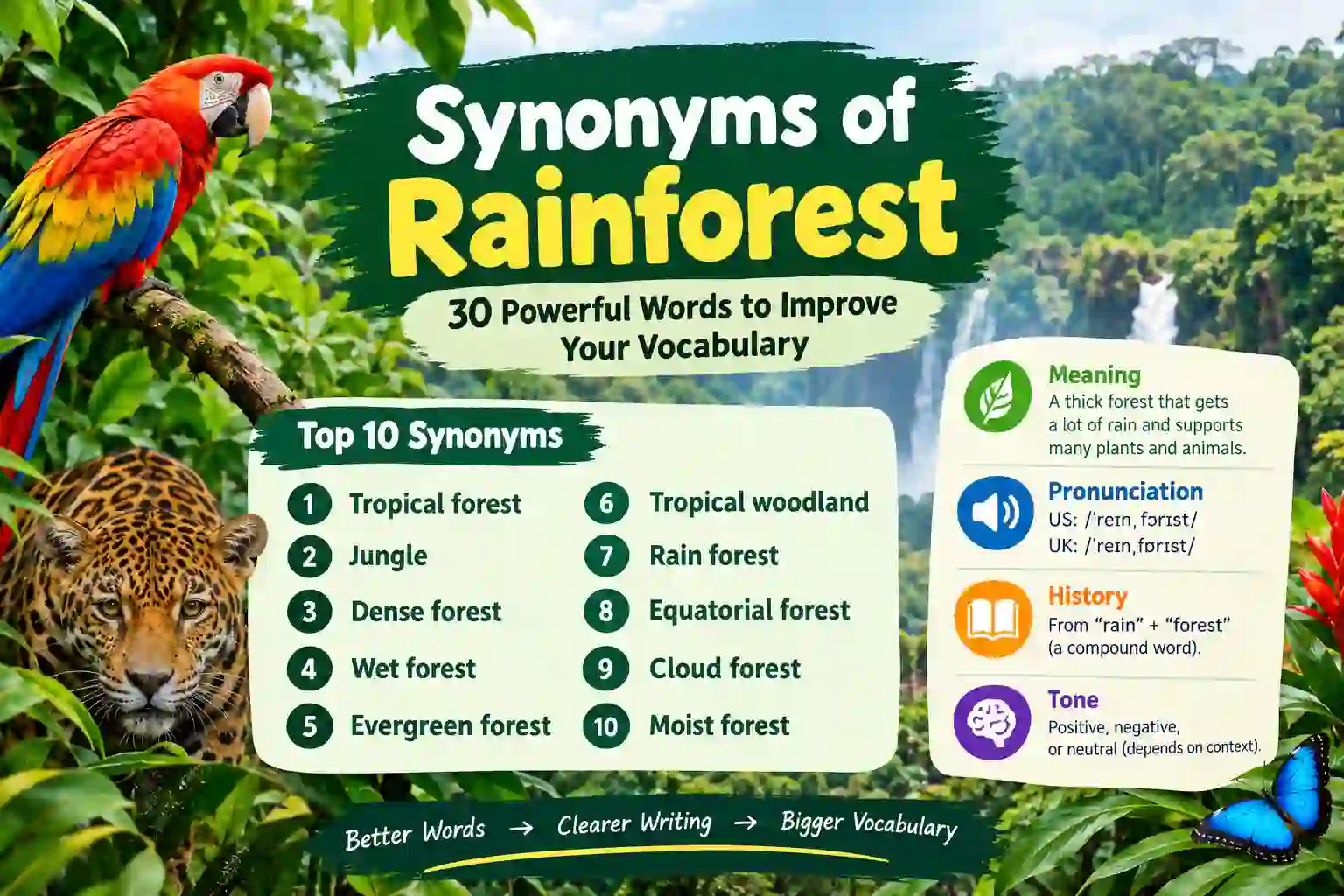
Rainforest synonyms and related terms include tropical forest, jungle, dense forest, tropical woodland, wet forest, evergreen forest, rain forest, and tropical rainforest. The best alternative depends on the context because some terms describe a specific type of forest, while others are broader or less precise.
Top 10 Synonyms of Rainforest
| No. | Synonym or Related Term | Simple Meaning |
| 1 | Tropical forest | A forest in a tropical region |
| 2 | Jungle | A thick forest with dense plant growth |
| 3 | Dense forest | A forest with many closely growing trees |
| 4 | Wet forest | A forest in a wet environment |
| 5 | Evergreen forest | A forest with trees that keep their leaves throughout the year |
| 6 | Tropical woodland | A wooded area in a tropical region |
| 7 | Rain forest | An alternative spelling of rainforest |
| 8 | Equatorial forest | A forest near the equator |
| 9 | Cloud forest | A mountain forest often covered in mist or low clouds |
| 10 | Moist forest | A forest with high moisture levels |
Usage note: These terms are related, not perfect synonyms. A cloud forest, for example, is a particular kind of forest, while jungle often refers to dense vegetation and may not describe a rainforest accurately in every scientific context.
Meaning of Rainforest
Definition
Rainforest (noun): A thick forest that receives heavy rainfall and supports a wide variety of plants and animals.
Rainforests are found in tropical regions and in some cooler mountain areas. They often have rich plant life, high moisture levels, and many different species.
Examples
- The Amazon rainforest is home to many rare animals.
- We learned about rainforest plants in our science class.
Connotative Meaning
(Connotation means the feelings, ideas, or associations that a word brings to mind beyond its basic definition.)
- Positive tone: Rainforest may suggest beauty, life, natural wealth, fresh air, and biodiversity.
- Negative tone: It may suggest danger, darkness, difficult travel, insects, or threats from deforestation.
- Neutral tone: In science and geography, rainforest is a factual term for a type of forest.
Etymology
- Rain: From Old English regn, meaning rain or rainfall.
- Forest: From Old French forest, meaning a wooded area or land set aside for hunting; the word ultimately has roots in Medieval Latin.
- Rainforest: A compound word formed from rain and forest. It describes a forest associated with heavy rainfall.
Short History of the Keyword
Old English (450–1100): The word rainforest was not established as a compound in this period. Old English had the word regn for rain, while related words for wooded land were used to describe forests and trees.
Middle English (1100–1500): English developed through strong French influence after the Norman Conquest. The word forest entered English through Anglo-French and Old French. The modern compound rainforest was not yet in common use.
Modern English (1500–Present): As geography, botany, and ecology developed, English gained more precise terms for forest types. Rainforest became an established term for forests linked to high rainfall and rich biological diversity. Today, it is widely used in education, science, conservation, and everyday writing.
Pronunciation (US & UK – IPA)
US: /ˈreɪnˌfɔrɪst/
UK: /ˈreɪnˌfɒrɪst/
Syllables
rain-for-est — 3 syllables.
Affixation Pattern of Rainforest
Root: rain + forest
Prefix: None.
Suffix: None.
Word formation: Rainforest is a compound noun formed by joining two complete words.
Common grammatical forms and related words include:
- Rainforest (noun): A forest with high rainfall.
- Rainforests (plural noun): More than one rainforest.
- Rainforest-related (compound adjective): Connected with rainforests.
- Rainforest ecosystem (noun phrase): The living things and physical environment of a rainforest.
- Rainforest conservation (noun phrase): The protection of rainforests.
The word itself does not need a prefix or suffix. Most of its related expressions are formed by adding another word or using the plural ending -s.
Synonyms of Rainforest
The following 30 terms include close alternatives, related forest types, and descriptive expressions. Because rainforest is a specific ecological term, some entries are suitable replacements only in certain contexts.
1. Tropical Forest (Noun)
US IPA: /ˈtrɑːpɪkəl ˈfɔːrɪst/ | UK IPA: /ˈtrɒpɪkəl ˈfɒrɪst/
Meaning: A forest found in a tropical region.
Examples:
- The tropical forest supports many kinds of wildlife.
- Scientists study plants in the tropical forest.
2. Jungle (Noun)
US IPA: /ˈdʒʌŋɡəl/ | UK IPA: /ˈdʒʌŋɡəl/
Meaning: An area with thick vegetation, often in a tropical region.
Examples:
- The explorers walked through the jungle.
- Many birds live among the thick jungle plants.
3. Dense Forest (Noun Phrase)
US IPA: /dens ˈfɔːrɪst/ | UK IPA: /dens ˈfɒrɪst/
Meaning: A forest where trees and plants grow close together.
Examples:
- The path disappeared into a dense forest.
- Many small animals hide in the dense forest.
4. Wet Forest (Noun Phrase)
US IPA: /wet ˈfɔːrɪst/ | UK IPA: /wet ˈfɒrɪst/
Meaning: A forest that receives or retains a great deal of moisture.
Examples:
- Ferns grow well in a wet forest.
- The wet forest floor was covered with leaves.
5. Evergreen Forest (Noun Phrase)
US IPA: /ˈevərɡriːn ˈfɔːrɪst/ | UK IPA: /ˈevəɡriːn ˈfɒrɪst/
Meaning: A forest made up mainly of trees that keep their leaves throughout the year.
Examples:
- The evergreen forest stayed green in winter.
- Birds built nests in the evergreen forest.
6. Tropical Woodland (Noun Phrase)
US IPA: /ˈtrɑːpɪkəl ˈwʊdlænd/ | UK IPA: /ˈtrɒpɪkəl ˈwʊdlænd/
Meaning: A wooded area in a tropical region, often less dense than a rainforest.
Examples:
- The tropical woodland provides shelter for birds.
- We explored the tropical woodland with a guide.
7. Rain Forest (Noun)
US IPA: /ˈreɪn ˌfɔːrɪst/ | UK IPA: /ˈreɪn ˌfɒrɪst/
Meaning: A forest that receives abundant rainfall; an alternative spelling of rainforest.
Examples:
- The rain forest is rich in plant life.
- Our class made a poster about the rain forest.
8. Equatorial Forest (Noun Phrase)
US IPA: /ˌekwəˈtɔːriəl ˈfɔːrɪst/ | UK IPA: /ˌekwəˈtɔːriəl ˈfɒrɪst/
Meaning: A forest located near the equator, often in a warm and wet climate.
Examples:
- The equatorial forest receives warmth throughout the year.
- Many species live in the equatorial forest.
9. Cloud Forest (Noun Phrase)
US IPA: /klaʊd ˈfɔːrɪst/ | UK IPA: /klaʊd ˈfɒrɪst/
Meaning: A mountain forest often covered by mist or low clouds.
Examples:
- Moss covered the trees in the cloud forest.
- Rare birds live in the cloud forest.
10. Moist Forest (Noun Phrase)
US IPA: /mɔɪst ˈfɔːrɪst/ | UK IPA: /mɔɪst ˈfɒrɪst/
Meaning: A forest with a moist environment.
Examples:
- Mushrooms grow on the ground in the moist forest.
- The moist forest supports many small plants.
11. Tropical Rainforest (Noun)
US IPA: /ˈtrɑːpɪkəl ˈreɪnˌfɔːrɪst/ | UK IPA: /ˈtrɒpɪkəl ˈreɪnˌfɒrɪst/
Meaning: A rainforest in a tropical region with warm conditions and high rainfall.
Examples:
- The tropical rainforest has many layers of plants.
- Monkeys moved through the tropical rainforest canopy.
12. Subtropical Rainforest (Noun)
US IPA: /ˌsʌbˈtrɑːpɪkəl ˈreɪnˌfɔːrɪst/ | UK IPA: /ˌsʌbˈtrɒpɪkəl ˈreɪnˌfɒrɪst/
Meaning: A rainforest found in a subtropical region, outside the main tropical zone.
Examples:
- The subtropical rainforest supports unusual plant species.
- We visited a subtropical rainforest on the coast.
13. Temperate Rainforest (Noun)
US IPA: /ˈtempərət ˈreɪnˌfɔːrɪst/ | UK IPA: /ˈtempərət ˈreɪnˌfɒrɪst/
Meaning: A cool or mild forest that receives abundant rainfall.
Examples:
- Tall trees dominate the temperate rainforest.
- Ferns thrive in the temperate rainforest.
14. Primary Forest (Noun Phrase)
US IPA: /ˈpraɪmeri ˈfɔːrɪst/ | UK IPA: /ˈpraɪməri ˈfɒrɪst/
Meaning: A forest that has developed naturally with little or no major human disturbance.
Examples:
- Researchers recorded rare species in the primary forest.
- Protecting primary forest helps preserve wildlife.
15. Old-Growth Forest (Noun Phrase)
US IPA: /ˌoʊld ˈɡroʊθ ˈfɔːrɪst/ | UK IPA: /ˌəʊld ˈɡrəʊθ ˈfɒrɪst/
Meaning: A mature forest with old trees and complex natural habitats.
Examples:
- The old-growth forest contains ancient trees.
- Owls nest in the old-growth forest.
16. Virgin Forest (Noun Phrase)
US IPA: /ˈvɜːrdʒɪn ˈfɔːrɪst/ | UK IPA: /ˈvɜːdʒɪn ˈfɒrɪst/
Meaning: A forest that has experienced little or no significant human disturbance.
Examples:
- The team surveyed a remote virgin forest.
- The virgin forest contains rare native plants.
17. Natural Forest (Noun Phrase)
US IPA: /ˈnætʃərəl ˈfɔːrɪst/ | UK IPA: /ˈnætʃərəl ˈfɒrɪst/
Meaning: A forest that has developed mainly through natural processes.
Examples:
- The natural forest provides food for wildlife.
- The project aims to protect the natural forest.
18. Wild Forest (Noun Phrase)
US IPA: /waɪld ˈfɔːrɪst/ | UK IPA: /waɪld ˈfɒrɪst/
Meaning: A forest that feels natural, remote, or largely untouched by people.
Examples:
- Deer moved quietly through the wild forest.
- The hikers camped near a wild forest.
19. Woodland (Noun)
US IPA: /ˈwʊdlænd/ | UK IPA: /ˈwʊdlənd/
Meaning: Land covered with trees and other woody plants.
Examples:
- The woodland provides shelter for rabbits.
- We walked through the woodland after lunch.
20. Forest (Noun)
US IPA: /ˈfɔːrɪst/ | UK IPA: /ˈfɒrɪst/
Meaning: A large area covered mainly with trees and other plants.
Examples:
- The forest is home to many animals.
- Rain fell on the forest all night.
21. Tropical Rain Forest (Noun Phrase)
US IPA: /ˈtrɑːpɪkəl ˈreɪn ˌfɔːrɪst/ | UK IPA: /ˈtrɒpɪkəl ˈreɪn ˌfɒrɪst/
Meaning: A rain forest found in the tropics; another form of tropical rainforest.
Examples:
- The tropical rain forest has a warm climate.
- Many insects live in the tropical rain forest.
22. Broadleaf Forest (Noun Phrase)
US IPA: /ˈbrɔːdˌliːf ˈfɔːrɪst/ | UK IPA: /ˈbrɔːdliːf ˈfɒrɪst/
Meaning: A forest dominated by trees with broad, flat leaves.
Examples:
- The broadleaf forest changes with the seasons.
- Birds feed on insects in the broadleaf forest.
23. Evergreen Woodland (Noun Phrase)
US IPA: /ˈevərɡriːn ˈwʊdlænd/ | UK IPA: /ˈevəɡriːn ˈwʊdlənd/
Meaning: A wooded area dominated by trees that remain green throughout the year.
Examples:
- The evergreen woodland provides year-round shelter.
- We saw several birds in the evergreen woodland.
24. Rain-Drenched Forest (Noun Phrase)
US IPA: /ˈreɪn drentʃt ˈfɔːrɪst/ | UK IPA: /ˈreɪn drentʃt ˈfɒrɪst/
Meaning: A forest soaked by heavy or frequent rain.
Examples:
- The rain-drenched forest smelled fresh.
- Sunlight shone on the rain-drenched forest floor.
25. Lush Forest (Noun Phrase)
US IPA: /lʌʃ ˈfɔːrɪst/ | UK IPA: /lʌʃ ˈfɒrɪst/
Meaning: A forest with abundant, healthy, green plant growth.
Examples:
- The lush forest looked beautiful after the rain.
- Bright flowers grew in the lush forest.
26. Verdant Forest (Noun Phrase)
US IPA: /ˈvɜːrdənt ˈfɔːrɪst/ | UK IPA: /ˈvɜːdənt ˈfɒrɪst/
Meaning: A green forest with rich plant growth.
Examples:
- A verdant forest covered the hillside.
- The river flowed beside the verdant forest.
27. Thick Forest (Noun Phrase)
US IPA: /θɪk ˈfɔːrɪst/ | UK IPA: /θɪk ˈfɒrɪst/
Meaning: A forest with many closely packed trees and plants.
Examples:
- The tiger disappeared into the thick forest.
- Thick forest covered the mountain slopes.
28. Rain-Fed Forest (Noun Phrase)
US IPA: /ˈreɪn fed ˈfɔːrɪst/ | UK IPA: /ˈreɪn fed ˈfɒrɪst/
Meaning: A forest whose water supply depends largely on rainfall.
Examples:
- The rain-fed forest depends on seasonal showers.
- Long dry periods can affect the rain-fed forest.
29. Humid Forest (Noun Phrase)
US IPA: /ˈhjuːmɪd ˈfɔːrɪst/ | UK IPA: /ˈhjuːmɪd ˈfɒrɪst/
Meaning: A forest with air that contains a high level of moisture.
Examples:
- The humid forest felt warm and damp.
- Many frogs live in the humid forest.
30. Biodiverse Forest (Noun Phrase)
US IPA: /ˌbaɪoʊdaɪˈvɜːrs ˈfɔːrɪst/ | UK IPA: /ˌbaɪəʊdaɪˈvɜːs ˈfɒrɪst/
Meaning: A forest that supports many different kinds of living things.
Examples:
- The biodiverse forest supports rare insects and birds.
- Conservationists work to protect the biodiverse forest.
Prototype Meaning
The most typical meaning of rainforest is a thick, green forest that receives a great deal of rain and supports many forms of life. When people hear this word, they often imagine tall trees, hanging vines, wet leaves, colorful birds, monkeys, insects, and a rich green canopy. They may also think of the Amazon rainforest, one of the world’s best-known tropical rainforests. The word often brings to mind nature, wildlife, and the need to protect the environment.
Prototype Categorization
Rainforest-related words can be grouped by their meaning and use. These categories help writers select the most accurate term instead of repeating the same word.
- Tropical forest types: Tropical forest, tropical rainforest, equatorial forest, and subtropical rainforest describe forests by climate or location.
- Wet forest types: Wet forest, moist forest, humid forest, and rain-fed forest focus on moisture or water supply.
- Dense vegetation: Jungle, dense forest, thick forest, and lush forest highlight thick plant growth.
- Forest age and natural condition: Primary forest, old-growth forest, virgin forest, and natural forest describe a forest’s history or condition. These terms have different technical meanings.
- Trees and plant cover: Evergreen forest, broadleaf forest, evergreen woodland, and woodland describe vegetation or the structure of a wooded area.
- Mountain and climate types: Cloud forest and temperate rainforest identify forests linked to particular environmental conditions.
- Descriptive and literary terms: Wild forest, verdant forest, rain-drenched forest, and biodiverse forest emphasize atmosphere, appearance, rainfall, or variety of life.
Choosing the right category makes writing more precise. For example, cloud forest is suitable when discussing a misty mountain habitat, while lush forest works well in descriptive writing.
Antonyms of Rainforest
Rainforest has no single exact antonym because it names a type of ecosystem. However, the following words describe contrasting environments.
- Desert (noun): A very dry region with little rainfall. Example: Few trees grow in the desert.
- Arid land (noun phrase): Land with very little moisture. Example: Arid land supports plants adapted to drought.
- Dryland (noun): Land where water is limited. Example: Farmers grow drought-resistant crops in dryland areas.
- Grassland (noun): Land covered mainly with grasses rather than dense forest. Example: Herds of animals grazed across the grassland.
- Savanna (noun): A tropical or subtropical grassland with scattered trees. Example: Elephants crossed the savanna.
- Barren land (noun phrase): Land with little vegetation. Example: The barren land had very few plants.
- Tundra (noun): A cold, largely treeless biome. Example: Mosses and low plants grow in the tundra.
These are contrasting environments, not strict opposites in every context.
Short Questions and Answers
– What does rainforest mean?
A rainforest is a forest that receives abundant rainfall and supports many plants and animals.
– When should rainforest be used?
Use rainforest when discussing a forest ecosystem associated with high rainfall, especially in environmental, geographical, or scientific writing.
– Is rainforest positive or negative?
The word is usually neutral. It can suggest beauty and rich wildlife, but it may also appear in discussions about dangerous conditions or environmental destruction.
– How is rainforest different from jungle?
A rainforest is a specific ecological type of forest. Jungle often describes thick vegetation and can refer to areas within tropical forests, but the terms are not always interchangeable.
– Is woodland a synonym for rainforest?
Not an exact synonym. Woodland is a broader term for land covered with trees and is often less dense than a rainforest.
– What is the most common synonym for rainforest?
Tropical forest is a useful alternative when the context refers to a tropical rainforest. However, the two terms may differ in scientific precision.
– What is the plural of rainforest?
The plural is rainforests. Example: Rainforests support a wide range of wildlife.
– Why are rainforests important?
Rainforests support biodiversity, store carbon, influence water cycles, and provide habitats for many species.
Conclusion
Learning the synonyms of rainforest and their meanings helps you build a stronger English vocabulary. Terms such as tropical forest, jungle, dense forest, and cloud forest let you describe nature in clearer and more specific ways. Learning their meanings, pronunciation, and tone also improves speaking, reading, and writing.
Remember that related words do not always have exactly the same meaning, so choose each word according to the context. You can avoid repetition by using suitable alternatives while keeping your message accurate. To improve your English confidence, practise learning a few new words each day, read example sentences, and use the words in your own writing. Regular practice will help you express your ideas with greater ease and precision.

I am a linguist with 15 years of experience in English language teaching, including postgraduate-level instruction. My expertise includes English grammar, and I contribute as a content and blog writer, producing scholarly and educational language resources.