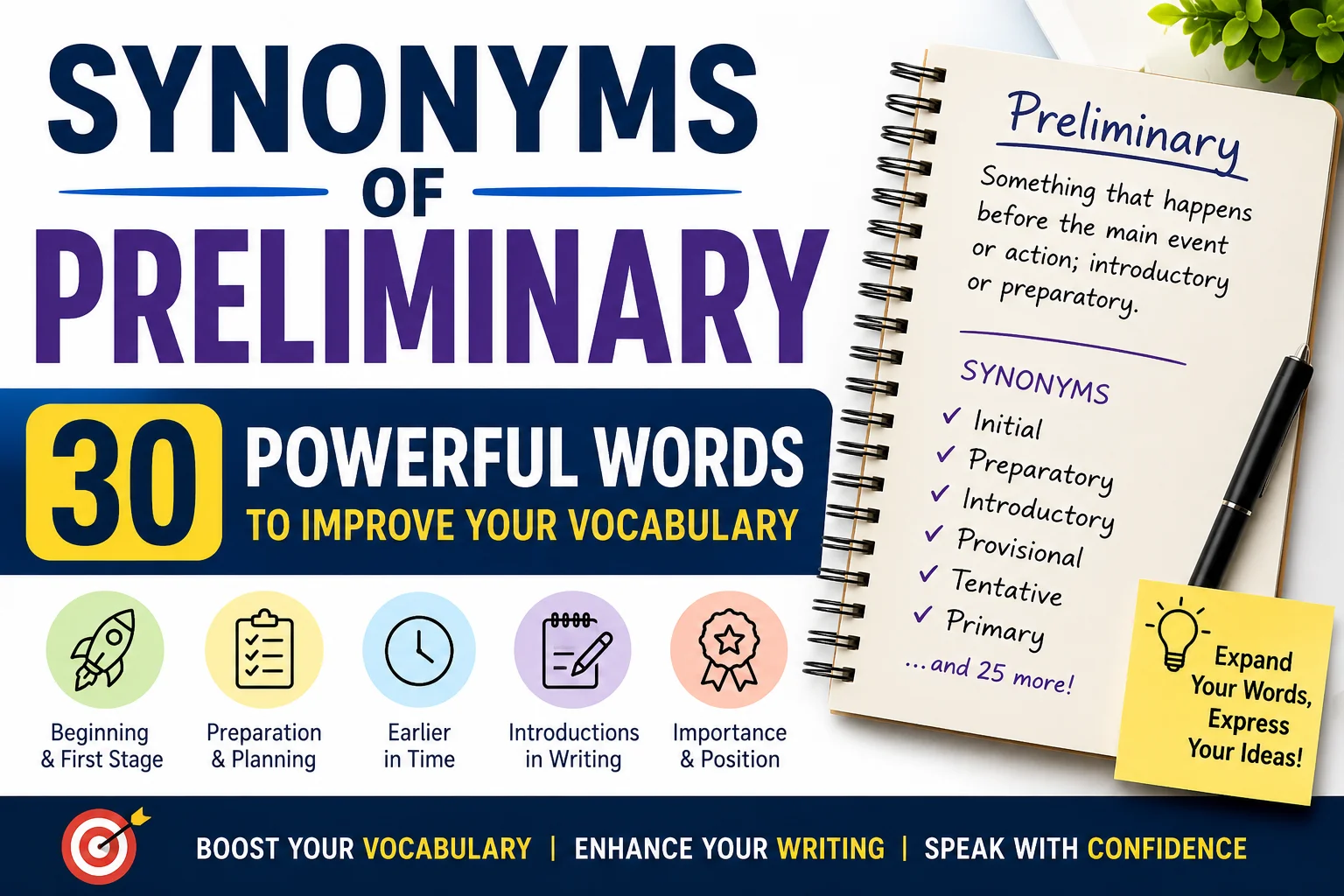
The word preliminary means something that happens before the main event or action. Imagine a student preparing for a final exam. Before taking the real test, the teacher gives a short practice quiz. That quiz is a preliminary step because it comes first and helps students get ready.
People use the word preliminary in school, business, science, sports, and everyday life. It describes early plans, first reports, opening discussions, and starting stages. Learning synonyms of preliminary helps English learners speak and write more naturally. It also helps content writers avoid repeating the same word again and again.
In this article, you will learn the meaning of preliminary, its pronunciation, grammar, history, connotation, and 30 useful synonyms with simple meanings and examples.
Meaning of Preliminary
Definition
Preliminary (Adjective):
Something that happens before the main event, action, or process to help prepare for it.
Examples
- The team held a preliminary meeting before the project started.
- We finished the preliminary checks before opening the store.
Connotative Meaning
(Connotation means the feeling or emotional idea that a word suggests beyond its basic dictionary meaning.)
- Positive tone: Shows good planning, careful preparation, and readiness.
- Negative tone: May suggest that something is unfinished, temporary, or incomplete.
- Neutral tone: Simply describes an early stage before the main event.
Etymology
- Source language: Latin
- Original word: praeliminaris
- Original meaning: “Before the threshold” or “coming before the beginning.”
Short History
- Old English (450–1100): The word was not used in Old English. Similar ideas were expressed with native words meaning “before” or “first.”
- Middle English (1100–1500): The concept entered English through French and Latin influence, but the modern word was still uncommon.
- Modern English (1500–Present): Preliminary became widely used to describe early actions, reports, meetings, exams, and preparations.
Pronunciation (US & UK – IPA)
US
/prɪˈlɪməˌnɛri/
UK
/prɪˈlɪmɪnəri/
Syllables
pre-lim-in-ar-y
Affixation Pattern of Preliminary
Root
- limin (Latin limen, meaning “threshold” or “entrance”)
Prefix
- pre- (before)
Suffix
- -ary (forming an adjective)
Word Formation
- Preliminary (Adjective)
- Preliminarily (Adverb)
- Preliminaries (Plural Noun)
- Preliminary examination (Noun Phrase)
- Preliminary report (Noun Phrase)
- Preliminary meeting (Noun Phrase)
- Preliminary stage (Noun Phrase)
- Preliminary draft (Noun Phrase)
Synonyms of Preliminary
1. Initial (Adjective)
US: /ɪˈnɪʃəl/ | UK: /ɪˈnɪʃəl/
Meaning: Happening at the beginning of something.
Examples:
- The initial plan looked promising.
- We discussed the initial ideas yesterday.
2. Introductory (Adjective)
US: /ˌɪntrəˈdʌktəri/ | UK: /ˌɪntrəˈdʌktəri/
Meaning: Intended to introduce a subject or activity.
Examples:
- She gave an introductory speech.
- This is an introductory lesson for beginners.
3. Preparatory (Adjective)
US: /prɪˈpærəˌtɔri/ | UK: /prɪˈpærətri/
Meaning: Done to prepare for something.
Examples:
- The athletes attended preparatory training.
- Preparatory work began last month.
4. Opening (Adjective)
US: /ˈoʊpənɪŋ/ | UK: /ˈəʊpənɪŋ/
Meaning: Coming at the start of an event or activity.
Examples:
- The opening ceremony attracted many visitors.
- His opening remarks were inspiring.
5. Introductive (Adjective)
US: /ˌɪntrəˈdʌktɪv/ | UK: /ˌɪntrəˈdʌktɪv/
Meaning: Serving as an introduction.
Examples:
- The book begins with an introductive chapter.
- She wrote an introductive note for readers.
6. Beginning (Adjective)
US: /bɪˈɡɪnɪŋ/ | UK: /bɪˈɡɪnɪŋ/
Meaning: Existing at the start of something.
Examples:
- The beginning stage was difficult.
- We learned the beginning steps first.
7. Early (Adjective)
US: /ˈɜrli/ | UK: /ˈɜːli/
Meaning: Happening before the expected or usual time.
Examples:
- We made an early decision.
- Early planning saved time.
8. Prefatory (Adjective)
US: /ˈprɛfəˌtɔri/ | UK: /ˈprefətəri/
Meaning: Serving as an introduction or preface.
Examples:
- The author included a prefatory note.
- His prefatory comments were brief.
9. Provisional (Adjective)
US: /prəˈvɪʒənəl/ | UK: /prəˈvɪʒənəl/
Meaning: Temporary until a final decision is made.
Examples:
- The committee released a provisional schedule.
- We accepted the provisional results.
10. Tentative (Adjective)
US: /ˈtɛntətɪv/ | UK: /ˈtentətɪv/
Meaning: Not final or fully decided.
Examples:
- We made a tentative agreement.
- The meeting has a tentative date.
11. Prior (Adjective)
US: /ˈpraɪər/ | UK: /ˈpraɪə/
Meaning: Existing or happening before another event or time.
Examples:
- We need prior approval before starting the project.
- She had prior experience in teaching.
12. Earlier (Adjective)
US: /ˈɜːrliər/ | UK: /ˈɜːliə/
Meaning: Happening before the present or before another event.
Examples:
- An earlier meeting solved many problems.
- I read the earlier version of the report.
13. Foregoing (Adjective)
US: /ˈfɔːrˌɡoʊɪŋ/ | UK: /ˈfɔːɡəʊɪŋ/
Meaning: Mentioned or occurring before.
Examples:
- The foregoing discussion explains the idea.
- Please read the foregoing paragraph carefully.
14. Previous (Adjective)
US: /ˈpriːviəs/ | UK: /ˈpriːviəs/
Meaning: Happening before the current one.
Examples:
- Her previous job was in banking.
- We learned this in the previous lesson.
15. Foremost (Adjective)
US: /ˈfɔːrmoʊst/ | UK: /ˈfɔːməʊst/
Meaning: First in order, importance, or position.
Examples:
- Safety is our foremost concern.
- He is among the foremost experts in the field.
16. Primary (Adjective)
US: /ˈpraɪmeri/ | UK: /ˈpraɪməri/
Meaning: First or most important in a sequence.
Examples:
- Our primary goal is customer satisfaction.
- Reading is a primary skill for learners.
17. Commencing (Adjective)
US: /kəˈmɛnsɪŋ/ | UK: /kəˈmensɪŋ/
Meaning: Beginning or starting.
Examples:
- The commencing session starts at 9 a.m.
- Students attended the commencing ceremony.
18. Inaugural (Adjective)
US: /ɪˈnɔːɡjərəl/ | UK: /ɪˈnɔːɡjərəl/
Meaning: Marking the first event in a series.
Examples:
- The company held its inaugural conference.
- She gave the inaugural lecture yesterday.
19. Preceding (Adjective)
US: /prɪˈsiːdɪŋ/ | UK: /prɪˈsiːdɪŋ/
Meaning: Coming before something else.
Examples:
- The preceding chapter explains the basics.
- Read the preceding instructions first.
20. Precedent (Adjective)
US: /ˈprɛsɪdənt/ | UK: /ˈpresɪdənt/
Meaning: Existing or occurring before another event.
Examples:
- The precedent agreement guided the discussion.
- We studied precedent cases before making a decision.
21. Precedent (Noun)
US: /ˈprɛsɪdənt/ | UK: /ˈpresɪdənt/
Meaning: An earlier event or decision that serves as an example for later actions.
Examples:
- The judge followed a legal precedent.
- This case created an important precedent.
22. Introductive (Adjective)
US: /ˌɪntrəˈdʌktɪv/ | UK: /ˌɪntrəˈdʌktɪv/
Meaning: Designed to introduce a subject before the main discussion.
Examples:
- The book begins with an introductive chapter.
- She gave an introductive explanation to the class.
23. First (Adjective)
US: /fɜːrst/ | UK: /fɜːst/
Meaning: Coming before all others in order or time.
Examples:
- This is the first step of the process.
- We met on the first day of school.
24. Lead-off (Adjective)
US: /ˈliːd ˌɔːf/ | UK: /ˈliːd ˌɒf/
Meaning: Happening at the beginning of an event or activity.
Examples:
- The lead-off presentation attracted attention.
- She gave the lead-off speech.
25. Ahead-of-time (Adjective)
US: /əˌhɛd əv ˈtaɪm/ | UK: /əˌhed əv ˈtaɪm/
Meaning: Done before the expected time.
Examples:
- We finished the work ahead of time.
- The team arrived ahead of time for the meeting.
26. Exploratory (Adjective)
US: /ɪkˈsplɔːrəˌtɔːri/ | UK: /ɪkˈsplɒrətəri/
Meaning: Done to discover facts before making a final decision.
Examples:
- The company held exploratory talks.
- Scientists conducted exploratory research.
27. Trial (Adjective)
US: /ˈtraɪəl/ | UK: /ˈtraɪəl/
Meaning: Intended for testing before full use.
Examples:
- The software is in its trial version.
- We completed a trial run before launch.
28. Experimental (Adjective)
US: /ɪkˌspɛrɪˈmɛntl/ | UK: /ɪkˌsperɪˈmentl/
Meaning: Used for testing new ideas or methods.
Examples:
- The team tried an experimental design.
- Scientists tested an experimental treatment.
29. Pilot (Adjective)
US: /ˈpaɪlət/ | UK: /ˈpaɪlət/
Meaning: Serving as the first test before full implementation.
Examples:
- The school started a pilot program.
- We launched a pilot project last month.
30. Preface (Noun)
US: /ˈprɛfəs/ | UK: /ˈprefɪs/
Meaning: An introductory section that appears before the main text of a book.
Examples:
- I read the preface before the first chapter.
- The author’s preface explains the purpose of the book.
Prototype Meaning
What Is the Typical Meaning of Preliminary?
When people hear the word preliminary, they usually think of the first stage before the main event. It describes something that prepares people for what comes next. A preliminary meeting, test, report, or discussion is not the final version. Instead, it helps people gather information, make plans, or get ready. The word often suggests preparation, organization, and an early step toward a larger goal.
Prototype Categorization
Synonyms Grouped by Meaning
Grouping synonyms into categories helps writers choose the best word for different situations.
- Beginning or First Stage: Initial, Beginning, First, Opening, Commencing, Introductory
- Preparation and Planning: Preparatory, Preliminary, Exploratory, Trial, Pilot
- Temporary or Not Final: Tentative, Provisional, Experimental
- Earlier in Time: Previous, Prior, Earlier, Preceding, Foregoing
- Introductions in Writing or Speaking: Prefatory, Introductive, Preface
- Importance or Position: Primary, Foremost
Choosing synonyms by category makes writing more accurate. For example, pilot is better for testing a new program, while prefatory is better for a book introduction. Tentative fits uncertain plans, whereas initial simply means the first step.
Antonyms of Preliminary
- Final (Adjective): Coming at the end; complete.
- Definitive (Adjective): Official and final without further changes.
- Complete (Adjective): Fully finished with nothing missing.
- Finished (Adjective): Brought to an end.
- Conclusive (Adjective): Providing a final answer or result.
- Ultimate (Adjective): Last or final in a series.
- Terminal (Adjective): Relating to the end of a process.
- Last (Adjective): Coming after all others.
- Settled (Adjective): Decided and no longer uncertain.
- Confirmed (Adjective): Officially accepted or approved.
Short Questions and Answers
- What does preliminary mean?
It means something that happens before the main event to prepare for it. - When should preliminary be used?
Use it when talking about an early stage, first report, practice test, planning meeting, or preparation. - Is preliminary positive or negative?
It is usually neutral. In many situations it has a positive meaning because it shows planning and preparation. Sometimes it can suggest that something is incomplete. - How is it different from similar words?
Preliminary focuses on preparation before the main event. Initial means simply the first step. Tentative emphasizes uncertainty. Provisional means temporary until something becomes official.
Conclusion
Learning the word preliminary and its synonyms can greatly improve your English vocabulary. Instead of repeating one word, you can choose the synonym that best matches your meaning. This makes your writing clearer, more natural, and more interesting. It also improves speaking by helping you express ideas with confidence. Understanding pronunciation, grammar, history, connotation, and word categories gives you a deeper knowledge of English. Practice using one new synonym each day in conversations or writing. Over time, these words will become a natural part of your vocabulary, making your English stronger and more professional.

I am a linguist with 15 years of experience in English language teaching, including postgraduate-level instruction. My expertise includes English grammar, and I contribute as a content and blog writer, producing scholarly and educational language resources.