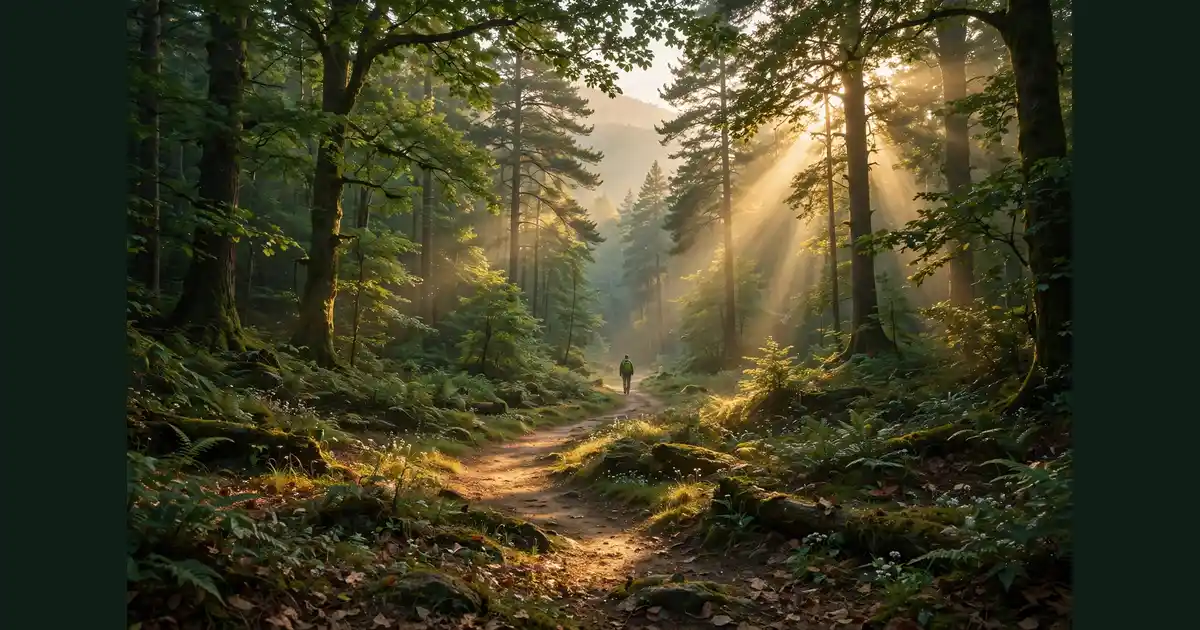
If you are looking for a word for a walk in nature, English gives you a whole path of choices, from a gentle stroll to a three-day trek. A stroll (IPA: /stroʊl/ ) is a slow, relaxed walk taken for pleasure, and it is the word most people reach for first. But the best word depends on the walk itself. You amble when there is no hurry, you hike when the hills are waiting, and you practise forest bathing when the trees themselves are the destination. These 30 words will help you name every kind of walk outdoors.
10 Words for a Walk in Nature at a Glance
| Word | Meaning |
| Stroll | Slow, relaxed walk for pleasure |
| Amble | Walk slowly in relaxed way |
| Saunter | Walk slowly, confidently, without hurry |
| Wander | Walk aimlessly, without fixed direction |
| Meander | Follow a slow, winding path |
| Roam | Wander freely over wide areas |
| Hike | Long walk in the countryside |
| Trek | Long, hard journey on foot |
| Ramble | Long country walk for pleasure |
| Nature Walk | Walk taken to enjoy nature |
Below, you will find 30 clear words for walking outdoors, each with a simple meaning, a pronunciation, and two easy examples, grouped by pace and purpose.
Gentle Words for a Walk in Nature: Slow and Easy
These first eight words name the slowest, softest kind of walking — no destination pressing, no clock watching. They are the words for gardens, riverbanks, village lanes, and the last light of the day.
1. Stroll (Verb)
US IPA: /stroʊl/ | UK IPA: /strəʊl/
Meaning: To stroll is to walk in a slow, relaxed way, usually for pleasure. It is the classic word for this whole idea — an easy walk with no hurry and no fixed destination. As a noun, a stroll is the walk itself.
Examples:
- After dinner, they strolled along the river in the cool evening air.
- We took a short stroll through the woods before breakfast.
2. Amble (Verb)
US IPA: /ˈæmbəl/ | UK IPA: /ˈæmbəl/
Meaning: To amble is to walk at a slow, relaxed pace, as if you have all day. The word comes from the gentle pace of a horse, and it still carries that unhurried, comfortable feeling.
Examples:
- An old man ambled down the forest path with his dog.
- We ambled through the meadow, stopping to look at every flower.
3. Saunter (Verb)
US IPA: /ˈsɔntər/ | UK IPA: /ˈsɔːntə/
Meaning: To saunter is to walk slowly and confidently, in a relaxed and happy way. A person who saunters is not just slow — they look pleased with the world as they go.
Examples:
- She sauntered along the woodland trail, humming a quiet tune.
- He sauntered into the garden as if he owned the morning.
4. Wander (Verb)
US IPA: /ˈwɑndər/ | UK IPA: /ˈwɒndə/
Meaning: To wander is to walk slowly and aimlessly, with no fixed direction or plan. Wandering is walking for the walk’s own sake — you follow your curiosity, not a map.
Examples:
- They wandered through the pine forest until the path disappeared.
- On Sundays, he likes to wander the hills with no plan at all.
5. Meander (Verb)
US IPA: /miˈændər/ | UK IPA: /miˈændə/
Meaning: To meander is to follow a winding, indirect path slowly and without hurry. The word comes from a famous winding river, and it suits both rivers and the people who walk beside them.
Examples:
- The trail meanders through the valley, following the stream.
- We meandered home along the hedgerows as the sun went down.
6. Mosey (Verb)
US IPA: /ˈmoʊzi/ | UK IPA: /ˈməʊzi/
Meaning: To mosey is to walk or move in a slow, relaxed, unhurried way. It is an informal American word, friendly and a little playful — the opposite of marching anywhere with purpose.
Examples:
- We moseyed down to the lake to watch the ducks.
- He moseyed along the garden path, coffee in hand.
7. Promenade (Verb)
US IPA: /ˌprɑməˈneɪd/ | UK IPA: /ˌprɒməˈneɪd/
Meaning: To promenade is to take a leisurely walk in a public place, traditionally to enjoy the air and be seen. As a noun, a promenade is also the wide path beside the sea where people walk.
Examples:
- In the evening, families promenade along the seafront.
- The hotel garden is a lovely place to promenade after tea.
8. Perambulate (Verb)
US IPA: /pəˈræmbjəleɪt/ | UK IPA: /pəˈræmbjəleɪt/
Meaning: To perambulate is to walk through or around a place, slowly and thoroughly. It is a formal, slightly humorous word — writers use it when a simple stroll deserves a grand name.
Examples:
- The inspector perambulated the whole estate before writing his report.
- On fine days, the old professor perambulates the college garden at noon.
Words for Wandering: Walking with No Fixed Path
The next seven words are about freedom rather than rest. A wandering walk has no timetable and no destination. If this is your favourite kind of walking, our full guide to synonyms of roam explores the leader of this family in depth.
9. Roam (Verb)
US IPA: /roʊm/ | UK IPA: /rəʊm/
Meaning: To roam is to wander freely over a wide area, with no fixed course. Animals roam the plains, and so do walkers who want the whole hillside, not just the path.
Examples:
- Deer roam the forest freely at dawn.
- As a boy, he roamed the fields around his village all summer.
10. Rove (Verb)
US IPA: /roʊv/ | UK IPA: /rəʊv/
Meaning: To rove is to wander widely and constantly, travelling from place to place. It is a close cousin of roam, a little more literary, and famous in the phrase a roving eye.
Examples:
- Wild horses rove the open hills in small bands.
- Her grandfather roved the countryside as a young shepherd.
11. Range (Verb)
US IPA: /ˈreɪndʒ/ | UK IPA: /ˈreɪndʒ/
Meaning: To range is to move freely over a large area, exploring as you go. The word always suggests wide, open ground covered on foot.
Examples:
- The cattle range over a thousand acres of grassland.
- We ranged the whole ridge before choosing a place to camp.
12. Drift (Verb)
US IPA: /drɪft/ | UK IPA: /drɪft/
Meaning: To drift is to move slowly and gently, carried along without effort or direction, like a boat on a calm current. A drifting walk follows the path the way smoke follows the wind.
Examples:
- They drifted along the beach path, in no hurry to get home.
- He drifted from one shady tree to the next, thinking.
13. Peregrinate (Verb)
US IPA: /ˈpɛrɪɡrəneɪt/ | UK IPA: /ˈpɛrɪɡrəneɪt/
Meaning: To peregrinate is to travel on foot from place to place, wandering widely. It is a rare, formal, old-fashioned word — the grandest member of the wandering family.
Examples:
- Medieval scholars peregrinated from one monastery to the next.
- The naturalist spent ten years peregrinating through Asia on foot.
14. Stray (Verb)
US IPA: /streɪ/ | UK IPA: /streɪ/
Meaning: To stray is to wander away from the right path, the group, or the place where you belong. It often carries a small warning inside it — the strayed walker may be lost.
Examples:
- Do not stray from the marked trail in the nature reserve.
- A few sheep strayed into the lower meadow.
15. Traipse (Verb)
US IPA: /treɪps/ | UK IPA: /treɪps/
Meaning: To traipse is to walk about in a casual, weary, or reluctant way, often over a long distance. It suggests tired feet and muddy boots rather than pleasure.
Examples:
- We traipsed all over the valley looking for the waterfall.
- She traipsed home through the fields in the rain.
Words for a Long Walk: Distance and Effort
When the word for a walk in nature has to cover real distance — hills, whole days, heavy boots — English changes gear. These eight words are stronger and more energetic, and many of them appear again in our wider verb synonyms collection of action words.
16. Hike (Verb)
US IPA: /haɪk/ | UK IPA: /haɪk/
Meaning: To hike is to go for a long walk in the countryside or mountains, usually for pleasure and exercise. It is the most common modern word for a serious outdoor walk. As a noun, a hike is the walk itself.
Examples:
- We hiked ten miles through the national park on Saturday.
- The trail hikes up the ridge to a small lake.
17. Trek (Verb)
US IPA: /trɛk/ | UK IPA: /trɛk/
Meaning: To trek is to make a long, difficult journey on foot, often through wild or mountainous country. A trek is never a short stroll — it is measured in days, not minutes.
Examples:
- They trekked through the jungle for five days.
- The trek to the mountain village took all morning.
18. Ramble (Verb)
US IPA: /ˈræmbəl/ | UK IPA: /ˈræmbəl/
Meaning: To ramble is to go for a long walk in the countryside for pleasure, following paths wherever they lead. In Britain, rambling is a beloved national hobby, and a ramble is its classic walk.
Examples:
- Every autumn, the club rambles across the chalk downs.
- We rambled for hours through lanes and woods.
19. Tramp (Verb)
US IPA: /ˈtræmp/ | UK IPA: /ˈtræmp/
Meaning: To tramp is to walk with heavy, steady steps over a long distance. In New Zealand, tramping is the ordinary word for hiking, and a tramp there means a long bush walk.
Examples:
- They tramped through the snow for six hours.
- He has tramped every valley in the national park.
20. March (Verb)
US IPA: /mɑrtʃ/ | UK IPA: /mɑːtʃ/
Meaning: To march is to walk with regular, determined steps, like a soldier. Outside the army, people march through nature when they have a goal and refuse to dawdle on the way.
Examples:
- The scouts marched up the hill in single file.
- She marched along the cliff path, determined to finish before dark.
21. Trudge (Verb)
US IPA: /trʌdʒ/ | UK IPA: /trʌdʒ/
Meaning: To trudge is to walk slowly and with heavy steps because you are tired, or the ground is hard — through snow, mud, or sand. Every step of a trudge costs effort.
Examples:
- They trudged through deep snow back to the cabin.
- At the end of the long walk, we trudged the last mile home.
22. Slog (Verb)
US IPA: /slɑɡ/ | UK IPA: /slɒɡ/
Meaning: To slog is to walk steadily and with great effort, especially through mud, snow, or water. Like trudge, it names the hard part of a long walk — the part you push through.
Examples:
- We slogged through the muddy fields for two hours.
- The team slogged up the steep slope in the rain.
23. Stride (Verb)
US IPA: /straɪd/ | UK IPA: /straɪd/
Meaning: To stride is to walk with long, confident, purposeful steps. A person who strides is fit, sure of the way, and covering ground quickly — the energetic opposite of a stroll.
Examples:
- He strode across the moor towards the distant farm.
- She strode along the ridge, enjoying the wind.
Mindful Words for a Walk in Nature: Walking to Heal
The last seven words treat walking as medicine for the mind. People search for them when the walk itself is the therapy — and the calm they name belongs to the same family as the feelings in our emotion and mood synonyms collection.
24. Nature Walk (Noun Phrase)
US IPA: /ˈneɪtʃər ˌwɔk/ | UK IPA: /ˈneɪtʃə ˌwɔːk/
Meaning: A nature walk is a walk whose real purpose is to enjoy and observe the natural world — the trees, birds, and wildflowers along the way.
Examples:
- The class went on a nature walk to identify ten kinds of leaves.
- A slow nature walk is the best cure for a noisy week.
25. Forest Bathing (Noun Phrase)
US IPA: /ˈfɔrɪst ˌbeɪðɪŋ/ | UK IPA: /ˈfɒrɪst ˌbeɪðɪŋ/
Meaning: Forest bathing is the practice of spending slow, quiet time among trees, breathing deeply and letting the forest calm your senses. Despite the name, no water and no swimming are involved — you “bathe” in the atmosphere of the forest.
Examples:
- Forest bathing for two hours lowered her stress for days.
- The park offers guided forest bathing every Sunday morning.
26. Shinrin-Yoku (Noun)
US IPA: /ˌʃɪnrɪn ˈjoʊkuː/ | UK IPA: /ˌʃɪnrɪn ˈjəʊkuː/
Meaning: Shinrin-yoku is the Japanese word that forest bathing translates — literally, “forest bath.” The practice began in Japan in the 1980s as a form of relaxation and preventive health care, and the word is now used in English around the world.
Examples:
- Shinrin-yoku teaches you to walk slowly and notice everything.
- Doctors in Japan have recommended shinrin-yoku for decades.
27. Walking Meditation (Noun Phrase)
US IPA: /ˈwɔkɪŋ ˌmɛdɪˈteɪʃən/ | UK IPA: /ˈwɔːkɪŋ ˌmɛdɪˈteɪʃən/
Meaning: Walking meditation is a form of meditation practised while walking slowly, paying close attention to each step and each breath. Buddhist monks have practised it for centuries, often on a short path walked back and forth.
Examples:
- He begins each day with twenty minutes of walking meditation in the garden.
- Walking meditation slowed her steps and quieted her thoughts.
28. Constitutional (Noun)
US IPA: /ˌkɑnstɪˈtuʃənəl/ | UK IPA: /ˌkɒnstɪˈtjuːʃənəl/
Meaning: A constitutional is a walk taken regularly for your health — your daily walk for fresh air and exercise. It is a gentle, slightly old-fashioned word.
Examples:
- Every morning, whatever the weather, he takes his constitutional around the park.
- Her evening constitutional along the canal keeps her fit at eighty.
29. Pilgrimage (Noun)
US IPA: /ˈpɪlɡrɪmɪdʒ/ | UK IPA: /ˈpɪlɡrɪmɪdʒ/
Meaning: A pilgrimage is a long journey on foot to a holy or meaningful place, made for spiritual reasons. Famous pilgrimages, like the Camino de Santiago in Spain, turn walking itself into an act of devotion.
Examples:
- Thousands walk the pilgrimage to Santiago every summer.
- For him, the month-long walk became a true pilgrimage.
30. Earthing (Noun)
US IPA: /ˈɜrθɪŋ/ | UK IPA: /ˈɜːθɪŋ/
Meaning: Earthing, also called grounding, is the practice of walking barefoot on natural ground — grass, soil, or sand — to feel a direct connection with the earth.
Examples:
- Earthing in the morning dew is her favourite ritual.
- He practises earthing by walking barefoot on the beach each day.
Strong Synonyms for a Walk in Nature
These are the toughest, most demanding words in this list — use them when the walk is long, steep, and serious.
- Trek — a long, difficult journey on foot through wild country.
- Tramp — heavy, steady walking over a long distance.
- March — determined walking with regular, soldier-like steps.
- Slog — slow, hard walking through mud, snow, or water.
- Stride — fast, confident walking with long steps.
Milder Synonyms for a Walk in Nature
These words describe the gentlest walks of all — slow, short, and taken purely for pleasure. For the bright language of the fine days made for such walks, see our guide to synonyms of sunny.
- Stroll — the classic slow, relaxed walk for pleasure.
- Amble — walking slowly, as if you have all day.
- Saunter — a slow, happy, confident walk.
- Mosey — an informal, playful word for moving slowly.
- Nature Walk — a walk taken simply to enjoy the outdoors.
Meaning of Stroll
Definition
Stroll (verb): To walk in a slow, relaxed way, especially for pleasure, with no hurry and no important destination.
As a noun, a stroll is a short, leisurely walk: “a stroll in the park.” It is the lead word of this guide because it is the word English speakers choose most often for a pleasant walk outdoors.
Examples
- We strolled through the old town as the lights came on.
- They went for a stroll along the canal before lunch.
Grammar and Usage
Stroll is a regular verb: stroll – strolled – strolling. For example, “She strolled home” and “She is strolling home.” As a noun it is countable: a stroll, two strolls.
Common patterns are go for a stroll, take a stroll, and stroll along / through / around a place. For example, “Let’s take a stroll around the lake.”
The word also appears in the idiom a stroll down memory lane — not a walk at all, but a pleasant look back at the past.
Connotative Meaning
(Connotation means the feelings, ideas, or emotions that a word suggests beyond its basic meaning.)
- Positive tone: Leisure, pleasure, and freedom — a stroll is a small holiday inside an ordinary day.
- Negative tone: Rare, but it can suggest carelessness: a person who strolls in late seems too relaxed about everyone else’s time.
- Neutral tone: In plain reports, simply a slow walk from one place to another.
Because stroll promises ease, writers choose it when the walk should feel like a gift, not a task.
Etymology
The word stroll began its life as a word for wandering without work or home — which explains its carefree spirit today.
- Source language: German strollen, apparently from Swiss German, related to strolchen, “to wander about, to loaf.”
- Original meaning: The German word is connected with Strolch, a vagabond or rascal — someone who wandered the roads with nowhere to be.
- The modern sense: English kept the wandering and lost the rascal: today a stroll is simply the most respectable form of walking to nowhere in particular.
Pronunciation (US & UK – IPA)
US: /stroʊl/
UK: /strəʊl/
The vowel sound is the only difference: American English rounds it to /oʊ/, while British English uses /əʊ/. The spelling and the single stress stay the same.
Syllables
stroll
The word has one syllable. Its forms stay short too: strolled has one syllable, and strolling has two.
Synonyms and Antonyms for a Walk in Nature
The words in this guide run on a scale of effort: feather-light words like stroll and amble at one end, and heavy words like trek and slog at the other. The antonyms stand on the far side of that scale — words for moving fast, with no time to look at the trees.
- Rush (verb): To move or act with great hurry. Example: They rushed past the lake without stopping.
- Hurry (verb): To move quickly because time is short. Example: We hurried home before the storm.
- Sprint (verb): To run at full speed for a short distance. Example: He sprinted up the hill to catch the bus.
- Dash (verb): To run or move suddenly and quickly. Example: The children dashed across the field.
- Race (verb): To move fast in a competition or in great haste. Example: She raced along the path to beat the rain.
Note: Rush is the everyday opposite of stroll. If a walk has no time for looking around, it has stopped being a walk in nature at all.
Frequently Asked Questions
What is another word for a nature walk?
The closest everyday words are stroll, amble, and wander. If the walk is long and in the countryside, use hike or ramble; if it is slow and thoughtful, nature walk itself and forest bathing fit best.
The best word for a walk in nature depends on the pace: gentle words for slow walks, strong words for long ones.
What is the Japanese word for walking in the forest?
The Japanese word is shinrin-yoku, which translates into English as forest bathing. It names the practice of walking slowly among trees and breathing in the calm of the forest.
Japan’s forestry authorities introduced the term in the 1980s, and it has since travelled the world. English speakers now use both shinrin-yoku and forest bathing for the same mindful walk.
What is a word for a long walk?
The most common words are hike and trek. A hike is a long walk in the countryside or hills, usually for pleasure; a trek is longer and harder, often lasting days.
For a long walk taken purely for enjoyment, British English loves ramble. And when the long walk turns tiring, the honest words are trudge and slog.
What is the German word for a long walk?
The German word is die Wanderung — a long walk or hike, from the verb wandern, to hike or wander. Germany’s marked Wanderwege (hiking trails) are famous across Europe.
For a gentler walk, German uses der Spaziergang, a leisurely stroll; and a walk in the woods is a Waldspaziergang. English wander and German wandern are close cousins from the same old root.
Conclusion
The right word for a walk in nature depends on the walk you mean. Gentle words like stroll, amble, and saunter name the slow hours that restore us. Strong words like hike, trek, and stride name the miles that test us. And mindful words like forest bathing name the walks that heal us. The American naturalist John Muir summed up the reward of every such walk:
“In every walk with nature one receives far more than he seeks.” — John Muir, Steep Trails (1918)
The same truth was felt by Henry David Thoreau, whose whole philosophy began with a morning walk:
“An early morning walk is a blessing for the whole day.” — Henry David Thoreau, Journal (20 April 1840)
Start by learning three new words from this list each day. Say them aloud with the pronunciation buttons, write one sentence for each, and then — best of all — close the page, step outside, and give your next walk its proper name.

I am a linguist with 15 years of experience in English language teaching, including postgraduate-level instruction. My expertise includes English grammar, and I contribute as a content and blog writer, producing scholarly and educational language resources.