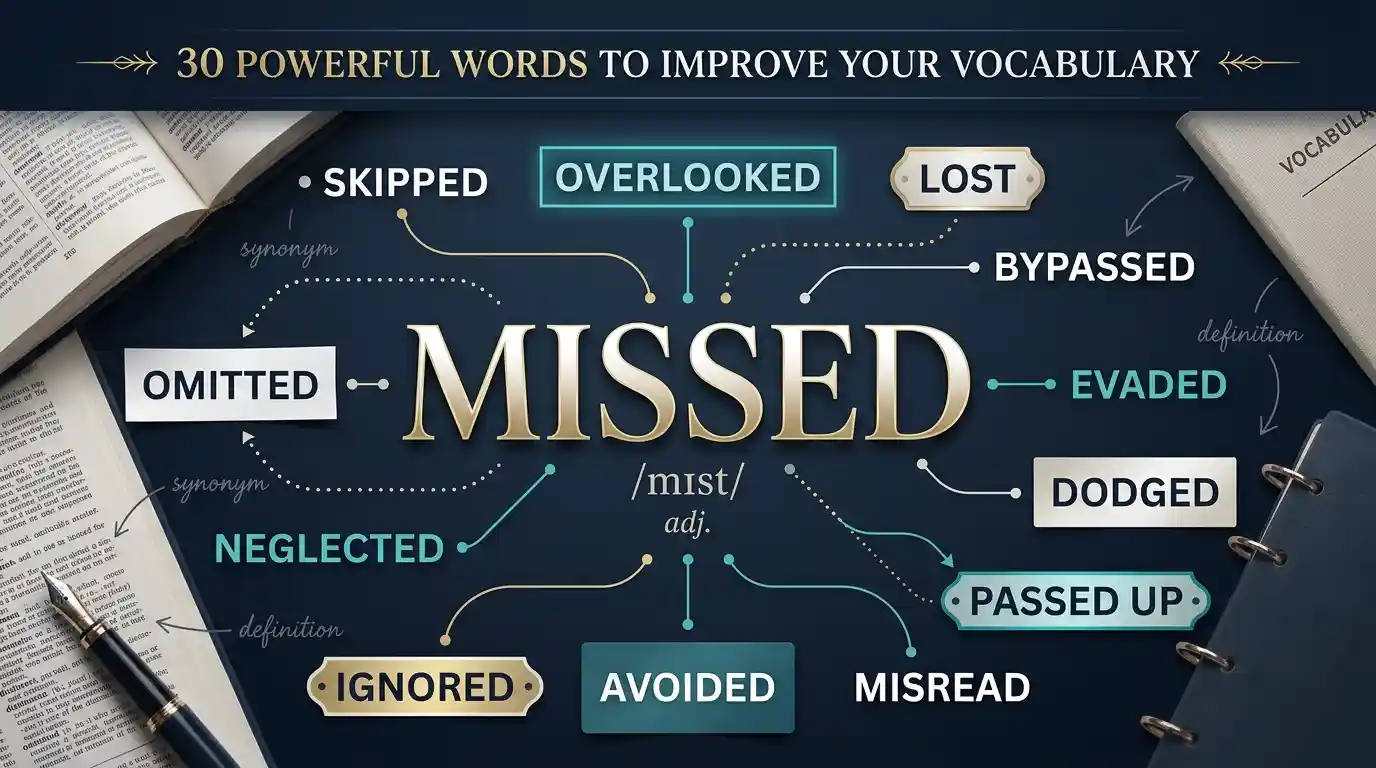
Missed means that you failed to see, attend, catch, reach, notice, hit, or experience something, or that you felt the absence of someone or something. The best synonyms of missed depend on the context. Common alternatives include skipped, overlooked, omitted, neglected, ignored, avoided, escaped, lost, bypassed, and failed to catch. Cambridge lists several major senses of miss, including failing to do or experience something, failing to hit or reach something, noticing an absence, and feeling sadness about someone’s absence.
| Synonym | Meaning | Best Context |
| Skipped | Did not attend or do | Classes, meals, activities |
| Overlooked | Failed to notice | Details, mistakes, facts |
| Omitted | Left something out | Writing, lists, information |
| Neglected | Failed to give proper attention | Duties, responsibilities |
| Ignored | Chose not to pay attention | Warnings, advice, messages |
| Avoided | Stayed away from something | Problems, events, danger |
| Escaped | Got away from or avoided | Danger, harm, capture |
| Lost | Failed to catch or gain | Chances, opportunities, objects |
| Bypassed | Went around or past | Places, steps, systems |
| Failed to catch | Did not catch or reach in time | Buses, trains, flights |
| Failed to notice | Did not see or recognize | Details, changes, signs |
This article explains missed and its synonyms through meaning, grammar, examples, pronunciation, history, word formation, emotional tone, and semantic categories. It also shows how each alternative works in real English so you can choose the right word instead of simply replacing one word with another.
Meaning of Missed
Definition
Missed (verb — past tense and past participle of miss): failed to see, attend, catch, hit, reach, notice, or experience something; or felt the absence of someone or something.
The meaning changes with context. For example, I missed the bus means I failed to catch it, while I missed my friend means I felt sad because my friend was absent. Cambridge also records meanings such as failing to do something, failing to hit something, noticing that something is absent, and regretting someone’s absence.
Examples
- I missed the morning bus.
- She missed the important point in the lesson.
- We missed the beginning of the movie.
- He missed his family while he was abroad.
Connotative Meaning
Connotation (the feeling or idea that a word suggests beyond its basic dictionary meaning) can change according to the sense of missed.
- Positive tone: Missed can suggest that someone or something was valuable or loved: “I missed my old friends.”
- Negative tone: It can suggest failure, loss, or disappointment: “She missed the final question.”
- Neutral tone: It can simply describe an event that was not attended or caught: “I missed the train.”
Etymology
- Source: Missed comes from the verb miss, which comes from Old English missan, meaning “to fail to hit” or “fail in what was aimed at.”
- Old English missan is related to Proto-Germanic missjan, connected with the idea of going wrong or changing from the expected path.
- The word is also connected with Old Norse missa, meaning “to miss” or “to lack.”
Short History of “Miss”
- Old English (450–1100): Missan referred mainly to failing to hit a target or failing in an intended action.
- Middle English (1100–1500): The word gained meanings connected with failing to find, notice, reach, or attain something. The meaning of feeling the absence of someone also developed around the 13th century.
- Modern English (1500–Present): Miss developed more senses, including avoiding something and, later, failing to arrive in time for transport. The sense of not being on time for something is recorded from the 19th century.
Pronunciation (US & UK – IPA)
US: /mɪst/
UK: /mɪst/
The base verb miss is pronounced /mɪs/ in both US and UK English; the past form missed adds the /t/ sound. Cambridge gives /mɪs/ for miss in both varieties.
Syllables
missed
It is a one-syllable word.
Affixation Pattern of “Missed”
- Root: miss
- Prefix: none
- Suffix: -ed, marking the simple past or past participle
Word Formation of “Miss”
- miss — verb: to fail to catch, see, hit, attend, or experience
- missed — past tense/past participle verb
- missing — present participle/gerund
- misses — third-person singular present verb
- miss — noun: a failure to hit, catch, do, or experience something
- missable — adjective: able to be missed
- missingly — rare adverbial formation
The most common grammatical forms in everyday English are miss, misses, missed, and missing.
Synonyms of Missed
The 30 synonyms below cover the major meanings of missed. They are not interchangeable in every sentence. Some describe missing an event, some describe failing to notice something, some describe avoiding something, and others express the emotional sense of missing a person.
1. Skipped (Verb)
US: /skɪpt/ | UK: /skɪpt/
Meaning: Did not attend, do, or take part in something.
Examples:
- I skipped the meeting yesterday.
- She skipped breakfast before school.
2. Overlooked (Verb)
US: /ˌoʊvərˈlʊkt/ | UK: /ˌəʊvəˈlʊkt/
Meaning: Failed to notice or consider something.
Examples:
- I overlooked a small spelling error.
- The manager overlooked an important detail.
3. Omitted (Verb)
US: /oʊˈmɪtɪd/ | UK: /əˈmɪtɪd/
Meaning: Left something out.
Examples:
- She omitted his name from the list.
- The writer omitted an important fact.
4. Neglected (Verb)
US: /nɪˈɡlektɪd/ | UK: /nɪˈɡlektɪd/
Meaning: Failed to give something the attention or care it needed.
Examples:
- He neglected his studies for several weeks.
- She neglected to check the final paragraph.
5. Ignored (Verb)
US: /ɪɡˈnɔrd/ | UK: /ɪɡˈnɔːd/
Meaning: Failed or chose not to give attention to something.
Examples:
- He ignored the warning sign.
- She ignored my message.
6. Avoided (Verb)
US: /əˈvɔɪdɪd/ | UK: /əˈvɔɪdɪd/
Meaning: Stayed away from something intentionally.
Examples:
- We avoided the busy road.
- She avoided the difficult question.
7. Escaped (Verb)
US: /ɪˈskeɪpt/ | UK: /ɪˈskeɪpt/
Meaning: Got away from or avoided something unpleasant or dangerous.
Examples:
- He escaped serious injury.
- The car escaped the worst of the storm.
8. Lost (Verb)
US: /lɔst/ | UK: /lɒst/
Meaning: Failed to obtain, keep, catch, or experience something.
Examples:
- She lost her chance to compete.
- We lost the opportunity to meet him.
9. Bypassed (Verb)
US: /ˈbaɪpæst/ | UK: /ˈbaɪpɑːst/
Meaning: Went around or past something without using or dealing with it.
Examples:
- The driver bypassed the crowded street.
- The team bypassed an unnecessary step.
10. Evaded (Verb)
US: /ɪˈveɪdɪd/ | UK: /ɪˈveɪdɪd/
Meaning: Avoided something, especially something difficult or unwanted.
Examples:
- The suspect evaded the police.
- He evaded the question.
11. Dodged (Verb)
US: /dɑdʒd/ | UK: /dɒdʒd/
Meaning: Quickly avoided something.
Examples:
- He dodged the ball.
- She dodged the difficult question.
12. Passed Up (Phrasal Verb)
US: /pæst ʌp/ | UK: /pɑːst ʌp/
Meaning: Chose not to accept or take an opportunity.
Examples:
- He passed up a good job offer.
- She passed up the chance to travel.
13. Failed to Catch (Verb Phrase)
US: /feɪld tə kætʃ/ | UK: /feɪld tə kætʃ/
Meaning: Did not catch or reach something in time.
Examples:
- I failed to catch the last train.
- They failed to catch the early flight.
14. Failed to Notice (Verb Phrase)
US: /feɪld tə ˈnoʊtɪs/ | UK: /feɪld tə ˈnəʊtɪs/
Meaning: Did not see or recognize something.
Examples:
- I failed to notice the small crack.
- She failed to notice that he had left.
15. Failed to Attend (Verb Phrase)
US: /feɪld tə əˈtend/ | UK: /feɪld tə əˈtend/
Meaning: Did not go to an event or place as expected.
Examples:
- He failed to attend the meeting.
- Several students failed to attend the class.
16. Misjudged (Verb)
US: /ˌmɪsˈdʒʌdʒd/ | UK: /ˌmɪsˈdʒʌdʒd/
Meaning: Judged something incorrectly.
Examples:
- He misjudged the distance and missed the ball.
- I misjudged the amount of time needed.
17. Miscalculated (Verb)
US: /ˌmɪsˈkælkjəleɪtɪd/ | UK: /ˌmɪsˈkælkjəleɪtɪd/
Meaning: Calculated something incorrectly.
Examples:
- She miscalculated the distance.
- We miscalculated how long the journey would take.
18. Misread (Verb)
US: /ˌmɪsˈriːd/ | UK: /ˌmɪsˈriːd/
Meaning: Read or understood something incorrectly.
Examples:
- I misread the instructions.
- He misread the question and gave the wrong answer.
19. Misheard (Verb)
US: /ˌmɪsˈhɝːd/ | UK: /ˌmɪsˈhɜːd/
Meaning: Heard something incorrectly.
Examples:
- I misheard your name.
- She misheard the final instruction.
20. Omitted from (Verb Phrase)
US: /oʊˈmɪtɪd frəm/ | UK: /əˈmɪtɪd frəm/
Meaning: Was left out of a group, list, text, or discussion.
Examples:
- His name was omitted from the report.
- Several details were omitted from the article.
21. Neglected to (Verb Phrase)
US: /nɪˈɡlektɪd tuː/ | UK: /nɪˈɡlektɪd tuː/
Meaning: Failed to do something that should have been done.
Examples:
- She neglected to lock the door.
- He neglected to send the email.
22. Missed Out On (Phrasal Verb)
US: /mɪst aʊt ɑn/ | UK: /mɪst aʊt ɒn/
Meaning: Failed to experience or receive something useful or enjoyable.
Examples:
- I missed out on a great opportunity.
- They missed out on the best part of the trip.
23. Forfeited (Verb)
US: /ˈfɔrfətɪd/ | UK: /ˈfɔːfətɪd/
Meaning: Lost something because of an action or failure.
Examples:
- He forfeited his chance to play.
- The team forfeited its opportunity through poor planning.
24. Relinquished (Verb)
US: /rɪˈlɪŋkwɪʃt/ | UK: /rɪˈlɪŋkwɪʃt/
Meaning: Gave up something voluntarily.
Examples:
- She relinquished her claim to the position.
- He relinquished control of the project.
25. Negated (Verb)
US: /nɪˈɡeɪtɪd/ | UK: /nɪˈɡeɪtɪd/
Meaning: Made something ineffective or canceled its effect.
Examples:
- The mistake negated the team’s earlier progress.
- One error negated the benefit of the change.
26. Failed (Verb)
US: /feɪld/ | UK: /feɪld/
Meaning: Did not succeed in doing or achieving something.
Examples:
- He failed to reach the target.
- She failed to notice the change.
27. Omitted (Adjective/Participle)
US: /oʊˈmɪtɪd/ | UK: /əˈmɪtɪd/
Meaning: Left out rather than included.
Examples:
- The omitted information was important.
- The omitted paragraph changed the meaning.
28. Unnoticed (Adjective)
US: /ˌʌnˈnoʊtɪst/ | UK: /ˌʌnˈnəʊtɪst/
Meaning: Not seen, observed, or recognized.
Examples:
- The small mistake went unnoticed.
- His absence remained unnoticed for hours.
29. Unattended (Adjective)
US: /ˌʌnəˈtendɪd/ | UK: /ˌʌnəˈtendɪd/
Meaning: Not attended or not taken care of.
Examples:
- The meeting was left unattended.
- The event remained unattended by several invited guests.
30. Longed For (Verb Phrase)
US: /lɔŋd fɔr/ | UK: /lɒŋd fɔː/
Meaning: Was deeply desired or emotionally missed.
Examples:
- She longed for her childhood home.
- He longed for the days when his family lived together.
Important: Some words above are synonyms only for a particular sense of missed. For example, skipped works for “missed a class,” while overlooked works for “missed a detail.” Longed for fits the emotional meaning, not the meaning of missing a bus.
Prototype Meaning
The most typical meaning of missed is failed to experience, reach, catch, see, or attend something that was expected or available. When people hear missed, they often imagine someone arriving too late for a bus, failing to see an important detail, or being absent from an event. The emotional meaning is also common when a person feels the absence of someone they care about.
Prototype Categorization
Synonyms become easier to learn when they are grouped by meaning rather than memorized as one long list.
- Missing an event or activity: skipped, failed to attend, omitted
- Missing a vehicle or opportunity: failed to catch, lost, passed up, missed out on
- Failing to notice: overlooked, ignored, failed to notice, unnoticed
- Avoiding something: avoided, evaded, dodged, bypassed, escaped
- Making an incorrect judgment: misjudged, miscalculated, misread, misheard
- Leaving something out: omitted, omitted from, neglected to
- Losing an opportunity: forfeited, passed up, failed
- Feeling someone’s absence: longed for
This categorization helps writers choose the exact word they need. Instead of using missed repeatedly, a writer can choose overlooked for a detail, skipped for a class, passed up for an opportunity, or longed for for a person.
Antonyms of Missed
- Attended (verb): went to or took part in an event.
- Caught (verb): successfully reached or captured something.
- Noticed (verb): became aware of something.
- Hit (verb): successfully struck a target.
- Reached (verb): successfully arrived at or achieved something.
- Included (verb): added something to a group or list.
- Observed (verb): watched or noticed something carefully.
- Experienced (verb): personally went through something.
- Attained (verb): successfully achieved something.
- Found (verb): discovered or located something.
- Accepted (verb): agreed to receive or take something.
- Remembered (verb): kept something in the mind or recalled it.
Short Questions and Answers
- What does “missed” mean?
Missed means failed to see, catch, attend, reach, hit, notice, or experience something. It can also mean feeling sad because someone or something is absent. - When should “missed” be used?
Use missed when someone did not catch, attend, notice, reach, experience, or successfully hit something. The exact meaning comes from the sentence. - Is “missed” positive or negative?
It is usually neutral or negative when it describes failure or loss. It can express affection or emotional attachment when someone says, “I missed you.” - How is “missed” different from similar words?
Skipped often means intentionally not attending or doing something. Overlooked means failing to notice. Omitted means leaving something out. Avoided suggests staying away intentionally. Longed for expresses emotional desire or absence. - Can “missed” be used for people?
Yes. “I missed my brother” means that you felt sad because your brother was absent or you wanted to see him. - Can “missed” describe an opportunity?
Yes. “She missed an opportunity” means she failed to use or take an opportunity. - Can “missed” describe a bus or train?
Yes. “I missed the train” means you arrived too late to travel on it. - Is “missed” the past tense of “miss”?
Yes. Missed is both the simple past and past participle form of miss.
Keep exploring: emotion and mood synonyms, synonyms of contented and synonyms of hidden.
Conclusion
Learning the synonyms of missed can make your English more accurate and flexible. The word missed has several meanings, so choosing the right synonym of missed depends on the situation. You can use skippedfor an activity, overlooked for a detail, omitted for information, avoided for something unwanted, passed up for an opportunity, and longed for when talking about emotional absence. These distinctions help you avoid repetition and express your ideas more clearly. Studying pronunciation, grammar, word history, and meaning also builds a stronger vocabulary base. Try learning two or three alternatives each day and use them in your own sentences. With regular practice, you can improve both your writing and speaking and become more confident in English.

I am a linguist with 15 years of experience in English language teaching, including postgraduate-level instruction. My expertise includes English grammar, and I contribute as a content and blog writer, producing scholarly and educational language resources.